Home›Insights›Employee Commitment Alone Cannot Build a Performance Culture
Login
Please wait...!
Insights
Performance Culture
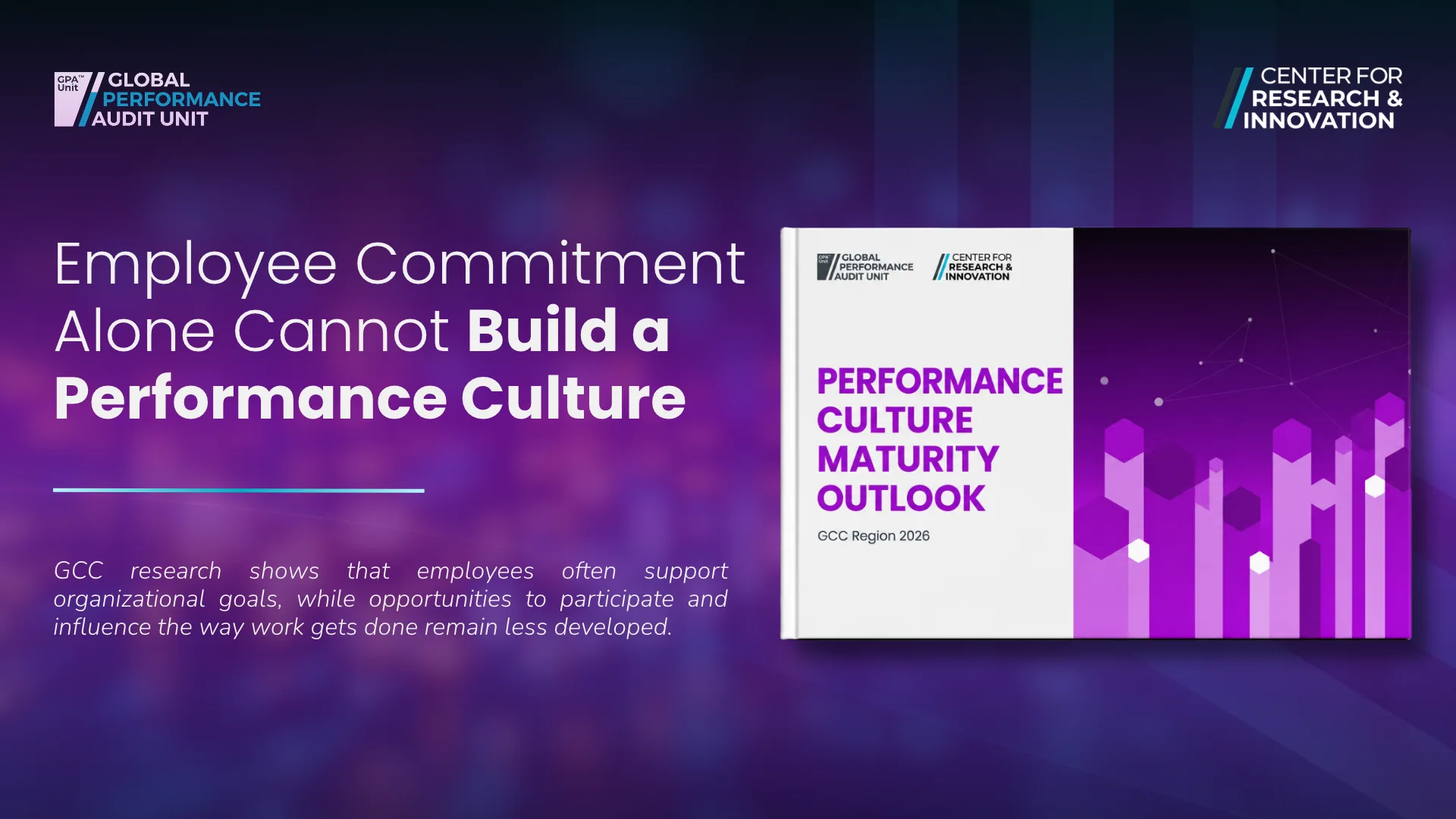
Employee Commitment Alone Cannot Build a Performance Culture
GCC research shows that employees often support organizational goals, while opportunities to participate and influence the way work gets done remain less developed.
by Bori Pentek, Ph.D. | 27 November 2026
| Share on
An organization can have a well-established employee performance management system and still struggle to create a strong performance culture.
Employee Performance Management (EPM) focuses on how individual performance is planned, measured, reviewed, improved, and rewarded. It establishes objectives, monitors progress, and provides a formal process for evaluating employee contributions.
Performance Culture (PC) concerns the wider organizational environment in which these processes operate. It includes how leaders communicate, whether employees can contribute ideas, how teams learn from results, and whether the workplace supports people in performing well over time.
An organization may conduct regular evaluations and offer performance bonuses while employees remain reluctant to speak openly or participate in decisions. Its EPM processes may be established, even when the surrounding performance culture is still developing.
The Six Dimensions of Performance Culture
GPA Unit's Performance Culture Maturity Model examines six dimensions that help organizations assess the conditions surrounding employee and organizational performance:
Systems Integration & Governance
How performance management is connected across the organization and how responsibilities are assigned.
Communication & Leadership Support
How openly organizations communicate and how actively senior leaders support performance.
Innovation & Engagement
Whether employees can contribute ideas, solve problems, and experiment.
Learning & Growth
How organizations support development, improvement, and knowledge sharing.
Rewards & Recognition
How employee contributions are evaluated, acknowledged, and rewarded.
Happiness & Wellbeing
How working conditions, stress, and organizational support shape employee experience.
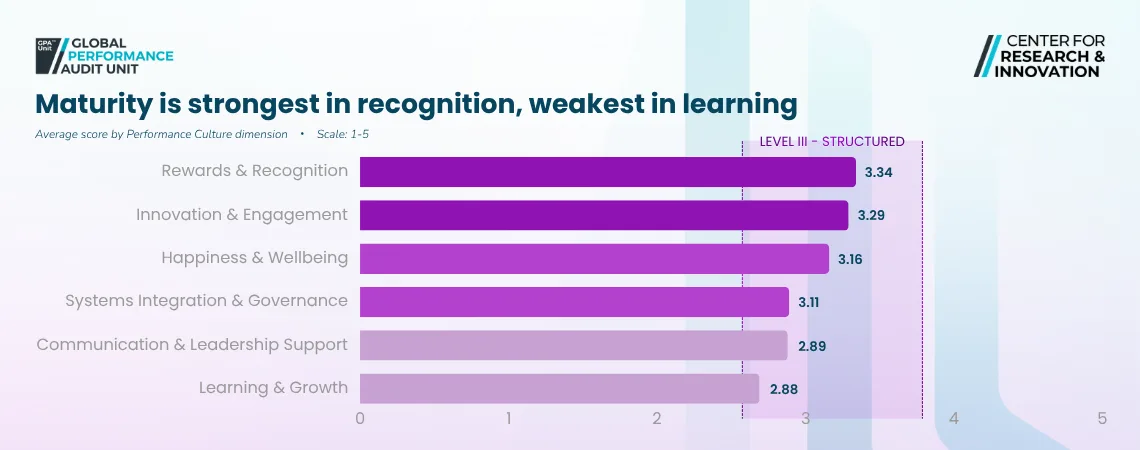
GPAU's Performance Culture Maturity Outlook, GCC Region 2026 places overall maturity at 3.11 out of 5, corresponding to Level III (Structured).
Rewards & Recognition is the strongest dimension, scoring 3.34, while Learning & Growth ranks last at 2.88. Formal recognition practices are better established than some of the conditions supporting continuous development.
Alongside its maturity benchmarks, GPA Unit's Performance Culture Maturity Outlook addresses some practical questions about performance culture, using findings from organizations across the GCC.
How can an organization measure its performance culture?
Employee satisfaction and engagement surveys offer useful information, but they do not capture every aspect of performance culture. Organizations also need to examine how consistently management practices work and how employees experience them.
GPAU's findings show considerable differences in maturity across the GCC sample. Only 8% of organizations qualify for the Top Tier, compared with 51% in the Average Tier and 41% at Entry Level.
These categories reflect scores across the six performance culture dimensions. They provide a way to compare organizational practices and working conditions, rather than a direct ranking of business productivity. An assessment can reveal where formal processes are established and where employees still lack opportunities to contribute.
Can employees be committed without feeling heard?
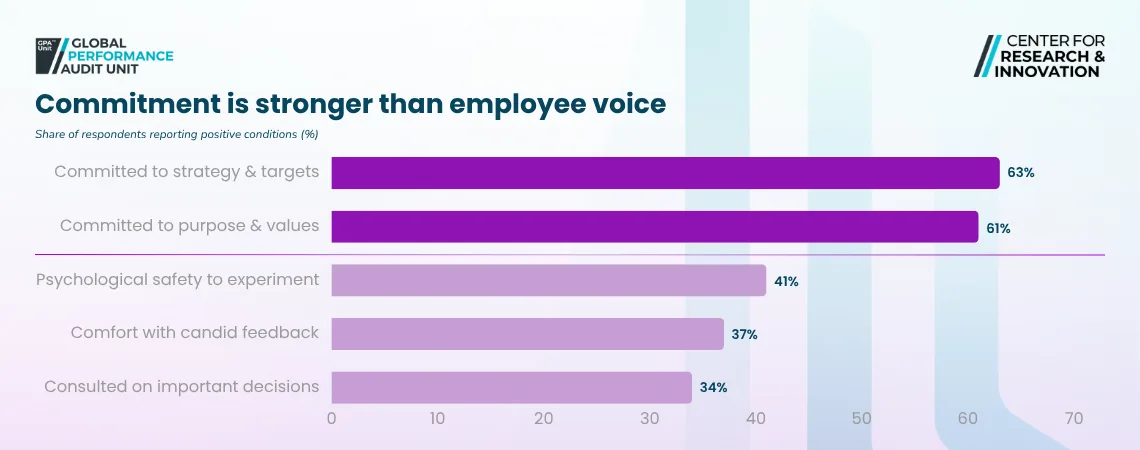
Employee commitment is one of the stronger features of the GCC performance culture profile. In the GPAU survey, 63% of respondents agreed that they felt committed to their organization's strategy, objectives, and targets. Similarly, 61% reported commitment to its purpose and values.
Employee participation presents a different picture. Only 34% agreed that employees are consulted on important organizational decisions. Meanwhile, 41% reported high or very high psychological safety for experimentation and learning from mistakes, and just 37% agreed that employees feel comfortable giving and receiving honest feedback, including negative feedback.
Organizational commitment appears more common than the conditions that allow employees to question decisions and speak openly. Encouraging performance therefore involves opportunities to influence how work is carried out, rather than relying on commitment to established objectives alone.
What role does leadership communication play in performance culture?
Leadership communication is central to helping employees understand organizational priorities and their own contribution.
Across the GCC sample, 59% of respondents reported being sufficiently informed about their organization's strategy and performance results. Yet only 28% said strategy is communicated regularly throughout the year, and just 17% reported communication that reaches all organizational levels.
The availability of communication channels does not appear to be the main obstacle. In fact, 58% of organizations use at least two structured interaction channels between top management and employees.
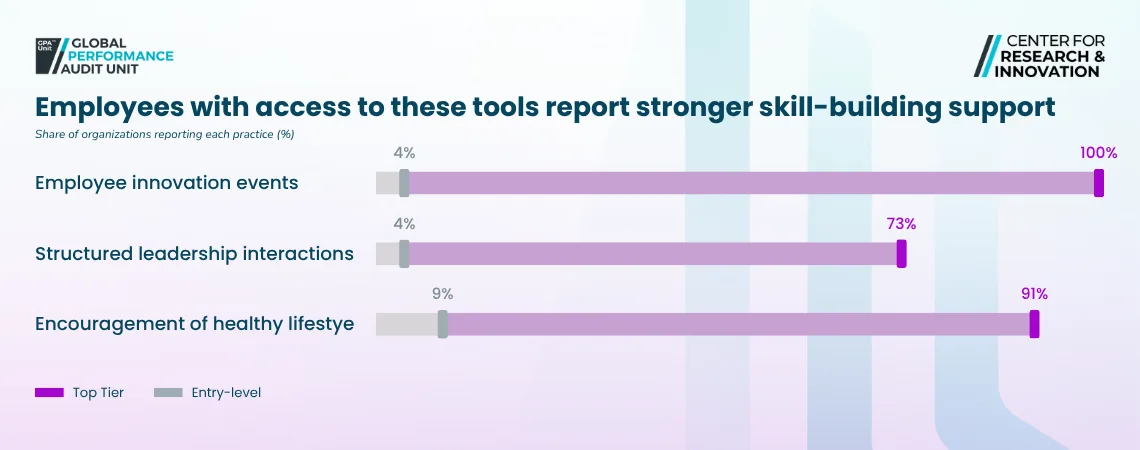
The difference becomes clearer across maturity tiers. Among Top Tier organizations, 73% report using a broad range of structured leadership interactions, compared with only 4% of Entry-level organizations. These include leadership roundtables, Q&A sessions, strategic briefings, and other opportunities for employees to engage with management.
The findings point to the importance of communication that is regular, reaches different organizational levels, and creates opportunities for dialogue.
How can organizations create a culture of innovation and continuous improvement?
Innovation depends on employees having opportunities to contribute ideas and participate in solving organizational problems.
In the GCC study, 45% of respondents agreed that senior management actively promotes continuous innovation. A smaller share, 40%, reported internal events or competitions that engage employees in problem-solving and innovation.
The difference between maturity tiers is especially pronounced: 100% of Top Tier organizations report these structured innovation opportunities, compared with just 4% at Entry Level.
Learning practices show room for improvement as well. Only 41% report that their teams analyze gaps between targets and results every month, while 45% agree that knowledge is regularly shared across functional areas.
Organizations should look beyond encouraging innovative thinking. Employees need practical opportunities to test ideas, learn from results, and share what they discover with others.
Can a strong performance culture support employee wellbeing?
Performance expectations and employee wellbeing are sometimes treated as competing priorities. Yet an organizational culture also includes the conditions under which people are expected to deliver results.
Across the GCC sample, only 38% reported that everyday stress is limited or positively motivating. Organizational support for work-life balance received positive responses from 43%, while 40% agreed that their organization encourages a healthy lifestyle.
The differences across maturity tiers are substantial. Among Top Tier organizations, 91% report favorable conditions for organizational encouragement of a healthy lifestyle, compared with only 9% of Entry-level organizations.
These comparisons describe conditions associated with maturity; they do not establish that particular wellbeing initiatives produce higher performance. They do show that wellbeing is closely connected to the wider performance environment assessed by GPAU.
Building a stronger performance culture
The GCC findings reveal a promising starting point. Employee commitment is relatively strong, and many organizations have already established formal recognition and performance management practices.
The next opportunity lies in strengthening the conditions surrounding that commitment. Employees need opportunities to participate, leaders need to maintain meaningful communication, and organizations need to support learning and wellbeing throughout the year.
For executives, HR leaders, and performance management professionals, understanding which practices are established and which remain weak is an important first step.
Explore the report.
Discover the full Performance Culture Maturity Outlook, GCC Region 2026, published by GPA Unit, for detailed benchmarks across all six dimensions, industry comparisons, and the practices that distinguish Top Tier organizations.
Get our research first in Google Search and AI Mode.
Performance Culture
Employee Commitment Alone Cannot Build a Performance Culture
GCC research shows that employees often support organizational goals, while opportunities to participate and influence the way work gets done remain less developed.
Where Performance Improvement Breaks Down in GCC Organizations
The region has regular reporting and review routines, but the analysis, follow-up and transparency needed to turn results into improvement are less mature.
The Strategy Is Clear at the Top. What Happens on the Way Down?
Research across GCC organizations shows that strategic planning has developed faster than the practices needed to connect corporate priorities with everyday work.