Home›Insights›The Next Challenge for Employee Performance Management in the GCC
Login
Please wait...!
Insights
Employee Performance Management
The Next Challenge for Employee Performance Management in the GCC
Formal systems are widespread, but more frequent performance conversations, employee development and better use of performance data remain priorities.
by Bori Pentek, Ph.D. | 27 November 2026
| Share on
Employee performance management across the GCC has a solid foundation. Formal performance processes and defined rating scales are reported by 87% of surveyed organizations, while 74% have written EPM policies. Overall maturity stands at 3.25 out of 5, placing the region at Level III – Structured.
The formal process is well established in many organizations. Keeping it active throughout the year is proving harder. Performance Review is the lowest-scoring of the six assessed areas, at 3.00, while Performance Improvement (3.40) and Recognition (3.34) show greater maturity.
Performance planning provides direction, but less room for change
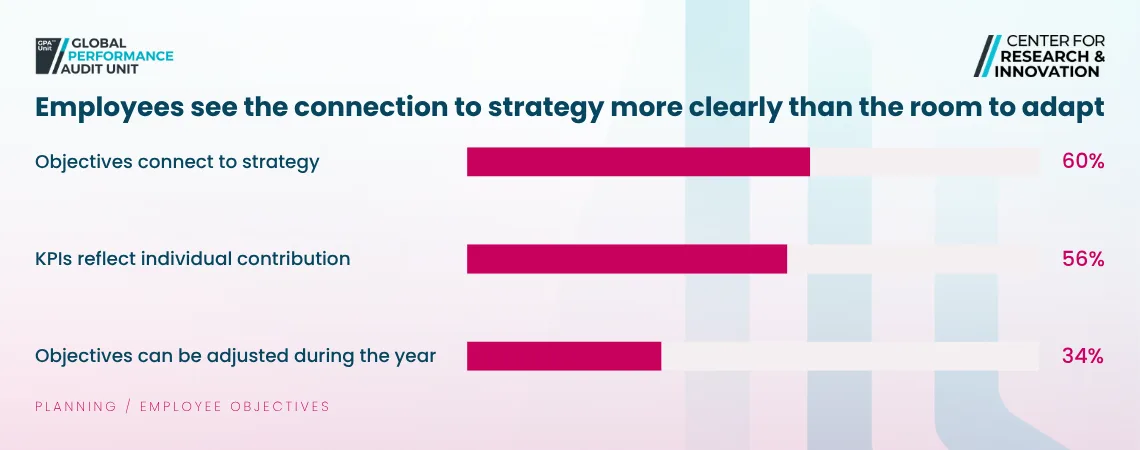
Our survey found that around 60% of respondents understand how their individual objectives contribute to organizational strategy. More than half also agree that their KPIs reflect their contribution to organizational performance.
The difficulty comes when priorities change. Only 34% rate positively their ability to adjust objectives during the year.
For managers, this creates a practical problem. A KPI may have been appropriate when objectives were agreed upon, but become less useful after a project changes direction or new responsibilities arise. Without regular opportunities to revisit objectives, employees may continue working toward targets that no longer reflect what their organization needs, or their own aspirations.
Employees want more frequent performance conversations
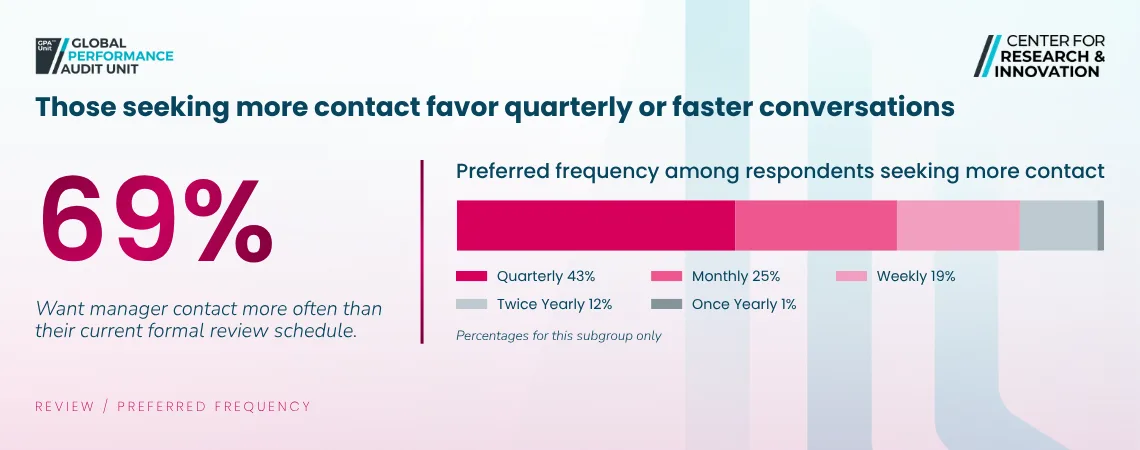
Our survey found that 69% of respondents would prefer manager contact more often than their current formal review schedule. Among those seeking more contact, most prefer quarterly or more frequent conversations.
The case for regular conversations is supported by Gallup's 2026 research. Across seven studies covering more than 44,000 responses, employees reporting meaningful feedback in the previous week were far more likely to be engaged at work.
For organizations, this makes the quality of manager–employee conversations as important as their frequency. A quarterly meeting has limited value if it simply repeats the annual appraisal. Conversations about current objectives, obstacles and development needs give employees a chance to address performance problems while there is still time to act.
Development support works best when it reaches employees
Performance Improvement is the strongest EPM dimension in the GCC study, scoring 3.40 out of 5. Organizations offer a range of development tools, but access varies.
Individual development plans are reported by 51% of respondents, compared with only 18% reporting access to mentoring and 21% to coaching.
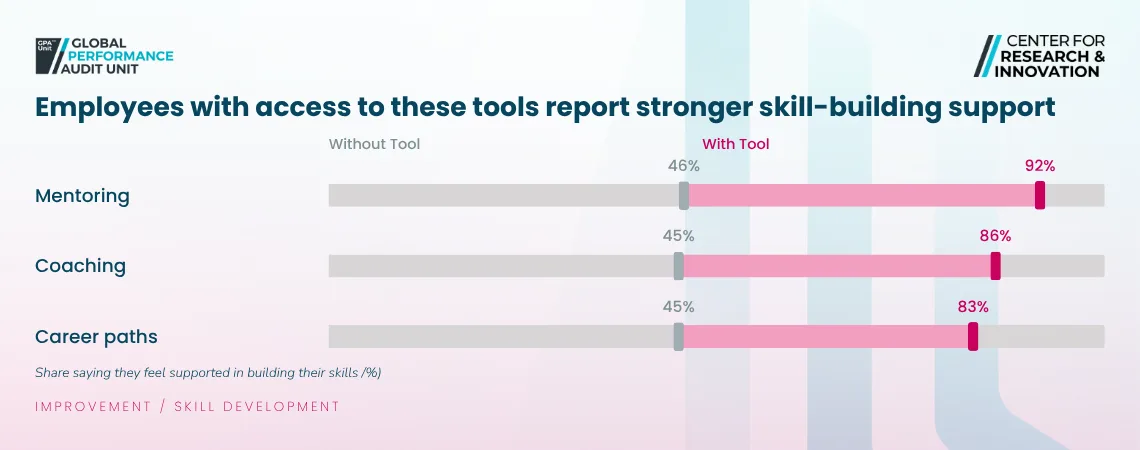
The difference in employee experience is substantial. Among respondents with access to mentoring, 92% feel supported in building their skills, compared with 46% of those without it. Coaching shows a similar pattern: 86% versus 45%.
These are associations, not proof that a particular development tool causes better outcomes. Still, they suggest that personal support deserves attention alongside formal development plans. Managers can help employees understand where they need to improve, while mentoring and coaching provide additional opportunities to work through challenges and develop skills.
Recognition is stronger when it follows a clear approach
Recognition also ranks among the region's stronger EPM capabilities, with a maturity score of 3.34.
Financial rewards remain important: 60% of respondents identify an attractive bonus as their main motivation for exceeding expectations. Yet the way organizations manage rewards differs.
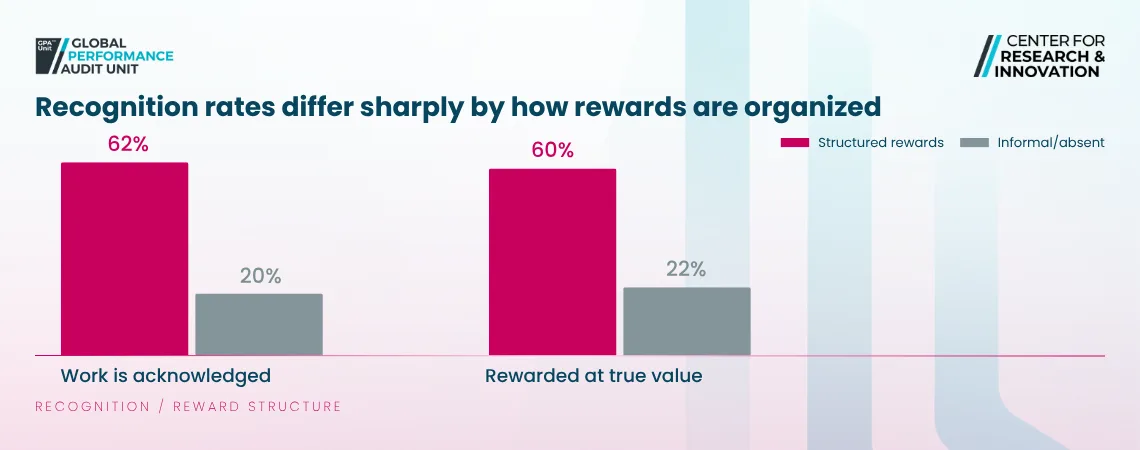
Among respondents reporting structured reward arrangements, 62% say their work is acknowledged, compared with 20% where rewards are informal or absent. Similarly, 60% feel rewarded at their true value, compared with 22%.
The difference suggests that employees' experience of recognition depends on how consistently rewards are managed. Formal criteria can help employees understand what contributions are valued and how performance connects to rewards. Recognition also depends on managers noticing and discussing good work throughout the year. A formal reward scheme provides structure, while everyday acknowledgement can reinforce the connection between contribution and appreciation.
Governance needs to support the work, not only administer it
As organizations develop their performance processes, the next challenge concerns how well these systems support employees and managers.
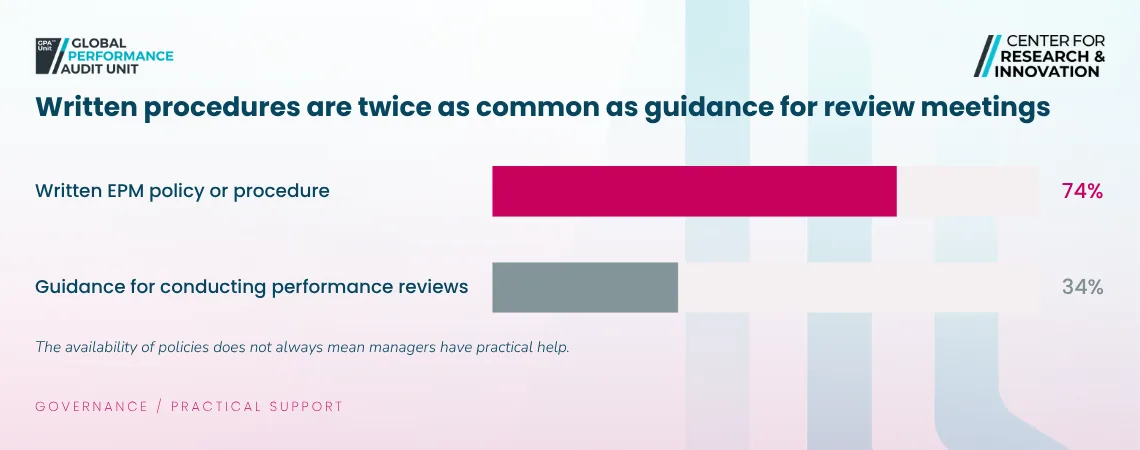
Policies are common, but practical guidance is less available. While 74% report written EPM procedures, only 34% report guidance on conducting performance reviews.
Technology presents another gap. Only 9% report fully automated individual KPI data collection, and 53% say their HR function conducts little or no analysis of performance data.
These findings suggest that organizations have made greater progress in organizing performance management than in using the resulting data to improve it. Better access to performance data could help HR teams identify recurring problems, review evaluation consistency and see where employees need additional support.
The GCC region already has much of the structure needed for effective employee performance management. With strong foundations in planning, improvement and recognition, organizations have opportunities to build on practices that are already established.
Three priorities deserve attention:
Review objectives and performance more regularly. Give managers and employees opportunities to discuss progress and adjust expectations during the year.
Connect development and recognition to performance conversations. Use feedback to identify support needs and acknowledge contributions while they are still relevant.
Assess the maturity of the complete EPM system. Examine how well planning, reviews, improvement, recognition and governance work together, then focus improvement efforts on the weakest areas.
Explore the report on which this article was based:Employee Performance Management Maturity Outlook, GCC Region 2026, published by GPA Unit. The full study provides maturity benchmarks, industry comparisons and detailed findings across six EPM dimensions.
Get our research first in Google Search and AI Mode.
Performance Culture
Employee Commitment Alone Cannot Build a Performance Culture
GCC research shows that employees often support organizational goals, while opportunities to participate and influence the way work gets done remain less developed.
Where Performance Improvement Breaks Down in GCC Organizations
The region has regular reporting and review routines, but the analysis, follow-up and transparency needed to turn results into improvement are less mature.
The Strategy Is Clear at the Top. What Happens on the Way Down?
Research across GCC organizations shows that strategic planning has developed faster than the practices needed to connect corporate priorities with everyday work.