Home›Insights›The Strategy Is Clear at the Top. What Happens on the Way Down?
Login
Please wait...!
Insights
Strategic Planning
The Strategy Is Clear at the Top. What Happens on the Way Down?
Research across GCC organizations shows that strategic planning has developed faster than the practices needed to connect corporate priorities with everyday work.
by Bori Pentek, Ph.D. | 27 November 2026
| Share on
Organizations have become better at documenting their strategies through defined objectives, KPIs, scorecards, and formal planning processes. These tools help leaders set priorities and track progress, but they offer only part of the picture. A department can perform well against its own targets without making much progress toward the organization's wider goals.
GPA Unit's Strategic Planning Maturity Outlook, GCC Region 2026 examines this problem through the practices of organizations across Saudi Arabia, the UAE, Qatar, Bahrain, and Oman.
The study places overall strategic planning maturity at 3.20 out of 5 (Level III – Structured). Of the six areas assessed, Strategy Articulation received the highest score, at 3.59, while Strategy Alignment ranked last, at 2.96.
Formal planning has become well established among the organizations surveyed. The connections between corporate strategy, departmental priorities, and employee performance are less developed.
Formal strategies are outpacing operational alignment
The 0.63-point difference between Strategy Articulation and Strategy Alignment tells us something about where organizations have focused their efforts. Strategy plans and the tools used to monitor them are relatively well developed. The harder work of linking these plans to what departments and employees do has received less attention.
Operational plans received an average alignment score of 3.24 out of 5, suggesting a moderate connection between departmental plans and corporate strategy. At the individual level, the score fell to 2.93, among the lowest results in the study.
A corporate objective often depends on work carried out across several departments. For example, improving customer retention may require changes to service processes alongside new employee capabilities. If departments set their targets separately, each may report good results without improving the customer experience.
Among organizations with advanced strategic planning practices, these connections appear much stronger. Top Tier organizations recorded an operational alignment score of 4.18, compared with 2.61 among Entry-level organizations. Individual performance-plan alignment showed an even wider difference, at 4.11 versus 2.18.
The findings fit with McKinsey's 2025 research on organizational execution. McKinsey identifies accountability and coordination among the factors that support execution, together with employee capabilities and motivation. Planning tools are useful, but their value depends on how responsibilities are assigned and how work is coordinated across the business.
Strategic awareness dilutes with each organizational level
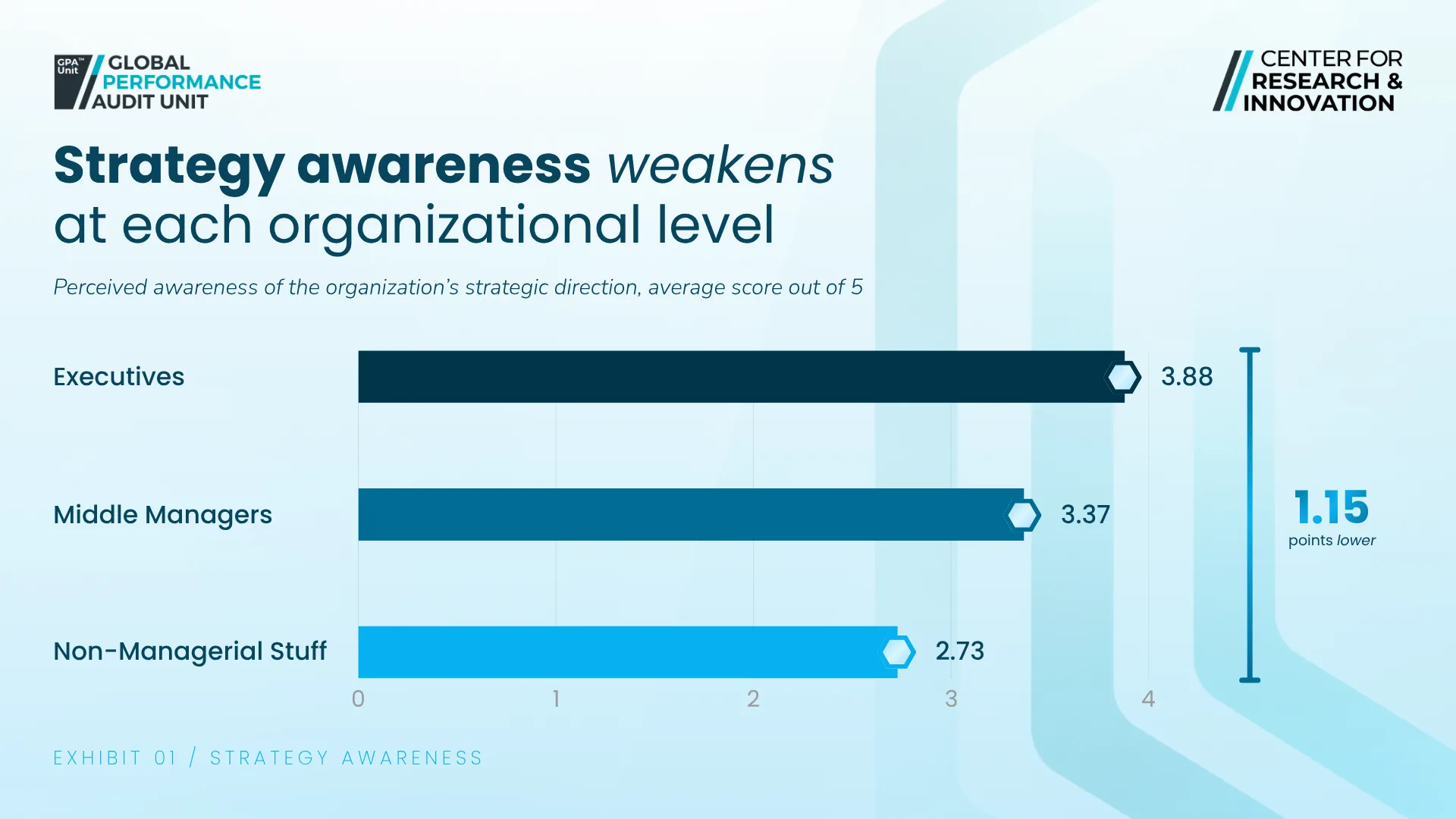
Employees cannot be expected to work toward corporate priorities they do not fully understand. Yet strategic awareness appears to weaken as we move further from senior management.
GPAU's research found the following differences in perceived awareness:
The difference between executives and non-managerial employees reaches 1.15 points.
These scores reflect respondents' perceptions of how well people understand strategy, rather than a direct assessment of employee knowledge. Even with that limitation, the pattern deserves attention.
Middle managers have a particularly important role here. They interpret corporate priorities when setting team objectives and deciding how resources should be used. Their understanding of strategy affects the decisions that employees face in their everyday work.
The problem also appears beyond the GCC region. In McKinsey's State of Organizations 2026, 56% of executives reported clear visibility of their organization's most important strategic priorities. Among senior managers, the figure was 44%, falling to 27% among middle managers.
The two studies, while they use different samples and measures, point to a similar concern. Corporate priorities can be well understood by senior leaders while remaining much less clear to the people responsible for turning them into operational plans.
Communication frequency matters more than communication format
How organizations communicate strategy appears closely related to these differences in awareness.
Across the GCC sample, only 33% of organizations reported communicating strategy to all employees to a high or very high extent. Regular communication throughout the year was reported by 36%, while 34% communicated strategy only at the beginning of the year.
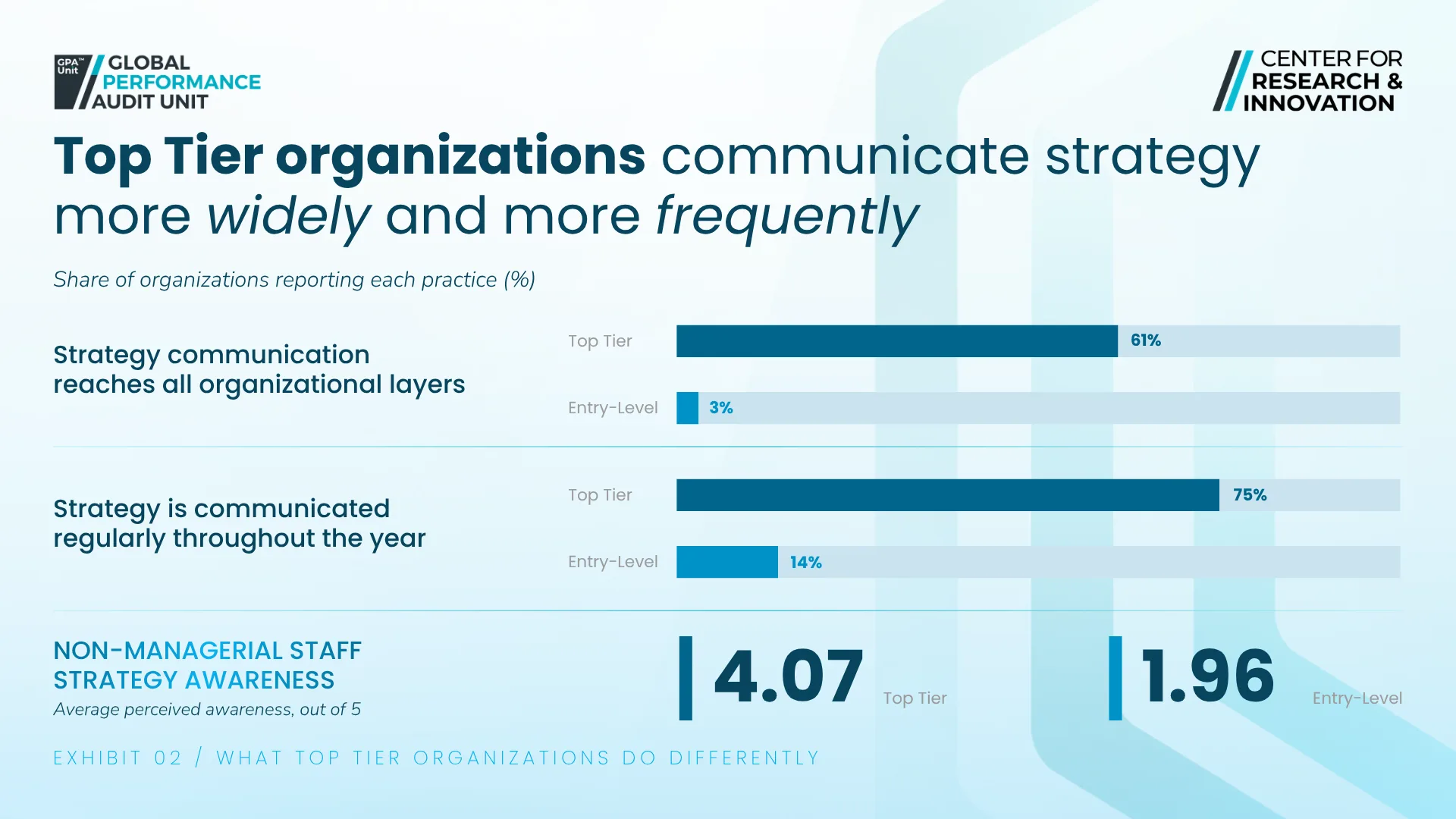
The differences between maturity tiers are striking.
The widest maturity difference between Top Tier and Entry-level organizations in the entire survey concerns how widely strategy is communicated, with a 2.21-point gap.
Frequency also appears to matter. Organizations that communicate strategy regularly throughout the year report non-managerial awareness scores 1.09 points higher than organizations communicating intermittently.
The communication channel, however, shows no statistically significant relationship with perceived awareness. Written materials, meetings, and other formats do not appear to explain the differences on their own.
This is worth considering when organizations review their internal communication practices. A yearly presentation of corporate objectives may explain the strategy at the time it is introduced, but employees also need to understand how those priorities apply as circumstances change.
Gartner's 2026 research on strategy communication addresses a related problem: changes in corporate strategy can happen faster than employees can understand and respond to them. Gartner identifies the need for leaders to communicate changes in ways that help employees understand what they are expected to do.
Strategic planning needs ownership beyond the annual planning cycle
The differences between maturity tiers extend to the way organizations manage strategic planning throughout the year.
Among Top Tier organizations, 61% have a dedicated strategy office or full-time strategic planning role, compared with 26% of Entry-level organizations.
Review practices show similar differences. In the Top Tier, 82% review strategy quarterly or annually, compared with 48% of Entry-level organizations. At the other end, 47% of Entry-level organizations review strategy only when circumstances demand it or every three or more years. Among Top Tier organizations, the figure is 4%.
More frequent reviews give organizations opportunities to check whether their plans remain relevant. The usefulness of these reviews, however, depends on whether the organization acts on what it learns.
There is a difference between identifying that a priority has changed and adjusting the resources assigned to it.
PwC's 2025 Global CEO Survey offers a related perspective. Around half of CEOs reported reallocating no more than 10% of their financial and human resources between business units from one year to the next.
GPAU's study did not directly measure resource reallocation, but the PwC finding adds context to the challenge of keeping strategy relevant. Organizations may recognize the need to change direction while finding it difficult to move resources away from established activities.
Organizational size offers little explanation for the differences found in the GPAU study. The research identified no statistically significant differences in perceived strategy alignment across organization-size categories.
The practices associated with higher maturity are therefore worth examining across organizations of different sizes, although the survey cannot establish that these practices directly cause higher maturity.
For executives and strategy professionals, the findings suggest several areas for review. Corporate objectives need to remain connected to departmental priorities as the year progresses. Individual performance measures should reflect the contribution employees are expected to make. Regular communication and strategy reviews can help maintain those connections when business priorities change.
The survey does not establish a single method for achieving stronger alignment. It does, however, show where important differences exist between organizations with advanced strategic planning practices and those still developing them.
Explore the full Strategic Planning Maturity Outlook, GCC Region 2026 for detailed findings across all six strategic planning dimensions, industry comparisons, regional maturity benchmarks, and the practices that distinguish Top Tier organizations.
Get our research first in Google Search and AI Mode.
Performance Culture
Employee Commitment Alone Cannot Build a Performance Culture
GCC research shows that employees often support organizational goals, while opportunities to participate and influence the way work gets done remain less developed.
Where Performance Improvement Breaks Down in GCC Organizations
The region has regular reporting and review routines, but the analysis, follow-up and transparency needed to turn results into improvement are less mature.
The Strategy Is Clear at the Top. What Happens on the Way Down?
Research across GCC organizations shows that strategic planning has developed faster than the practices needed to connect corporate priorities with everyday work.