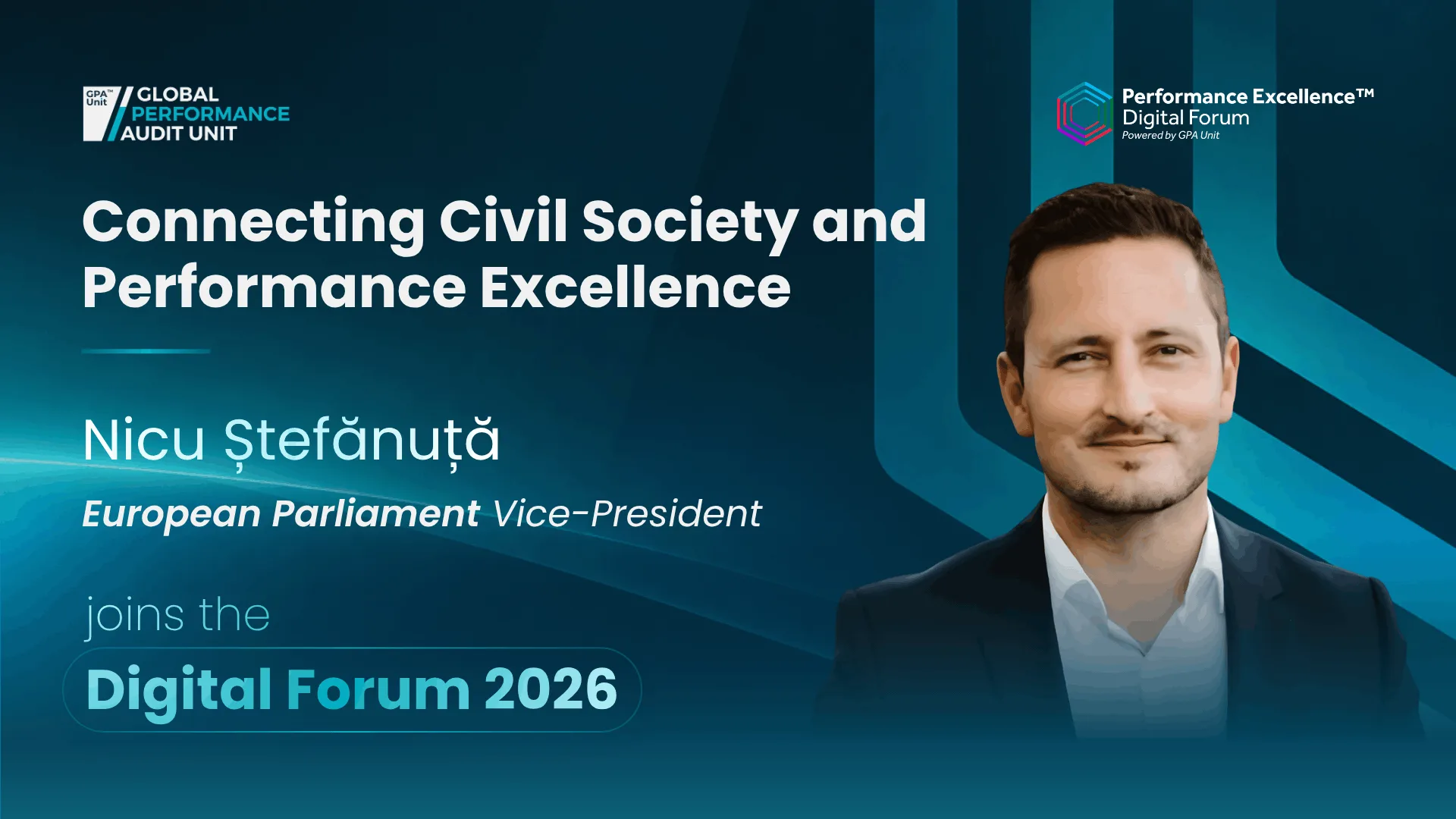
Much of Nicu Ștefănuță’s work has been built around connecting institutions, communities and priorities that are often addressed separately.
As Vice-President of the European Parliament, his current responsibilities include relations with European civil society organisations and the European Citizens’ Initiative, human rights, rule of law and democracy support, as well as participation in working groups focused on sustainable infrastructure, digital transformation, cybersecurity and information security. He is also a member of the Parliament’s Committees on Budgets and on Industry, Research and Energy.
Together, these responsibilities span several areas that are increasingly interconnected: sustainability, civic participation, institutional governance, digital transformation and long-term public value.
They also reflect a broader theme throughout his work: building bridges.
Between European institutions and civil society. Between Romania and the wider European community. Between policy priorities and the citizens and organisations they are designed to serve. His work has also included a strong international dimension, including engagement with US lawmakers on transatlantic cooperation and democratic institutions.
It is this connection with civil society that creates a particularly relevant point of connection with GPAU’s new Social Impact Through Excellence (SITE) initiative.
From mission to sustainable impact
SITE has been developed to support nonprofit and civil-society organisations in strengthening the management systems that enable them to fulfil their missions, and the principle behind it is that a strong mission requires an equally strong organizational foundation.
Civil-society organisations often operate in environments defined by limited resources, multiple stakeholder expectations and complex social objectives. Their success cannot be understood through financial performance alone. Financial sustainability remains essential, but it serves a wider purpose: enabling the organisation to create and sustain social impact. For mission-driven organisations, the question is whether governance structures, management practices and performance systems are helping the organisation translate its mission into measurable and sustainable results.
This makes governance, strategy and performance management particularly important.
GPAU approaches performance management as more than a system of indicators or reporting mechanisms. Mature performance management connects strategic direction with execution, creates greater clarity around priorities and accountability, and provides the information required for continuous improvement.
In the nonprofit and civil-society context, these capabilities can help organisations strengthen their operational foundations while maintaining focus on the outcomes they were established to achieve.
Connecting civil society and performance excellence
The launch of SITE at the Performance Excellence Digital Forum 2026 brings these two perspectives together.
Dr. Teo Gorski, Director of SITE and Head of Partnerships & Growth at GPAU, will be joined by Nicu Ștefănuță for a conversation focused on the role of civil society, the transition from commitment to sustainable impact, and the contribution of stronger management and performance systems to mission-oriented organisations. The session forms part of GPAU’s wider effort to connect performance excellence expertise with organisations working to generate social value, as, for GPAU, this represents an important extension of the performance excellence conversation.
The principles that support mature organisations — clear governance, strategic alignment, accountability, measurement and continuous improvement — are not limited to the private or public sectors, but are equally relevant where the primary objective is social impact.
In these organisations, financial performance is a means rather than the final goal. The performance system therefore has to answer a broader question: how effectively is the organisation converting its resources, capabilities and mission into meaningful impact?
Join Dr. Teo Gorski and Nicu Ștefănuță on 9 December 2026, from 14:45 to 15:10 Riyadh time (GMT+3) for the official launch of Social Impact Through Excellence, as part of the Performance Excellence Digital Forum.
Get our research first in Google Search and AI Mode.