Home›Insights›How to Become a GPAU Employee Performance Management Accredited Assessor
Login
Please wait...!
Insights
Employee Performance Management
How to Become a GPAU Employee Performance Management Accredited Assessor
The GPAU Employee Performance Management Assessor pathway develops professionals from certification to authorization and supervised client accreditation, building competence to assess how consistently organizations manage and improve employee performance.
by GPA Unit | 01 October 2026
| Share on
The GPAU assessor pathway provides a structured route from professional education to supervised assessment practice. It combines certification, applied simulation, formal authorization and client-based accreditation within the GPAU Maturity Assessment Framework.
The pathway is available across five capabilities: Strategic Planning, Performance Measurement, Performance Improvement, Employee Performance Management and Performance Culture. Professionals who qualify across the complete framework may pursue the Integrated Performance pathway.
Each pathway follows the same progression:
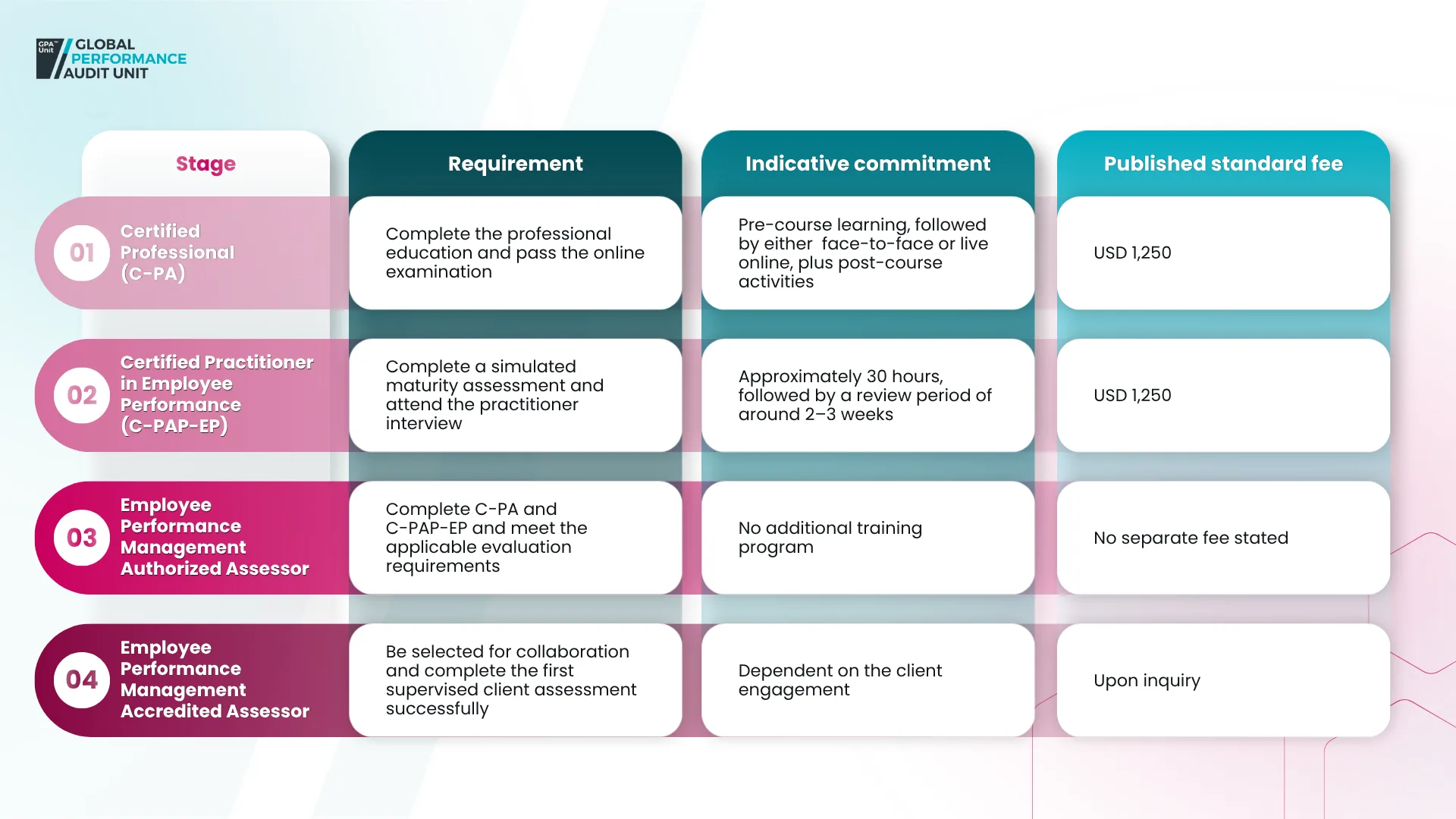
Certified Professional: establishes the conceptual and methodological foundation.
Certified Practitioner: develops applied competence through a simulated maturity assessment.
Authorized Assessor: formally recognizes the candidate as qualified within the selected capability.
Accredited Assessor: recognizes successful performance in supervised client assessments and enables participation in GPA Unit’s external assessment network.
This article explains how the pathway applies to Employee Performance Management, including the requirements, time commitment, fees and credentials associated with each stage.
Assessing the system that shapes employee performance
Many organizations have the visible components of an Employee Performance Management system: an annual review, a rating scale, individual objectives and a software platform. Their presence, however, says little about whether employees receive clear direction, fair evaluations and meaningful support for improvement.
An Employee Performance Management Maturity Assessor looks at the complete system through which individual performance is planned, monitored, reviewed, improved and recognized, and also considers the governance and infrastructure that make these practices reliable across departments and managerial levels.
Evidence may include the EPM policy and procedure, objective-setting guidance, performance review forms, calibration guidelines, Performance Improvement Plans, competency frameworks, training materials and system-generated reports. Interviews and survey results show how employees, managers and HR experience the system in practice.
An assessment therefore goes beyond checking whether annual reviews take place and it asks whether employees understand what is expected of them, whether managers evaluate performance consistently and whether review outcomes lead to appropriate development, recognition or corrective action.
At early maturity levels, performance management depends heavily on managerial discretion and reacts mainly to problems. More structured organizations formalize the cycle, align objectives with strategy and introduce consistent review practices. At advanced levels, performance conversations become more frequent, technology connects performance with learning and talent decisions, and employees participate more actively in managing their own performance.
What the pathway requires
The Employee Performance pathway combines professional education with an approximately 26-hour assessment simulation. Accreditation then introduces supervised client work, with the duration determined by the engagement.
The published standard tuition for the professional and practitioner stages is USD 2,500 for one capability. Eligible enrolments completed by 31 December 2026 may qualify for the published Founding Grant fee of USD 1,500 for the combined Authorized Assessor pathway, subject to GPA Unit approval and the applicable conditions.
Accreditation is not a further course available automatically after certification. It depends on eligibility, selection for collaboration and successful performance in supervised client work.
Stage 1: Establishing the professional foundation
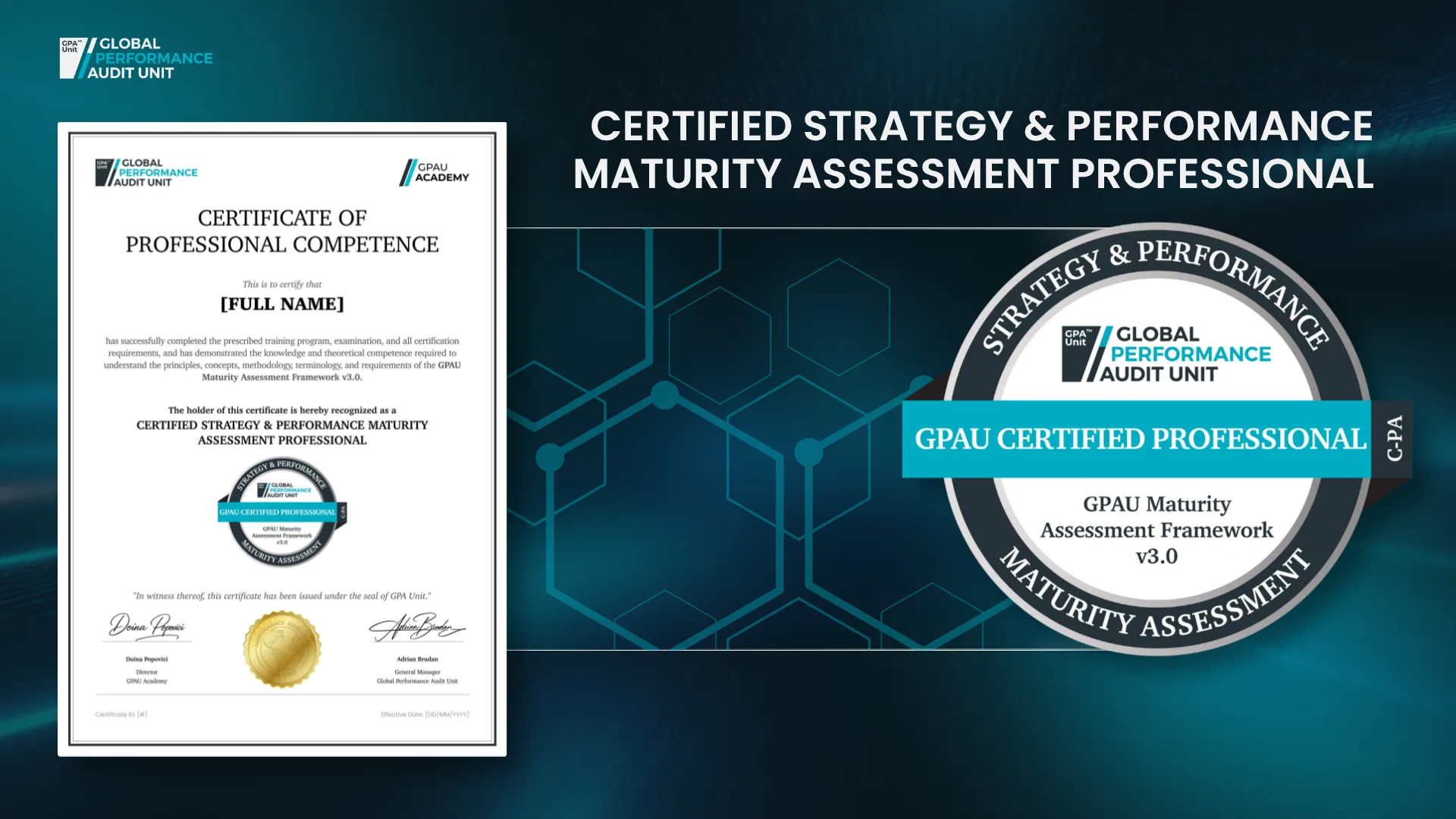
The pathway begins with the Certified Strategy and Performance Maturity Assessment Professional certification, or C-PA. The program introduces candidates to the GPAU Maturity Assessment Framework and the methodology used to evaluate organizational practices.
Candidates learn how to:
interpret maturity criteria and examine organizational evidence;
determine defensible maturity scores; and
translate assessment results into findings and recommendations.
The core course is available in three formats:
Face-to-face: 3 days, 8 hours per day;
Live online: 5 days, 4 hours per day; or
In-house: adapted to the organization’s requirements.
The program also includes prerequisite pre-course learning and approximately 11 hours of post-course activities. The duration of the post-course assignments varies depending on the selected course format, ensuring a total learning experience of approximately 40 hours.
Candidates then complete an online examination comprising 75 multiple-choice questions. A minimum result of 67% is required.
For Employee Performance Management professionals, C-PA shifts the focus from administering individual forms, rating scales or technology platforms to assessing the wider system in which these elements operate. Candidates learn to determine whether the organization’s practices work together consistently to direct, evaluate and improve employee performance.
Stage 2: Testing assessor judgment through simulation
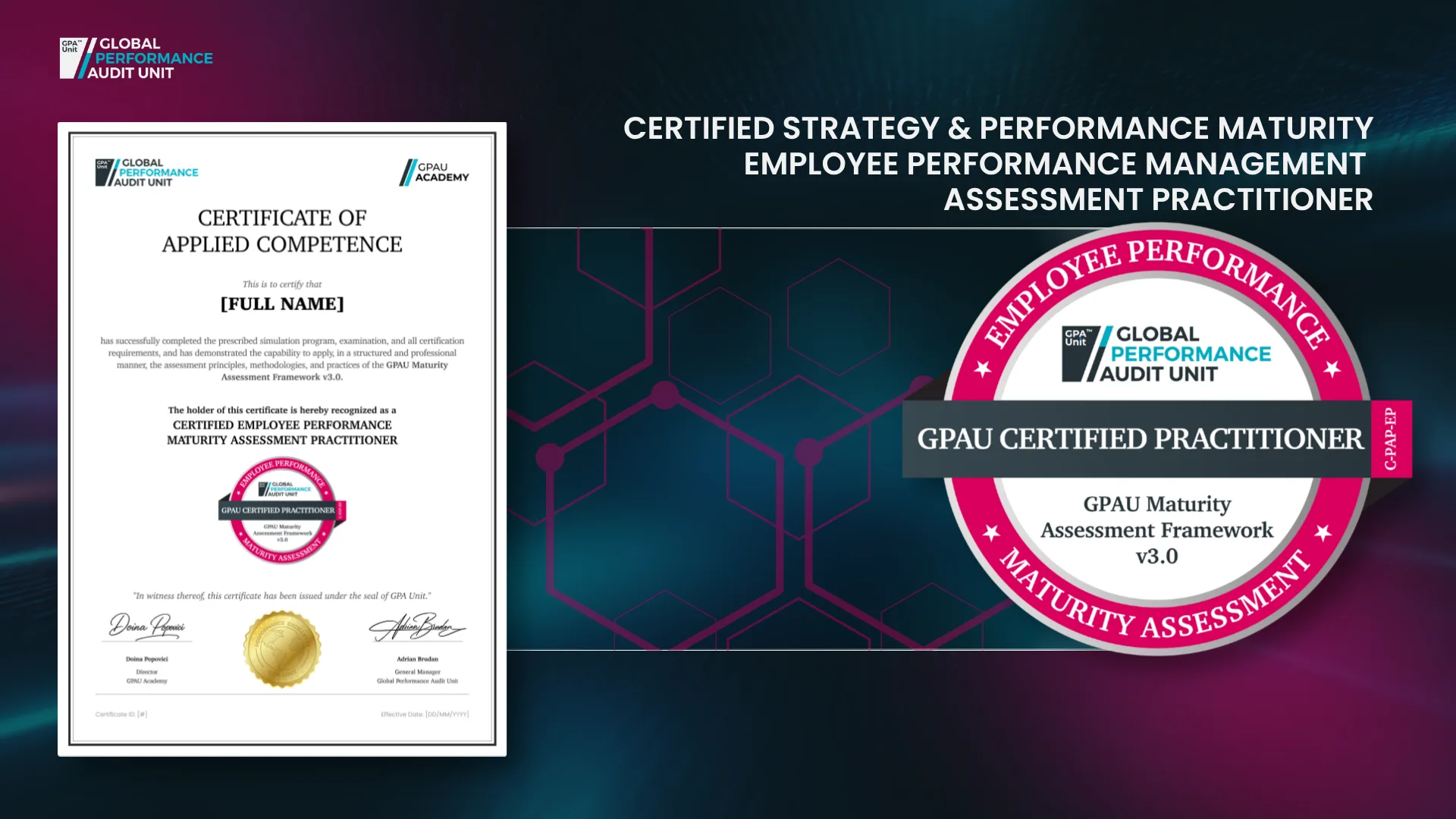
The Certified Employee Performance Management Management Maturity Assessment Practitioner credential, or C-PAP-EP, requires candidates to apply the methodology rather than describe it.
C-PA is a mandatory prerequisite. The practitioner then completes an individual simulation based on a fictional organization, with online mentorship available throughout the experience.
The estimated workload is 26 hours across five assignments:
documentation review and scoring;
survey audience segmentation;
insights consolidation and maturity-level identification;
assessment report writing; and
roadmap for improvement report writing.
Employee performance evidence rarely produces a simple conclusion. Formal policies may suggest consistency, while interviews reveal that managers interpret the same requirements differently. A practice can also be mature in one part of the EPM cycle and considerably less developed in another.
Suppose an organization has documented calibration guidelines and conducts calibration sessions as part of every annual review cycle. Managers receive training on rating criteria and bias, indicating a structured practice. During the assessment, however, the candidate finds that HR continues to impose a forced distribution and concentrates the discussion on adjusting outliers rather than developing a shared understanding of performance standards.
Elsewhere in the same system, poor performance is addressed through a standardized Performance Improvement Plan with defined actions, responsibilities and deadlines. Follow-up varies between departments, and managers sometimes use the same document for corrective action and employee development.
The candidate cannot treat these observations as one general indication that performance reviews are either mature or immature. Calibration and corrective action belong to different assessment practices. Each must be evaluated against its own criteria, using the available documents, interviews and survey findings.
Judgment is required at several points. The candidate must determine what the documented calibration process demonstrates, how the continued use of forced distribution limits the score and whether the inconsistent follow-up of Performance Improvement Plans represents an isolated implementation gap or a broader weakness in the system.
Every assignment must receive a minimum evaluation of 4 out of 5. If rework is required, candidates are entitled to one complementary reassessment opportunity.
After submission, GPA Unit reviews the completed work and invites the candidate to an online practitioner interview. The interview provides an opportunity to discuss scoring decisions, examine the reasoning behind the findings and receive structured feedback. The review and interview stage generally takes two to three weeks.
Candidates who meet the requirements receive the C-PAP-EP badge and Certificate of Applied Competence which confirms their designation as a Certified Employee Performance Management Maturity Assessment Practitioner.
From practitioner competence to professional authorization
By completing C-PA and C-PAP-EP, the candidate demonstrates both knowledge of the assessment framework and the ability to apply it internally to evaluate their organization’s Employee Performance Management capability.
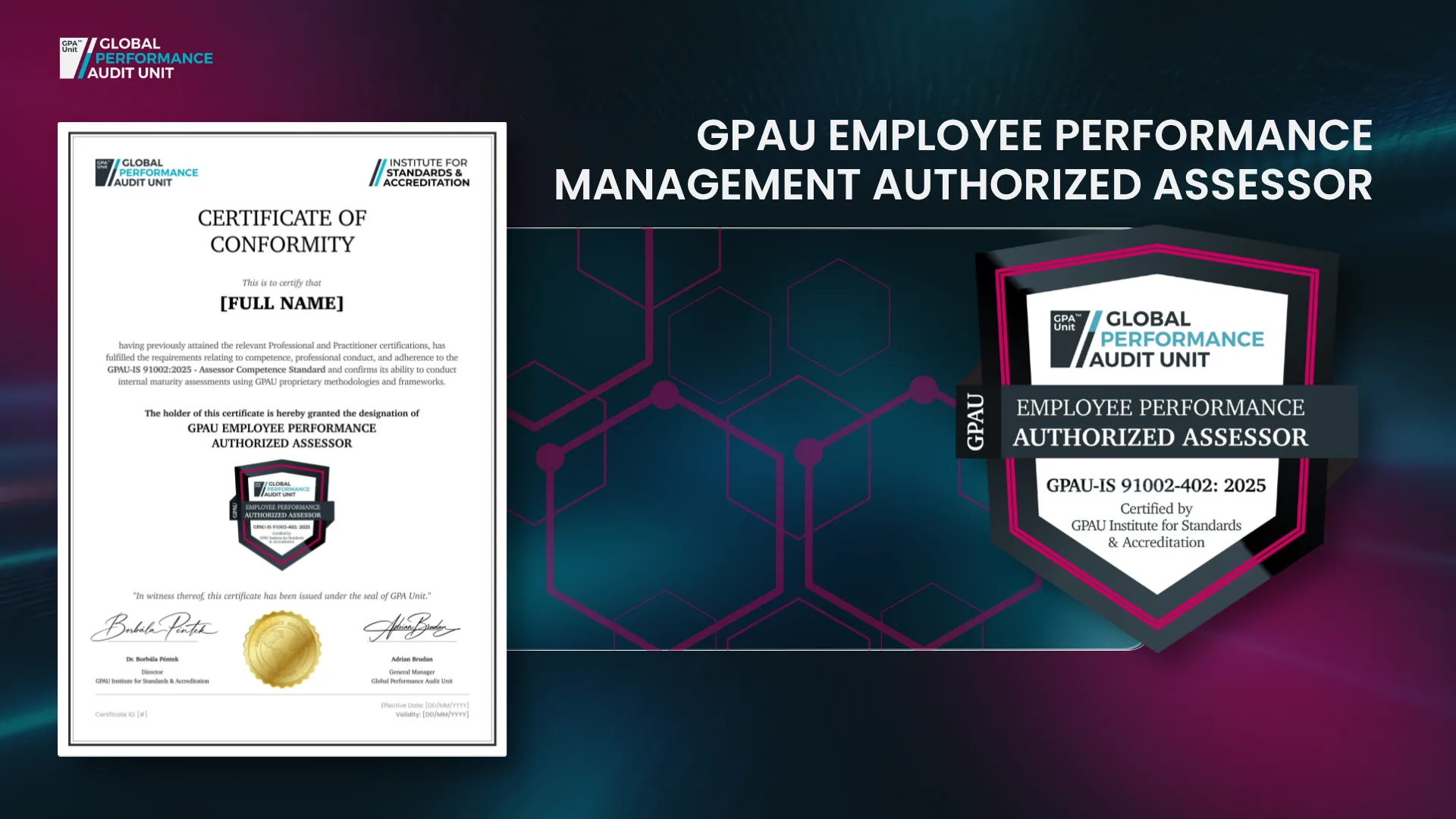
Subject to the applicable evaluation requirements, the GPAU Institute for Standards & Accreditation can then issue the Employee Performance Authorized Assessor credential.
No additional training course sits between practitioner certification and authorization. The Authorized Assessor status formally recognizes the professional competence already developed and evaluated through the pathway and grants the right to conduct internal Employee Performance Management assessments using GPAU’s digital assessment platform and grants the right to conduct internal Employee Performance Management assessments using GPAU’s digital assessment platform.
The assessor receives:
the Employee Performance Management Authorized Assessor badge; and
a Certificate of Conformity referencing GPAU-IS 91002-402:2025.
The authorization applies specifically to the Employee Performance capability. Within that scope, the assessor may use the GPAU methodology to support internal maturity assessments, including within their own organization. Participation in formal external client assessments through GPAU’s network requires accreditation.
Stage 3: Applying the methodology in client practice
Employee Performance accreditation is earned through assessed work in a real organizational environment.
GPA Unit may select eligible Authorized Assessors to collaborate on external client engagements. During the first assessment, the assessor works under supervision and receives technical guidance, feedback and review of the outputs produced.
Client evidence often reveals different experiences of the same EPM system. HR may confirm that calibration is mandatory and provide the relevant procedure. Senior managers may describe established calibration meetings, while employees report large differences in how ratings are explained and challenged across departments. A technology platform may record regular check-ins without demonstrating that meaningful performance conversations occurred.
The assessor must separate formal design from operational consistency. Neither the policy alone nor an individual stakeholder’s experience is sufficient. A conclusion must account for the combined weight of the evidence.
An illustrative finding could state:
Calibration is formally embedded in the annual performance review cycle and supported by documented guidelines. However, the continued use of forced distribution and inconsistent application of rating criteria across departments limit its effectiveness in ensuring fair and comparable evaluations.
The assessment may also expose gaps after the review stage. An organization can have a detailed process for managing underperformance, yet fail to distinguish clearly between corrective Performance Improvement Plans and Individual Development Plans. Employees may therefore experience development as a response to failure rather than as a normal part of professional growth.
Recommendations must respond to the maturity gap identified. Where calibration remains HR-led and focused on rating adjustment, the next step may be to strengthen managers’ shared understanding of performance standards and reduce reliance on forced distribution. Where Performance Improvement Plans exist but follow-up is weak, introducing another template is unlikely to solve the problem; clearer accountability and monitoring may be more relevant.
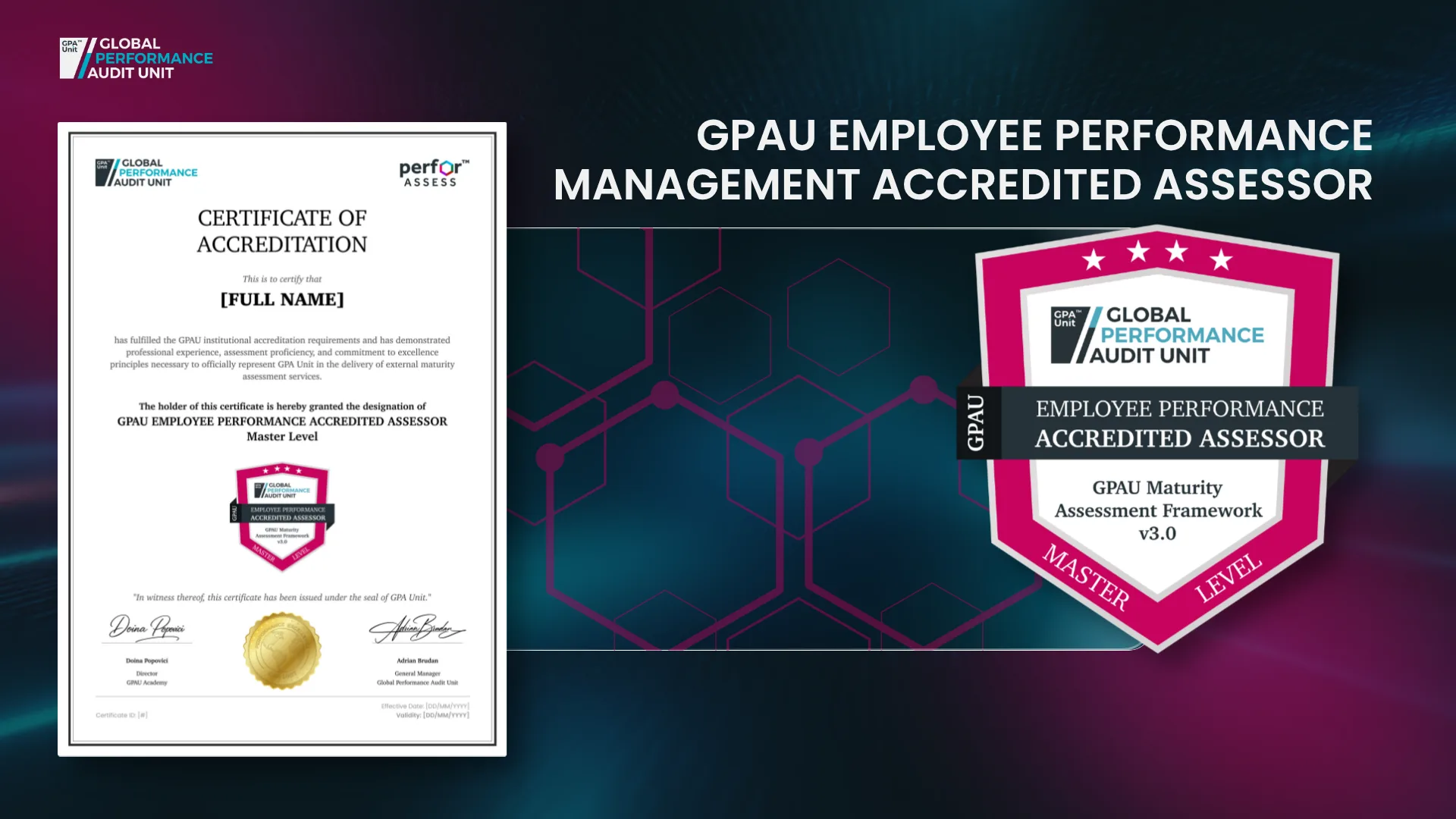
After successfully completing the first supervised client assessment, the assessor receives the GPAU Employee Performance Management Accredited Assessor title at Specialist level, together with the corresponding badge and Certificate of Accreditation.
Progressing through the accreditation levels
The Employee Performance Management accreditation model recognizes four levels of professional practice:
Specialist, awarded following successful completion of the first supervised client assessment;
Senior, reflecting broader experience and participation in more demanding engagements;
Expert, based on sustained delivery and consistently strong assessment judgment; and
Master, the highest level of recognition within the capability.
Moving between these levels does not require candidates to repeat the GPAU Academy pathway. Progression reflects assessment work: its volume and complexity, the quality of the outputs, the outcomes achieved and the feedback received.
Accredited Assessors participate in annual proficiency reviews. Accreditation is also renewed every three years, ensuring that the status continues to reflect active and demonstrated professional capability.
What the candidate receives
Each credential in the pathway confirms a distinct professional outcome:
C-PA confirms the conceptual and methodological foundation required for maturity assessment;
C-PAP-EP confirms applied competence through an Employee Performance Management assessment simulation;
Authorized Assessor status formally recognizes the individual within the Employee Performance capability; and
Accredited Assessor status confirms successful performance in supervised client practice and entry into GPA Unit’s global global assessment network.
The pathway is particularly relevant to professionals working in human resources, talent management, organizational development, performance management and management consulting. It develops the ability to move beyond administering the EPM cycle and evaluate whether the organization has created a fair, consistent and strategically aligned system for managing employee performance.
The professional stage includes pre-course learning, live online training or face-to-face training, and post-course activities. The practitioner simulation requires approximately 26 additional hours. Together, the two stages carry a published standard fee of USD 2,500 for one capability.
Progression to accreditation also requires a supervised client assessment. Its timing depends on candidate eligibility, selection for collaboration and the availability and scope of an appropriate engagement.
For current schedules, Founding Grant eligibility and accreditation requirements, contact GPA Unit at assessment@gpaunit.org.
Get our research first in Google Search and AI Mode.
Overall
Dr. Adrian Brudan Featured by GulfApex for Leadership in Performance Excellence
GulfApex has featured Dr. Adrian Brudan, CEO and Co-Founder of GPA Unit, in its Leadership Feature series.
GPA Unit Welcomes ALANSARI CONSULTING to Its Partner Network as an Associate Partner in the Kingdom of Bahrain
GPA Unit has welcomed ALANSARI CONSULTING as an Associate Partner in Bahrain, expanding access to internationally recognized, evidence-based strategy and performance assessments across Bahrain and the wider GCC.
How to Become a GPAU Employee Performance Management Accredited Assessor
The GPAU Employee Performance Management Assessor pathway develops professionals from certification to authorization and supervised client accreditation, building competence to assess how consistently organizations manage and improve employee performance.
GPA Unit Welcomes EFQM CONSULTING to Its Partner Network as an Associate Partner in the United Arab Emirates
GPA Unit has welcomed EFQM CONSULTING as an Associate Partner in the UAE, expanding access to internationally recognized, evidence-based strategy and performance maturity assessments across the market.
How to Become a GPAU Strategic Planning Accredited Assessor
How to Become a GPAU Strategic Planning Accredited Assessor The pathway to becoming an Accredited Assessor The GPAU assessor pathway provides a structured route from professional education to supervised assessment practice.