Home›Insights›From Workflow to System: The Operational Maturity Threshold
Login
Please wait...!
Insights
Overall
From Workflow to System: The Operational Maturity Threshold
Operational challenges rarely emerge as sudden failures. Instead, they develop gradually through small inefficiencies, recurring issues, fragmented information, and competing priorities that quietly accumulate over time.
by Dr. Cristina Cristea | 29 October 2026
| Share on
At first glance, many organizations appear to operate successfully. Projects are delivered, meetings are held, reports are produced, and teams remain busy. Day-to-day operations continue to move forward, often creating the impression that everything is under control.
Yet operational challenges rarely emerge as sudden failures. Instead, they develop gradually through small inefficiencies, recurring issues, fragmented information, and competing priorities that quietly accumulate over time. Individually, these problems may seem manageable. Collectively, they begin to slow decision-making, reduce organizational agility, hinder strategy execution, and make it increasingly difficult to achieve strategic objectives.
Operational immaturity often remains invisible until organizational complexity increases. By the time its effects become visible in declining performance, employee frustration, or missed opportunities, addressing them is far more difficult and expensive. What often appears to be a collection of isolated operational issues is, in reality, a symptom of something much larger: the absence of an integrated operational system.
The transition from isolated workflows to an integrated operational system distinguishes operationally mature organizations from those that continue to rely on informal, disconnected ways of working.
The hidden costs of operational immaturity
Cost #1: Operational Planning — everyone is moving, but not together
Without clear operational planning, teams stay busy but often move in different directions. Projects compete for attention, priorities shift frequently, and operational decisions become disconnected from organizational goals. The result is wasted effort, duplicated initiatives, and slower strategy execution.
Cost #2: Performance Measurement — data everywhere, insight nowhere
Many organizations generate vast amounts of data but struggle to turn it into meaningful insights. Reports come from different sources, metrics are inconsistent, and teams spend more time validating numbers than acting on them. Without a shared view of performance, decision-making slows and opportunities are often missed.
Cost #3: Performance Improvement — the same problems, different days
Recurring operational issues are often treated as isolated incidents rather than opportunities for improvement. Teams repeatedly solve the same problems without identifying their root causes, leading to unnecessary rework, inefficiencies, and slow organizational learning.
Cost #4: Employee Performance Management — people perform, but the system doesn't
High individual performance does not necessarily translate into high organizational performance. When expectations, feedback, accountability, and development are inconsistent, success depends more on individual effort than on a structured performance management approach.
Cost #5: Performance Culture — people improve, but the culture doesn't
Employees may embrace new ways of working, but lasting improvement is difficult when the organizational culture remains unchanged. Without shared values, consistent leadership, and behaviors that reinforce operational performance, improvements gradually lose momentum and organizations tend to revert to familiar ways of working.
What changes when an organisation crosses from informal-but-functional to systematised?
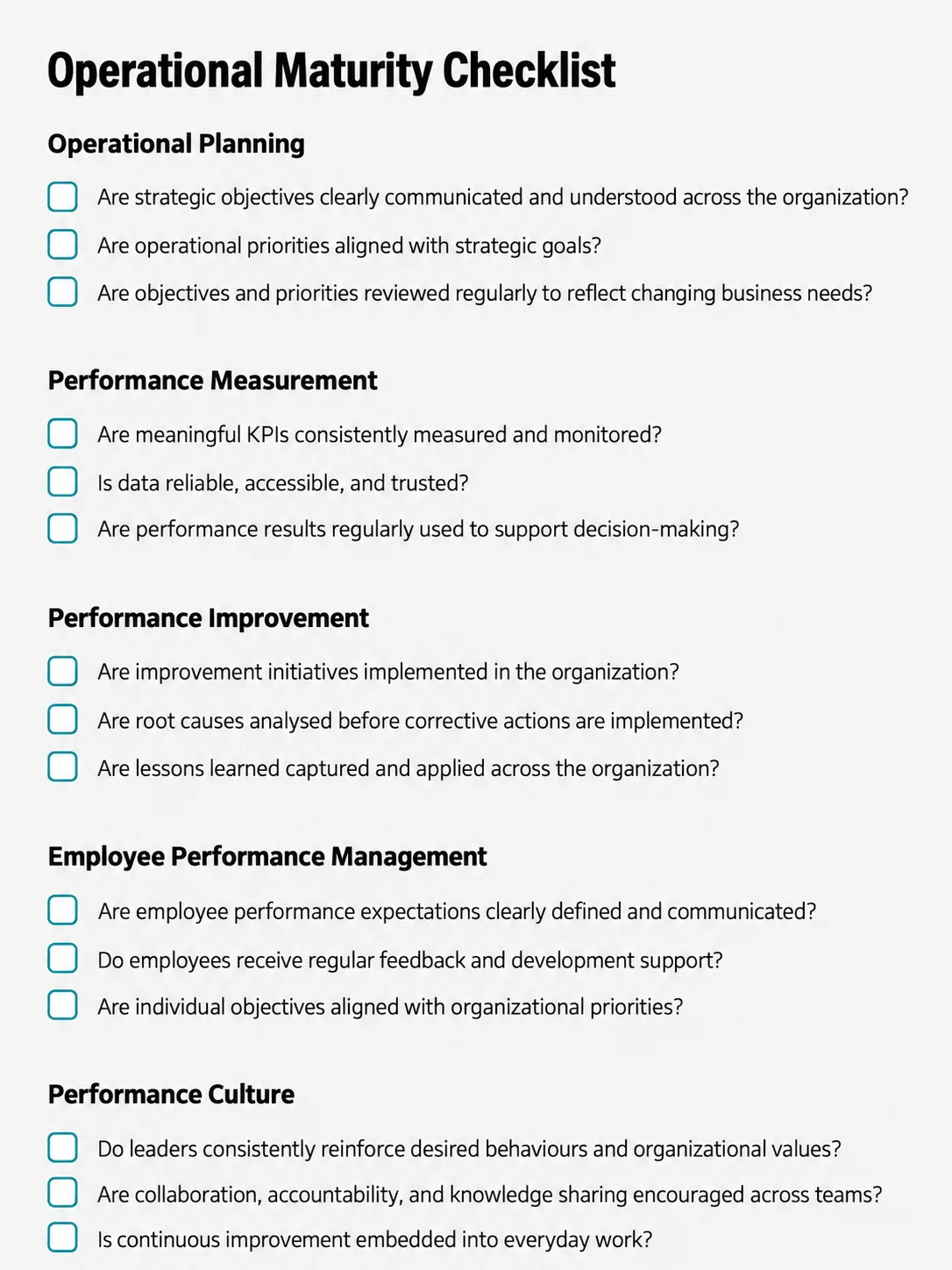
Operational maturity is rarely achieved through a single transformation initiative. Instead, it becomes visible through a series of practical changes. The following questions provide a practical reflection on the capabilities that enable organizations to perform consistently, adapt more effectively, and continuously improve over time.
4.From framework to practice: what actually makes a difference
Frameworks help organizations understand what operational maturity looks like, but practice is where that maturity is built. Across different operational transformation initiatives, one lesson becomes increasingly clear: sustainable operational maturity is not achieved through a single project, methodology, or tool. Instead, it develops gradually through practical improvements that simplify work, strengthen collaboration, improve decision-making, and create greater consistency in how operations are managed. Some examples include:
Automating repetitive operational activities using advanced Excel functions, standardized reporting templates, and automated workflows, reducing manual effort.
Creating a single source of truth supported by interactive dashboards and visualization tools such as Power BI or Looker Studio, enabling reliable reporting and faster, evidence-based decision-making.
Improving coordination and execution through project management platforms such as Asana, Monday.com, or Jira, increasing visibility, accountability, and collaboration across teams.
Designing operational processes around people, balancing clear expectations with empathy, open communication, and shared ownership to encourage stronger engagement and more sustainable change.
Individually, these activities may seem incremental. Together, they strengthen the operational foundations that enable organizations to perform more consistently and sustainably.
When workflows become systems
Operational maturity is not achieved by optimizing individual parts of an organization. It emerges when those parts function as an integrated operational system. At that point, operational planning, performance measurement, improvement, employee performance management and performance culture no longer operate in isolation—they reinforce one another, creating an environment where improvement becomes continuous rather than occasional. Ultimately, operational maturity is about building an integrated operational system where every part contributes to a stronger whole—because, in the end, the whole system is greater than the sum of its parts.
Get our research first in Google Search and AI Mode.
Overall
From Workflow to System: The Operational Maturity Threshold
Operational challenges rarely emerge as sudden failures. Instead, they develop gradually through small inefficiencies, recurring issues, fragmented information, and competing priorities that quietly accumulate over time.
From Level 1 to Level 2 in Employee Performance Management: A Roadmap
Moving from Level 1 to Level 2 in Employee Performance Management marks the transition from fragmented, reactive practices to a more structured and consistent system.
GPA Unit Welcomes ALANSARI CONSULTING to Its Partner Network as an Associate Partner in the Kingdom of Bahrain
GPA Unit has welcomed ALANSARI CONSULTING as an Associate Partner in Bahrain, expanding access to internationally recognized, evidence-based strategy and performance assessments across Bahrain and the wider GCC.
How to Become a GPAU Employee Performance Management Accredited Assessor
The GPAU Employee Performance Management Assessor pathway develops professionals from certification to authorization and supervised client accreditation, building competence to assess how consistently organizations manage and improve employee performance.