Răzvan Arsene, Vice President Quality at Autoliv, will join the Performance Excellence Digital Forum for a panel discussion on performance maturity, organizational culture and the role of AI in strengthening execution.
With more than two decades of experience in the automotive industry, Arsene has held senior roles across quality, manufacturing, industrial strategy and operational leadership. Today, his work focuses on quality across Autoliv’s European operations, bringing together strategic direction, operational performance and continuous improvement across a complex international environment.
His perspective starts from a simple distinction: quality cannot stop at compliance. Compliance remains essential, but for Răzvan, quality also plays a broader role in efficiency, competitiveness, reputation and long-term business performance. Poor quality is not only a technical problem; it creates waste, increases cost and can directly affect business results.
Quality as part of strategy
In large organizations, quality cannot operate as an isolated function.
Răzvan argues that quality needs to be embedded across strategic initiatives, whether they concern manufacturing, logistics, digitalization, skills or operational efficiency. The closer this connection is translated from corporate priorities into local operations and individual responsibilities, the stronger the organization’s ability to maintain quality and efficiency at scale. This requires discipline and consistency.
A process that works in one location may not work in exactly the same way in another. Differences in organizational maturity, culture and operating context matter. The objective is therefore not to impose one identical solution everywhere, but to maintain common principles while adapting execution to local realities.
For global organizations, this balance between alignment and local adaptation is an important part of performance maturity.
From systems to culture
Processes and standards alone, however, do not create a performance culture.
Răzvan places particular emphasis on collaboration and leadership behaviour. Many operational problems can be traced back not only to technical causes, but also to how teams work together, communicate and take ownership across functions.
The same principle applies to culture. Leadership cannot simply communicate the desired behaviours and expect them to appear. Răzvan compares culture building to physical training: it requires repetition, consistency and time. Leaders have to model the behaviours they expect from the organization and reinforce them continuously. This is also where performance maturity becomes broader than formal systems.
An organization may have strong procedures, clear KPIs and well-designed management structures and still struggle with execution. For Răzvan, maturity includes the ability to achieve consistent and repeatable performance over time, supported by leadership, employee engagement, competencies and organizational discipline.
AI: technology is only part of the equation
The role of AI adds another dimension to this discussion.
Organizations now have access to more data, more advanced analytics and increasingly powerful AI tools. The challenge is no longer simply gaining access to technology.
It is developing the organizational capability to use it well.
Răzvan highlights upskilling as one of the main requirements. Technology can support better decisions, faster analysis and stronger performance management, but employees and leaders still need to understand how to use the available information and distinguish what is relevant from what is simply more data.
This becomes particularly important in performance measurement.
Not every KPI tells the same story. Lagging indicators provide information about what has already happened, while leading indicators can give organizations greater visibility into what may happen next. As business conditions become less predictable, the ability to identify and use the right indicators becomes increasingly important for decision-making.
Continuing the discussion at the Digital Forum
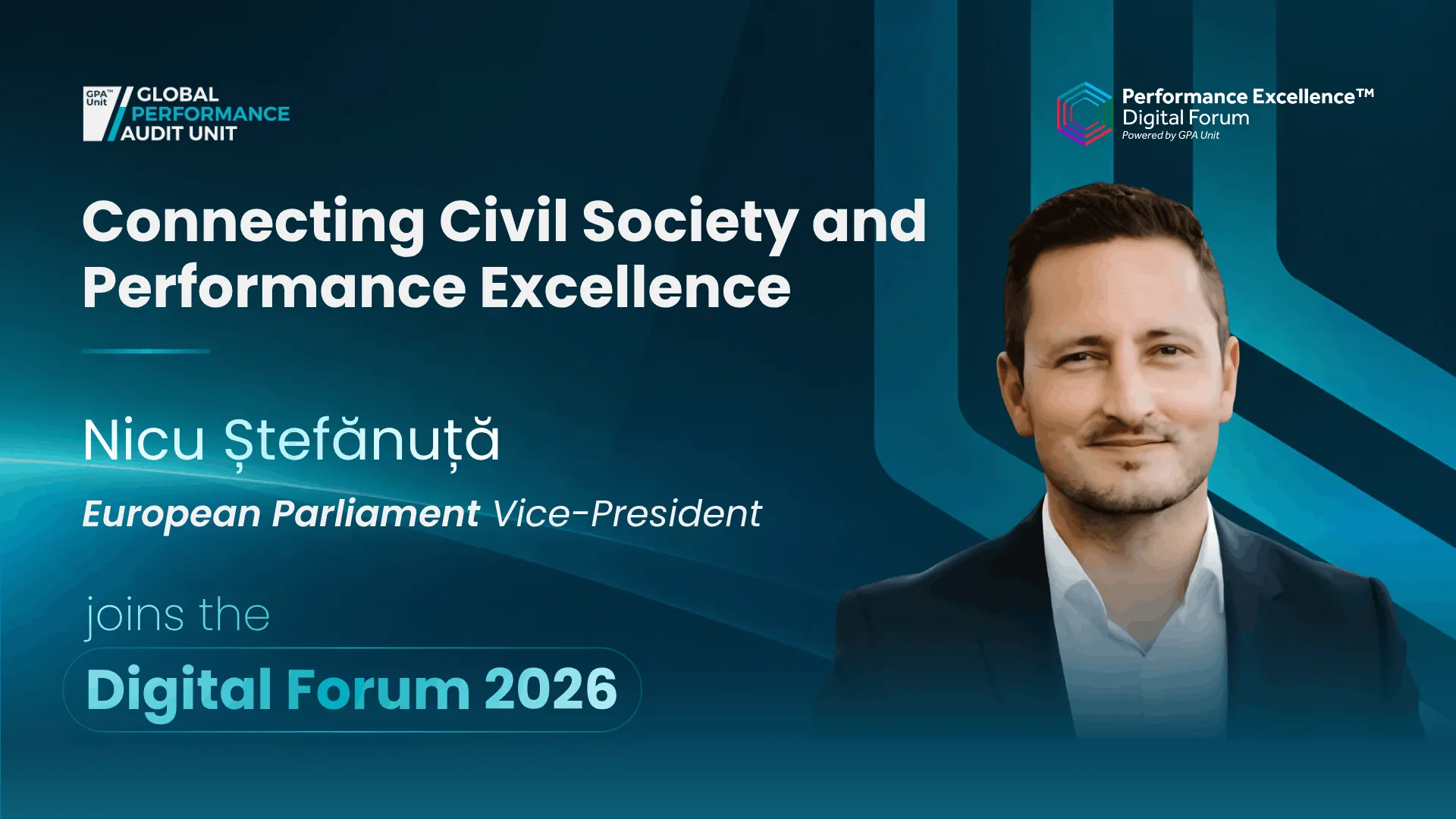
At the Performance Excellence Digital Forum, Răzvan Arsene will join the panel From Compliance to Culture: Rethinking Performance Maturity in the Context of the AI Paradigm.
The discussion will explore:
- AI as a catalyst for Performance Excellence;
- the transition from compliance toward a stronger performance culture; and
- the maturity of strategy and performance management systems in the European context.
Răzvan’s perspective brings these themes together through the experience of global manufacturing: strong performance depends on how consistently the right systems are executed, how leadership reinforces them, and how people use them in everyday decisions.
Ahead of the Forum, his full perspective on quality, strategy, organizational maturity, leadership and AI will also be available through the GPAU Leading Voices podcast, where he discusses the evolution of quality from a compliance function toward a broader business capability.
Join Răzvan Arsene on 9 December 2026, as part of the Performance Excellence Digital Forum.
Get our research first in Google Search and AI Mode.