Home›Insights›From Corporate Ambition to Functional Delivery
Login
Please wait...!
Insights
Integrated Performance
From Corporate Ambition to Functional Delivery
Corporate strategy only creates results when functional areas can translate it into consistent, measurable execution and improve the systems that support delivery.
by GPA Unit | 28 July 2026
| Share on
Across the GCC, many organisations have invested significantly in corporate strategy and performance management these past years. These developments have strengthened the architecture through which organisations set direction and monitor results. Strategy offices have been established, corporate scorecards have been automated, and alignment mechanisms have become more formal across the region and within the organizations responsible for Vision 2030 implementation. Things are coming together.
However– and this is the point of this article– corporate level performance management maturity does not automatically translate into effective execution.
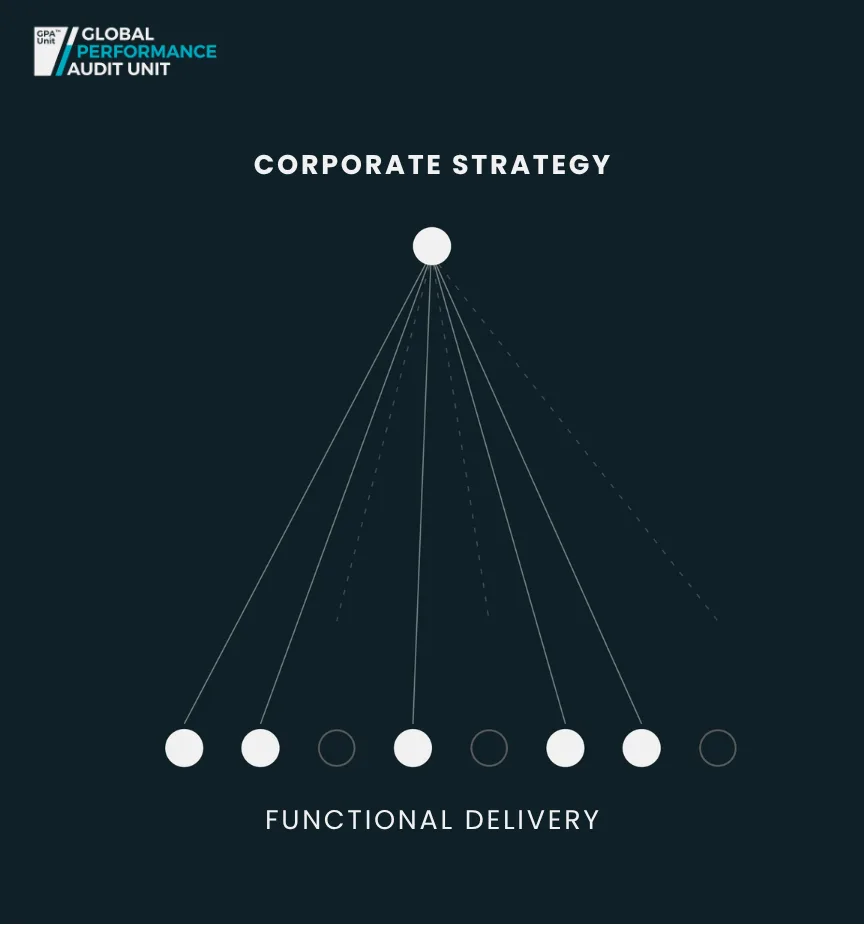
Strategy is ultimately delivered through functional areas: operations, commercial, human resources, information technology, finance, supply chain, and other departments. An organisation may have a mature corporate performance management system while the functions responsible for delivery continue to plan, measure, and improve inconsistently.
So, if strategy is designed and assessed at the corporate level, how do we evaluate the maturity of the functions that do more than implement it—those that translate, adapt, and ultimately shape its results?
Functional delivery of national targets
Vision 2030, for example, is expressed through national ambitions, but delivered through the daily work of organisations and their functions.
Targets related to economic diversification, service quality, digitalisation, local content, workforce capability, and customer experience must eventually be translated into departmental objectives, KPIs, initiatives, and individual responsibilities.
National targets may begin at the level of a Vision Realization Program, but their execution takes place within operations, finance, HR, IT, commercial, supply chain, and other business functions. Some examples:
Aviation: The target of increasing airport capacity to 330 million passengers by 2030 depends on airport operations, capacity planning, ground services, and workforce deployment as much as the enabling functions behind them, such as human resources, procurement, or IT
SME development: Monsha’at’s target of increasing SMEs’ contribution to GDP from 20% to 35% depends on financing, licensing, advisory services, and enterprise support.
Digital government: The National Transformation Program’s digitalisation agenda depends on technology, data, process redesign, service management, and employee adoption.
As 2030 approaches, the emphasis is shifting from strategy design to sustained delivery. This makes operational maturity increasingly important. Corporate systems may establish direction and monitor progress, but Vision 2030 outcomes will ultimately depend on whether business functions can convert strategic priorities into consistent, measurable results.
How can an operational performance management maturity assessment assist organizations to improve their delivery and align with their strategy?
Corporate and functional maturity answer different questions
The GPA Unit applies two related families of maturity frameworks that, combined, give a comprehensive overview of where an organization stands.
The Organisational Performance Maturity Model Frameworks assess performance management at the corporate level. Their unit of analysis is the organisation as a whole. They examine the architecture through which strategy is planned, measured, managed, translated into individual performance, and supported by organisational culture.
The individual corporate capabilities may also be assessed independently. An organisation may, for example, evaluate only its Strategic Planning, Performance Measurement, or Employee Performance Management capability. The central question is: Is the organisation’s corporate performance system designed, governed, and operated according to recognised good practices?
The Operations Performance Maturity Model Framework has a different unit of analysis: one functional area, division, or department. Unlike the corporate frameworks, these dimensions are mandatory to be assessed together. A department’s planning, measurement, improvement, people management, and culture form one operating system. Weakness in one dimension can limit the effectiveness of the others.
The two assessment levels are therefore complementary. The corporate assessment evaluates the overall architecture and the operations assessment determines whether that architecture reaches the areas where delivery takes place.
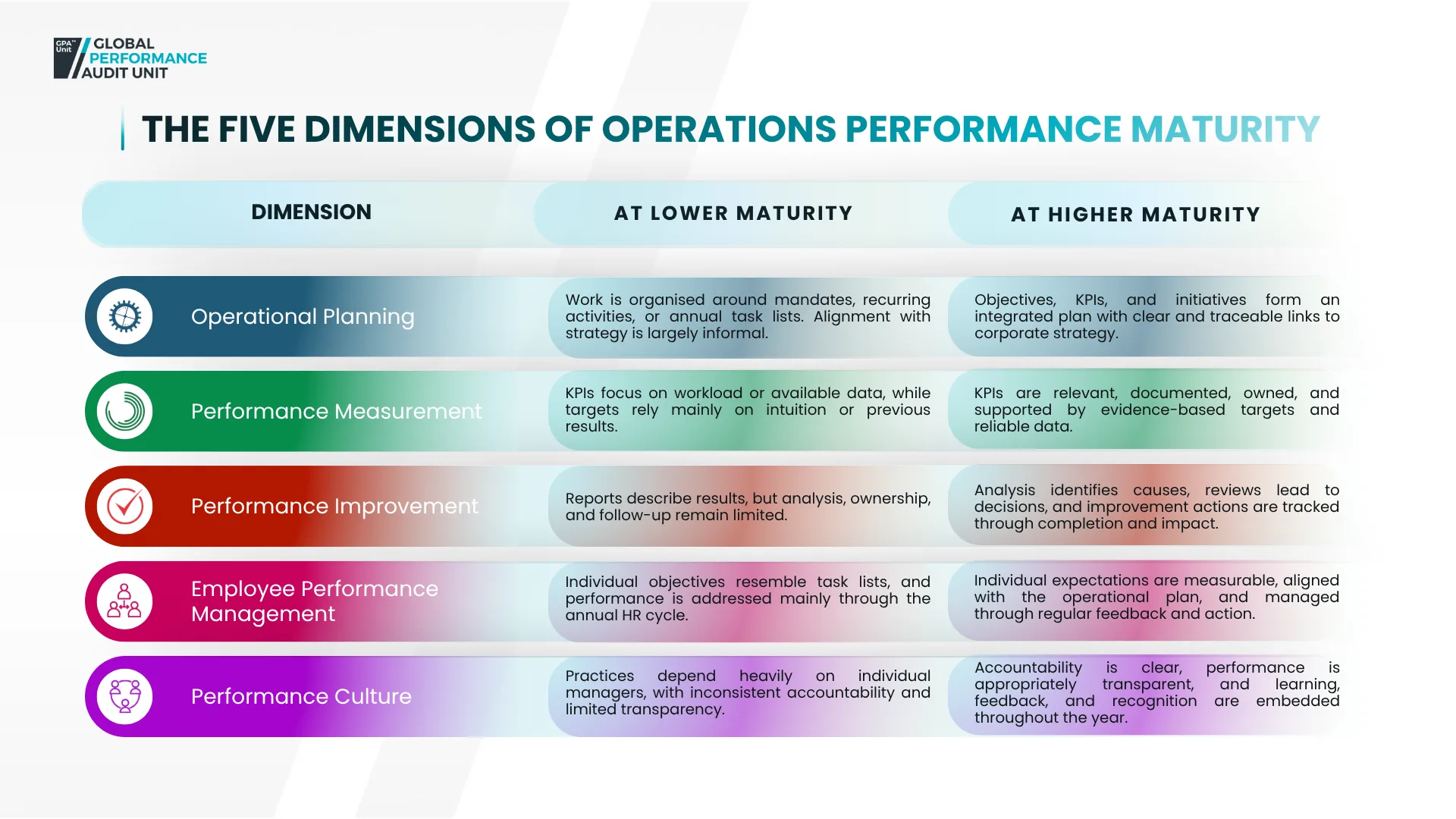
The five dimensions of operations performance maturity
The Operations Performance Maturity Model evaluates a functional area against approximately 80 best practice criteria across five interdependent dimensions, identical to the organizational model.
Operational Planning: how the function defines objectives, KPIs, and initiatives and aligns them with corporate strategy.
Performance Measurement: how KPIs are selected, documented, targeted, monitored, and supported by reliable data.
Performance Improvement: how results are analysed, reviewed, and translated into corrective actions and improvement initiatives.
Employee Performance Management: how functional objectives are translated into individual expectations, feedback, and performance decisions.
Performance Culture: how leadership, accountability, transparency, learning, recognition, and technology support sustained performance.
Together, these dimensions show whether the function has merely introduced performance management practices or developed an integrated capability for delivering results. In each dimension, the progression from Level 1 to Level 5 is based on an increase in formalization, consistency, integration, and the extent to which performance practices inform everyday decisions rather than remain procedural requirements.
The score shows the position; the profile sets the priorities
Similarly to the organizational assessments, each dimension is scored on a five-level scale, from Initial to Leading. The assessment combines evidence-based assessor scoring with an employee perception survey, weighted at 75% and 25% respectively. This allows the evaluation to consider both how the system is designed and how consistently it is experienced in practice.
The overall score provides a useful point of reference, but it is not the roadmap. Two functions can receive the same overall result while facing very different performance challenges. One may have reliable KPIs and disciplined reporting but weak accountability. Another may benefit from strong leadership and employee engagement but lack formal planning and measurement practices. Their maturity level may be similar, but their improvement priorities are not.
The dimension profile therefore matters more than the average, as it shows where the operating system is strong, where it is constrained, and which interventions should come first.
How to improve operations performance in 2026 using the maturity model?
For many organisations, the main challenge is not a lack of improvement activity, but sequence. Corporate improvement efforts create limited value when they are introduced before the operating system is ready to support them, in fact, they may hinder more than improve.
Four principles can help functions improve performance more effectively in 2026.
1. Diagnose at the dimension level
Improvement should begin with the maturity profile, not the overall score, especially when it comes to operations management, where capabilities are always assessed together.
Leaders need to identify which dimension is limiting performance and how that weakness affects the rest of the system. Weak Operational Planning, for example, can lead to irrelevant KPIs, disconnected employee objectives, and improvement initiatives that do not support strategic priorities. Similarly, weak Operational Performance Culture can prevent an otherwise well-designed system from being used consistently.
2. Strengthen measurement before investing further in technology
Technology can accelerate a mature performance system but it cannot correct a weak one.
Automating poorly selected KPIs produces faster access to information that may still be irrelevant. Applying analytics to unreliable data increases sophistication without increasing confidence. Introducing AI into a system with unclear ownership or arbitrary targets may simply automate existing weaknesses.
Before expanding technology, functions should confirm that:
operational objectives are clear;
KPIs measure the right outcomes;
targets are supported by evidence;
ownership is defined;
data are sufficiently reliable for decision-making.
Measurement discipline should come before measurement automation.
3. Build towards the next maturity level
Improvement plans often describe the characteristics of a Leading function without considering the foundations required to reach that level.
Advanced analytics, real-time optimisation, or highly decentralised decision-making depend on stable processes, reliable data, clear accountability, and established review routines. Introducing these practices too early can create isolated pockets of sophistication without improving the wider operating system.
Operational maturity develops cumulatively. Each level creates the conditions required for the next.
The practical objective for 2026 should therefore be to consolidate the next maturity level—not to adopt selected Level 5 practices while the fundamentals remain uneven.
4. Treat culture as part of the operating system
Performance Culture should not be approached as a communication campaign around a new process.
Accountability, transparency, learning, recognition, and leadership behaviour are reflected in how work is organised. They appear in meeting routines, decision rights, escalation processes, performance conversations, and the actions taken when results fall below expectations.
A mature culture does not depend on one committed manager to keep the system working. It is supported by practices that continue across teams and leadership changes.
This is what makes improvements sustainable.
From assessment to a practical roadmap
An operations performance maturity assessment turns the broad objective of “improving departmental performance” into a defined improvement programme.
The evaluation combines documentation analysis, employee perceptions, and stakeholder interviews. It establishes the function’s current maturity position, identifies strengths and development priorities across the five dimensions, and translates the findings into a sequenced roadmap.
The result, beyond the assessment report and the dashboard, also includes an executive view of the maturity profile and a practical plan for progressing towards the next level.
Get our research first in Google Search and AI Mode.
Overall
Dr. Adrian Brudan Featured by GulfApex for Leadership in Performance Excellence
GulfApex has featured Dr. Adrian Brudan, CEO and Co-Founder of GPA Unit, in its Leadership Feature series.
GPA Unit Welcomes ALANSARI CONSULTING to Its Partner Network as an Associate Partner in the Kingdom of Bahrain
GPA Unit has welcomed ALANSARI CONSULTING as an Associate Partner in Bahrain, expanding access to internationally recognized, evidence-based strategy and performance assessments across Bahrain and the wider GCC.
How to Become a GPAU Employee Performance Management Accredited Assessor
The GPAU Employee Performance Management Assessor pathway develops professionals from certification to authorization and supervised client accreditation, building competence to assess how consistently organizations manage and improve employee performance.
GPA Unit Welcomes EFQM CONSULTING to Its Partner Network as an Associate Partner in the United Arab Emirates
GPA Unit has welcomed EFQM CONSULTING as an Associate Partner in the UAE, expanding access to internationally recognized, evidence-based strategy and performance maturity assessments across the market.
How to Become a GPAU Strategic Planning Accredited Assessor
How to Become a GPAU Strategic Planning Accredited Assessor The pathway to becoming an Accredited Assessor The GPAU assessor pathway provides a structured route from professional education to supervised assessment practice.