Home›Insights›How to Become a GPAU Strategic Planning Accredited Assessor
Login
Please wait...!
Insights
Strategic Planning
How to Become a GPAU Strategic Planning Accredited Assessor
How to Become a GPAU Strategic Planning Accredited Assessor The pathway to becoming an Accredited Assessor The GPAU assessor pathway provides a structured route from professional education to supervised assessment practice.
by GPA Unit | 30 September 2026
| Share on
The GPAU assessor pathway provides a structured route from professional education to supervised assessment practice. It combines certification, applied simulation, formal authorization and client-based accreditation within the GPAU Maturity Assessment Framework.
The pathway is available across the framework’s capabilities: Strategic Planning, Performance Measurement, Performance Improvement, Employee Performance Management, Performance Culture. Professionals who complete all five capability-based practitioner tracks receive the additional Integrated Performance credential. Beyond the organizational capabilities, assessors can receive education on Operations Performance as well.
Each pathway follows the same progression:
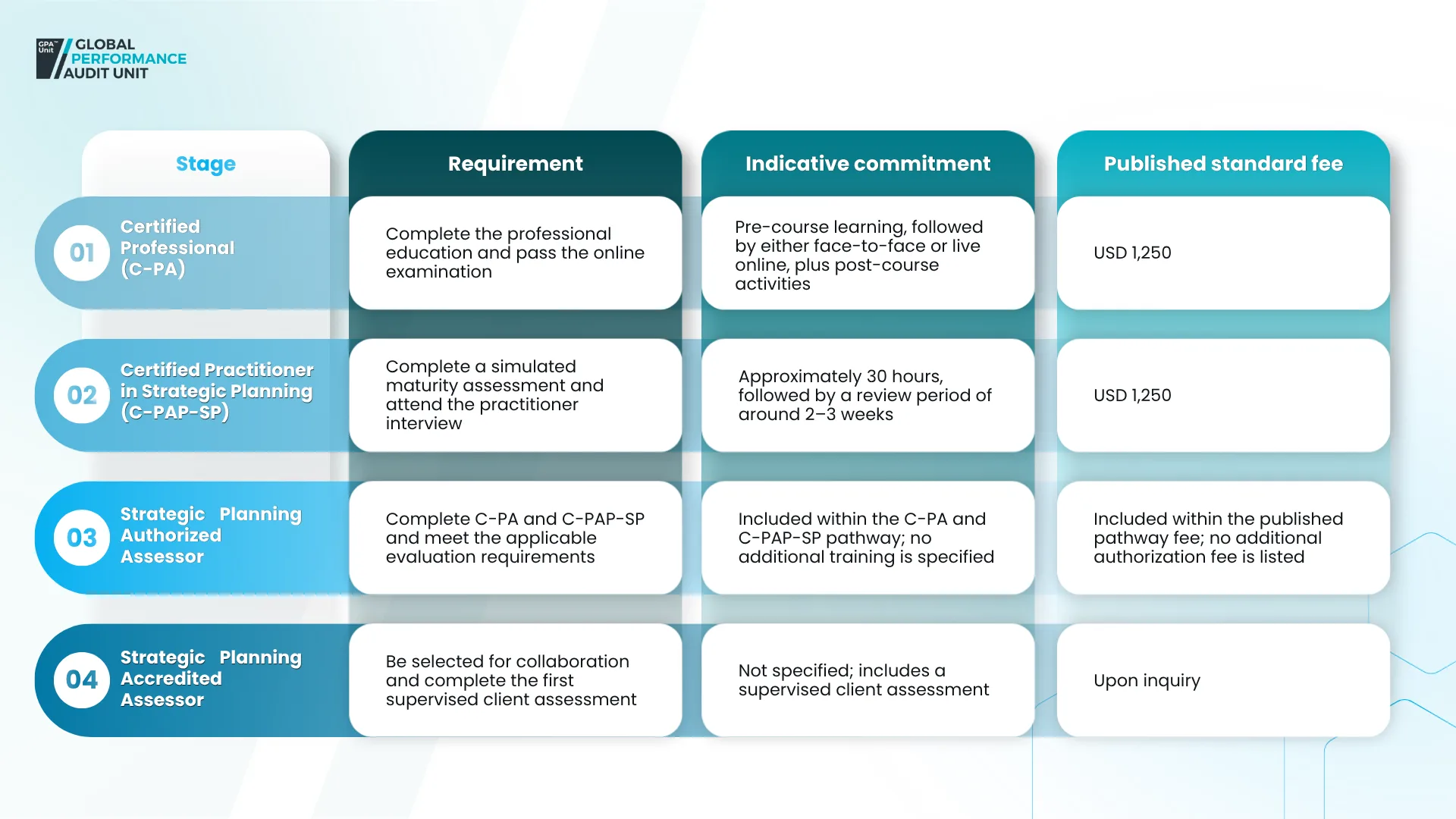
Certified Professional: establishes the conceptual and methodological foundation.
Certified Practitioner: develops applied competence through a simulated maturity assessment.
Authorized Assessor: formally recognizes the candidate as qualified within the selected capability.
Accredited Assessor: recognizes successful performance in supervised client assessments and enables participation in GPA Unit’s external assessment network.
This article explains how the pathway applies to Strategic Planning, including the requirements, time commitment, fees and credentials received at each stage.
Assessing the system behind the strategy
A GPAU Strategic Planning Maturity Assessor does not evaluate the quality of a single document. The focus is the organization’s capacity to establish direction and convert it into coordinated action consistently.
The assessment may involve strategic plans, environmental analyses, governance documents, performance reports and records of strategy review meetings. Interviews and survey results provide further insights of how leaders and employees understand the strategy and how consistently departments translate it into operational priorities.
The assessor examines whether the organization can:
understand its internal and external environment;
establish and communicate a clear strategic direction;
translate priorities into coordinated plans;
monitor execution and changing assumptions; and
improve its planning practices using evidence and organizational learning.
This distinction has practical consequences. A well-written strategy may still depend on a small number of individuals. A regular review cycle may track KPIs without testing whether the strategy remains relevant. Strategic objectives may be formally cascaded while departments apply different criteria when setting their priorities.
The assessor brings these observations together, tests them against the available evidence and determines what they indicate about organizational maturity.
What the pathway requires
For a candidate pursuing accreditation in Strategic Planning, the GPAU Academy stages represent approximately 70 hours of professional and applied preparation. Accreditation then introduces supervised client practice, with the duration determined by the scope of the engagement.
The published standard tuition for the professional and practitioner stages is USD 2,500 for one capability. Eligible enrollments completed by 31 December 2026 may qualify for the published Founding Grant fee of USD 1,500 for the combined Authorized Assessor pathway, subject to GPA Unit approval and the applicable conditions.
Accreditation is not an additional course that can be purchased after completing the GPAU Academy stages. It depends on eligibility, selection for collaboration and demonstrated performance in client work.
Stage 1: Establishing the professional foundation
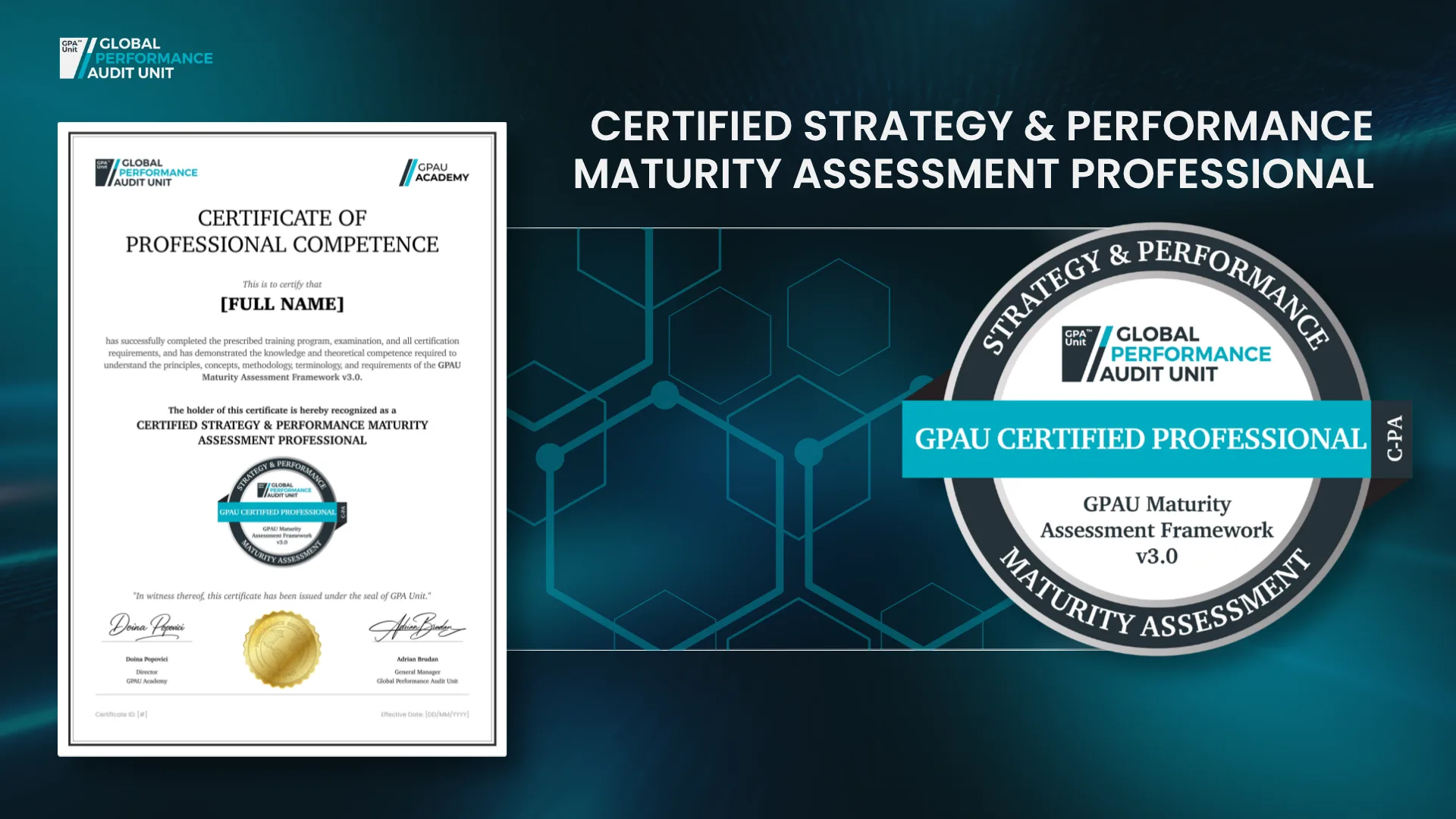
The pathway begins with the Certified Strategy and Performance Maturity Assessment Professional certification, or C-PA.
The program introduces the GPAU Maturity Assessment Framework and the principles that support a consistent assessment. Candidates learn how to interpret maturity criteria, evaluate organizational evidence, determine scores and move from assessment initiation to reporting and improvement planning.
The 40-hour commitment comprises:
pre-course assignments;
course participation and core-course activities; and
post-course assignments.
Candidates then complete an online examination of 75 multiple-choice questions. A minimum result of 67% is required.
The central shift begins here. Strategic planning is no longer viewed mainly as an exercise that produces an approved plan. It is examined as an organizational capability, supported by governance, evidence, defined practices and continuous review.
Candidates who pass the examination receive the GPAU Certified Professional badge and Certificate of Professional Competence.
Stage 2: Applying the methodology in simulation
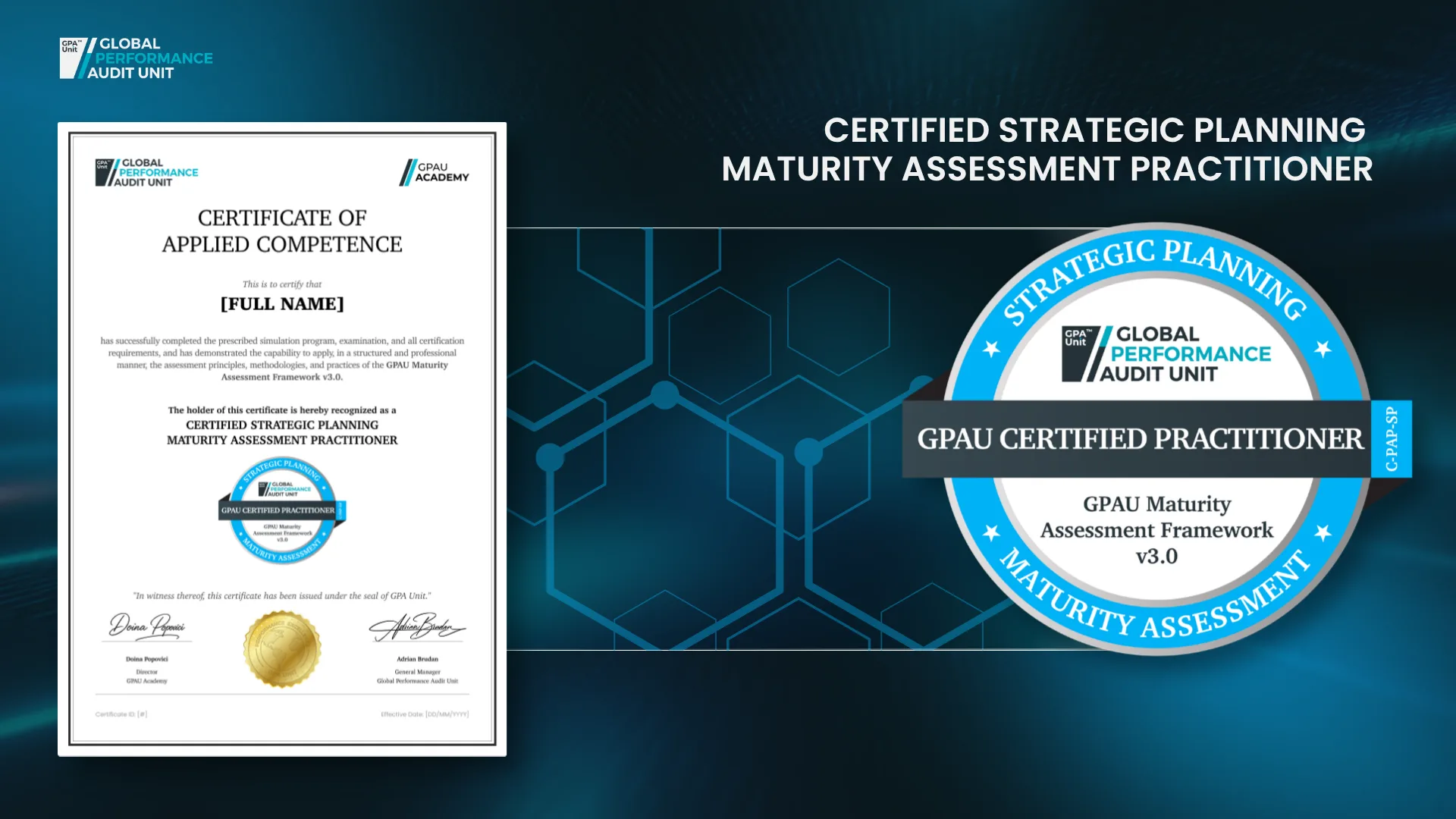
Professional knowledge alone does not show whether a candidate can conduct an assessment. The Certified Strategic Planning Maturity Assessment Practitioner, or C-PAP-SP, tests that capability through application.
C-PA is a mandatory prerequisite. Candidates then undertake an independent simulation based on a fictive organization, working with the evidence and decisions that arise across the assessment cycle.
The simulation requires approximately 26 hours and covers document review and scoring, survey audience segmentation, conducting interviews, maturity results consolidation, assessment report and roadmap report generation.
The work requires judgment. A candidate may find, for example, that an organization has established a strategy review calendar but provides no evidence that leaders reconsider external assumptions during those reviews. The candidate must identify the relevant maturity criteria, determine what the evidence supports and explain the finding in a form that management can use.
Each assignment must receive a minimum evaluation of 4 out of 5. Once the work is submitted, the Accreditation Mentor reviews the assignments and invites the candidate to an online practitioner interview. The discussion examines the candidate’s decisions and provides structured feedback. The review and interview stage generally takes two to three weeks.
Candidates who meet the requirements receive the C-PAP-SP badge and Certificate of Applied Competence.
From applied competence to professional authorization
Completion of C-PA and C-PAP-SP demonstrates two connected capabilities: knowledge of the strategic planning assessment framework and the ability to apply it under simulated conditions.
The GPAU Institute for Standards & Accreditation can then recognize the candidate as a Strategic Planning Authorized Assessor, subject to the applicable evaluation requirements.
Authorization is not a third training course. It is the formal status resulting from the education and applied preparation already completed.
The assessor receives:
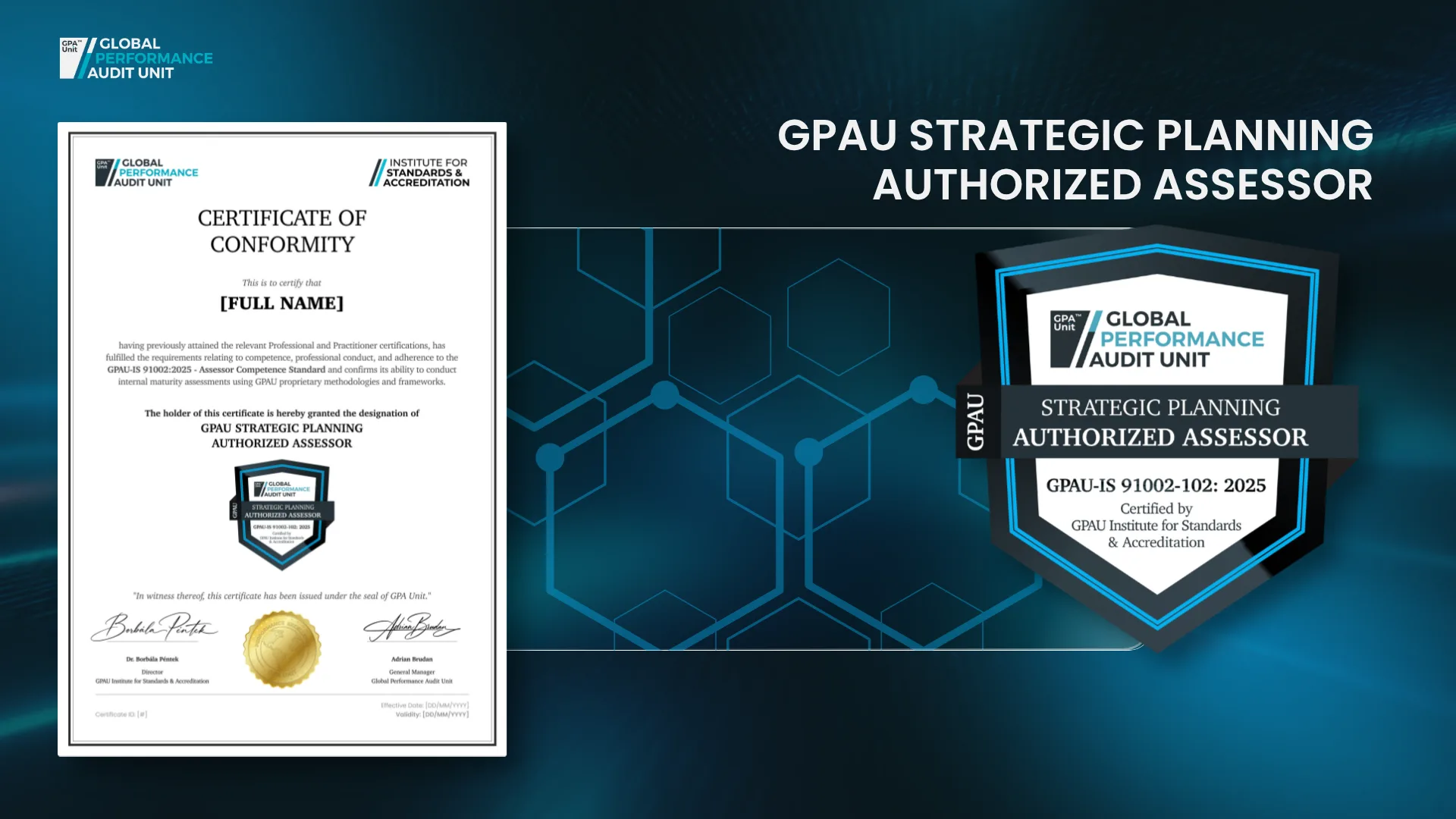
the Strategic Planning Authorized Assessor badge; and
a Certificate of Conformity referencing GPAU-IS 91002-102:2025 standard.
Within the scope of the authorization, the assessor may apply the GPAU methodology to internal maturity assessments within their own organization. Where covered by a Partnership Agreement with GPA Unit, Authorized Assessors may also deliver PerforAssess Diagnose services to third-party organizations. Accredited Assessor status provides the broader authority to conduct both Diagnose and Recognised assessments under GPAU accreditation.
Stage 3: Demonstrating capability in client practice
Accreditation moves the assessor from simulation into a real organizational setting.
Eligible Authorized Assessors may be selected to collaborate with GPA Unit and enter its external assessment network. Their first client assessment is conducted under supervision, with technical guidance, review of outputs and feedback on the quality of the work.
Client practice introduces conditions that a simulation can only approximate. Evidence may be incomplete. Stakeholders may describe the same process differently. A formally established practice may operate consistently in one department but remain largely absent elsewhere.
The assessor must determine what can be concluded without overstating the evidence. A finding must identify both the maturity gap and its organizational consequence:
Strategic objectives are formally cascaded, but departments use different criteria when translating them into priorities, limiting alignment across the organization.
The assessor must then support that conclusion through documented evidence, consistent scoring and a defensible interpretation of the maturity criteria.
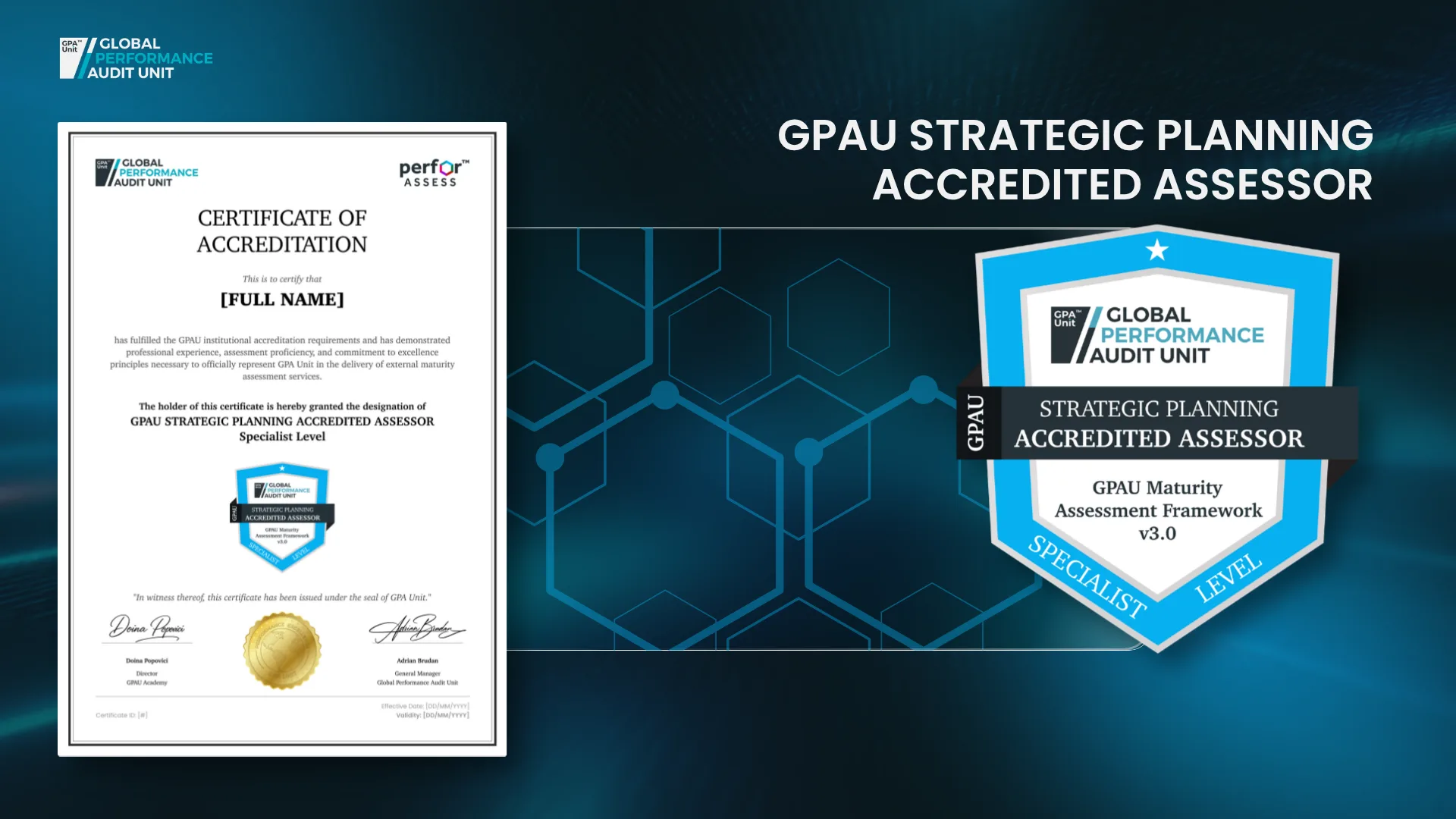
Following successful completion of the first supervised assessment, the assessor receives the GPAU Strategic Planning Accredited Assessor title at Specialist level, together with the corresponding badge and Certificate of Accreditation.
A progression based on assessed work
Accreditation develops through four professional levels:
Specialist, following successful completion of the first supervised client assessment;
Senior, reflecting broader experience and work on more demanding engagements;
Expert, based on sustained delivery and consistently strong professional judgment; and
Master, the highest level of recognition within the capability.
Progression is based on assessment activity rather than course attendance. GPA Unit considers the number and complexity of engagements completed, the quality of the outputs, the outcomes achieved and the feedback received.
Accredited Assessors also undergo annual proficiency reviews, while accreditation is renewed every three years. The model is designed to recognize current and demonstrated practice, not only the completion of an earlier qualification.
What the candidate receives
The pathway produces a sequence of related credentials, each marking a different professional outcome:
C-PA confirms the required conceptual and methodological foundation;
C-PAP-SP confirms applied competence in a Strategic Planning assessment simulation;
Authorized Assessor status formally recognizes the individual within the defined capability; and
Accredited Assessor status confirms successful performance in supervised client practice and entry into GPA Unit’s external assessment network.
For strategy professionals, the value lies in the change of perspective. The pathway develops the ability to look beyond whether an organization has a strategy and determine whether it has built a mature system for formulating, executing and adapting that strategy.
The GPAU Academy stages require approximately 70 hours and carry a published standard fee of USD 2,500 for one capability. Candidates interested in progressing to accreditation should also account for the supervised client assessment, whose timing depends on eligibility, selection and the availability and scope of an appropriate engagement.
For current schedules, Founding Grant eligibility and accreditation requirements, contact GPAU Academy at assessment@gpaunit.org.
Get our research first in Google Search and AI Mode.
Overall
Dr. Adrian Brudan Featured by GulfApex for Leadership in Performance Excellence
GulfApex has featured Dr. Adrian Brudan, CEO and Co-Founder of GPA Unit, in its Leadership Feature series.
GPA Unit Welcomes ALANSARI CONSULTING to Its Partner Network as an Associate Partner in the Kingdom of Bahrain
GPA Unit has welcomed ALANSARI CONSULTING as an Associate Partner in Bahrain, expanding access to internationally recognized, evidence-based strategy and performance assessments across Bahrain and the wider GCC.
How to Become a GPAU Employee Performance Management Accredited Assessor
The GPAU Employee Performance Management Assessor pathway develops professionals from certification to authorization and supervised client accreditation, building competence to assess how consistently organizations manage and improve employee performance.
GPA Unit Welcomes EFQM CONSULTING to Its Partner Network as an Associate Partner in the United Arab Emirates
GPA Unit has welcomed EFQM CONSULTING as an Associate Partner in the UAE, expanding access to internationally recognized, evidence-based strategy and performance maturity assessments across the market.
How to Become a GPAU Strategic Planning Accredited Assessor
How to Become a GPAU Strategic Planning Accredited Assessor The pathway to becoming an Accredited Assessor The GPAU assessor pathway provides a structured route from professional education to supervised assessment practice.