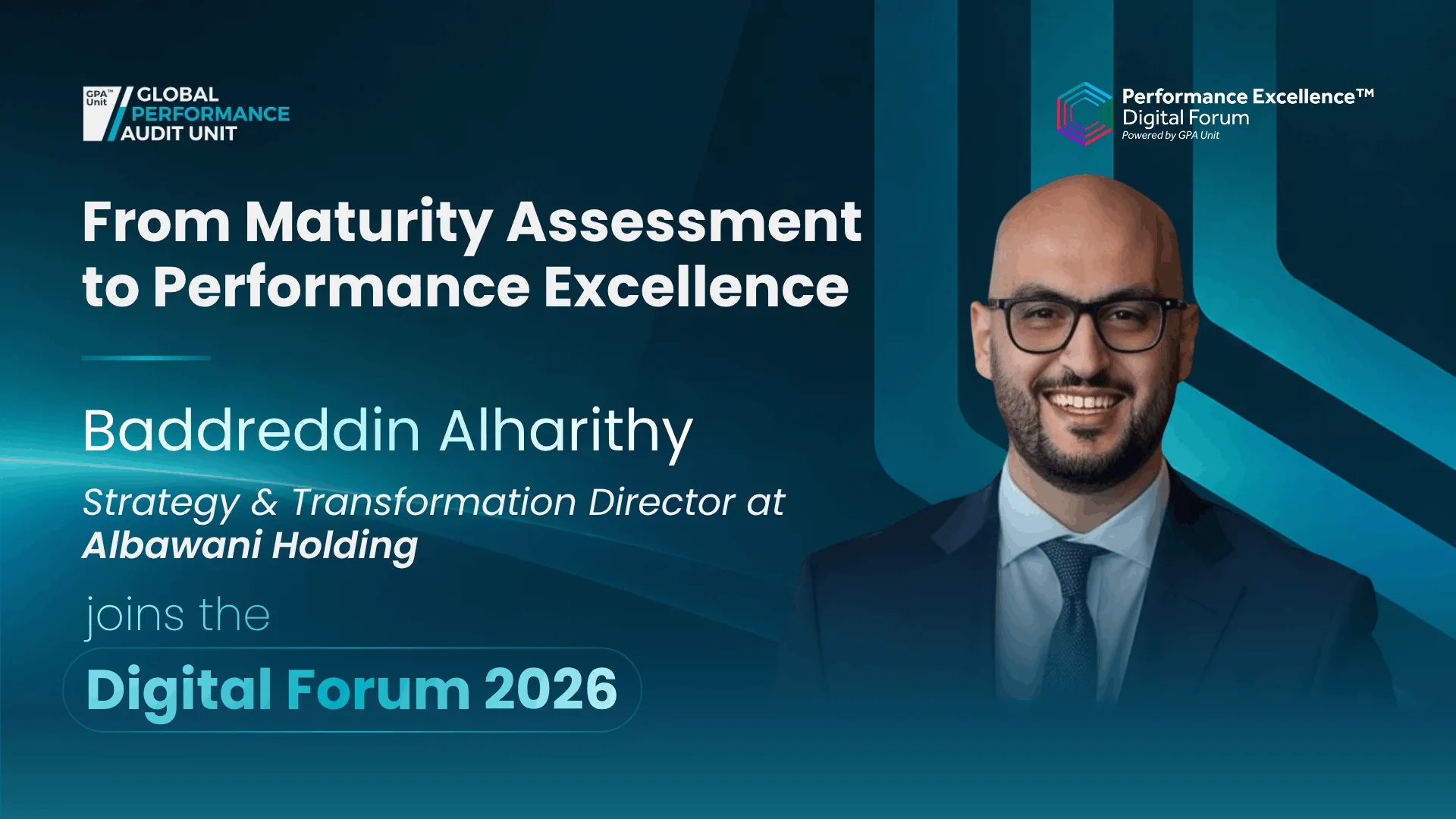
Baddreddin Alharithy, Strategy & Transformation Director at Albawani Holding, will join the Performance Excellence Digital Forum to discuss how maturity assessment findings can be translated into concrete improvement initiatives.
At Albawani Holding, he leads enterprise strategy, transformation, performance management and portfolio governance across a diversified Saudi group. His work focuses on translating strategic priorities into objectives, initiatives, performance measures and execution.
This is also the context in which Albawani undertook the GPAU strategy and performance management maturity assessment.
As Alharithy explained in a recent Leading Voices interview published in The Ladder, the organization had developed an ambitious strategy and wanted to ensure that its business units, objectives and KPIs were aligned around the same transformation agenda. The maturity assessment was used to understand how well the underlying performance management system supported that ambition.
Knowing where you stand
For Albawani, the maturity assessment created a baseline, revealing the systems and practices supporting strategic planning, performance measurement, performance improvement, performance culture and employee performance management. This gave the organization a more complete view of how its performance management system operated and where additional capabilities were required.
This baseline became particularly important for the transformation agenda.
Turning assessment into improvement
The next step is where the real value of maturity assessment is created.
At Albawani, the Strategy and Transformation Office plays a central role in connecting the group’s overall direction with the activities of its individual businesses. The objective is to ensure that the holding’s vision is translated into clear objectives, KPIs, targets and initiatives, while still recognizing the different needs of each business.
This is particularly relevant in diversified organizations. A common strategy needs common direction and governance, but execution must still reflect different operational realities.
Maturity models can support this process by providing a common structure for evaluating practices across the organization and identifying where further development is required.
Building the conditions for transformation
Systems and frameworks, however, are only one part of the transformation process.
In The Ladder interview, Alharithy highlights leadership sponsorship, stakeholder engagement, capability building and change management as important success factors.
Leadership involvement helps establish priorities and signals the importance of the transformation. Stakeholder engagement builds understanding and ownership. Capability development ensures that teams have a common language and the knowledge required to participate effectively. Change management helps move the organization from identified gaps to new ways of working.
For organizations operating in Saudi Arabia, these capabilities are increasingly important.
Alharithy describes alignment and speed as two central requirements in the current environment. Organizations need the ability to monitor performance, understand external change and adapt their plans and decisions accordingly. Strong strategy and performance management systems provide the structure required to do this consistently.
Continuing the journey
At the Performance Excellence Digital Forum, Alharithy, together with Alyn Bailey – Group Chief Strategy and Transformation Officer at Albawani Holding– will join a roundtable focused on The Journey from Maturity Assessment to Performance Excellence.
The discussion will explore:
- the role of strategy and performance management maturity models in organizational transformation;
- how assessment findings can be converted into improvement initiatives; and
- how organizations can build a stronger culture of performance excellence.
The Albawani experience offers a practical example of how maturity assessment can move beyond diagnosis and become part of a broader transformation system.
The broader lesson is simple: maturity assessment is most useful when it becomes part of an ongoing management cycle rather than a one-time diagnostic exercise. The value lies not only in knowing where an organization stands, but in using that baseline to prioritize improvement, build capabilities and measure progress over time.
Join Baddreddin Alharithy on 9 December 2026, from 16:00 to 16:25 Riyadh time (GMT+3), for The Journey from Maturity Assessment to Performance Excellence, as part of the GPAU Performance Excellence Digital Forum.
Get our research first in Google Search and AI Mode.