Sustainable performance requires managing economic, social, and environmental outcomes through a single strategy, scorecard, and decision-making system rather than treating sustainability as a separate reporting activity.
by Teo Gorski and Bori Pentek | 27 July 2026
| Share on
For decades, performance management has been based on a simple assumption: an organization is performing well if the financials look good. In the 1990s, Kaplan and Norton challenged this assumption by introducing the four perspectives of the Balanced Scorecard, where financial indicators were, naturally, balanced with a focus on customers, internal processes, and learning and growth — what they called People, Learning and Growth.
Back then, Kaplan and Norton argued that organizations need to explain how performance is created, not only what result appears at the end.
Since then, the Balanced Scorecard has become a best practice in some of the biggest companies, across industries and functional areas. But the context has changed again — and this time, just as radically.
Today, economic performance, even when it results from attention to internal processes, customers, and people, can no longer be treated separately from environmental responsibility, social impact, stakeholder trust, regulatory exposure, and ultimately, long-term resilience.
This shift has many reasons. Pick your favorite.
Management is moving from system thinking to ecosystem thinking. This is probably the best reason, because it includes the deeper shift in principles and values: from short-term value creation to a broader understanding of how organizations affect, depend on, and participate in the systems around them.
Customer preferences are also shifting toward more sustainable products and services, and customers are becoming more educated in their choices. This is another good motivation for companies to make the shift, because sustainability is no longer only a matter of responsibility; it is increasingly becoming part of competitiveness, relevance, and trust.
And if nothing else works, companies can still understand the importance of this shift by looking at the companies setting the pace. For the entire Russell 1000 Index, 81% of companies published a sustainability report in 2021, up from 70% in 2020.
The key shift in management is therefore, regardless of the reason, the merge of economic, social and environmental performance, both in the eyes of investors, customers, and, hopefully, leaders.
Sustainability Balanced Scorecard: extending the architecture
Associated with the work of Figge, Hahn, Schaltegger, and Wagner, the Sustainability Balanced Scorecard preserves the logic of the original Balanced Scorecard, but expands its scope. In other words, it does not ask organizations to forget everything they know about performance management and start again from scratch.
Instead, it asks something more practical: if economic, social, and environmental performance are now connected, why are they so often managed separately?
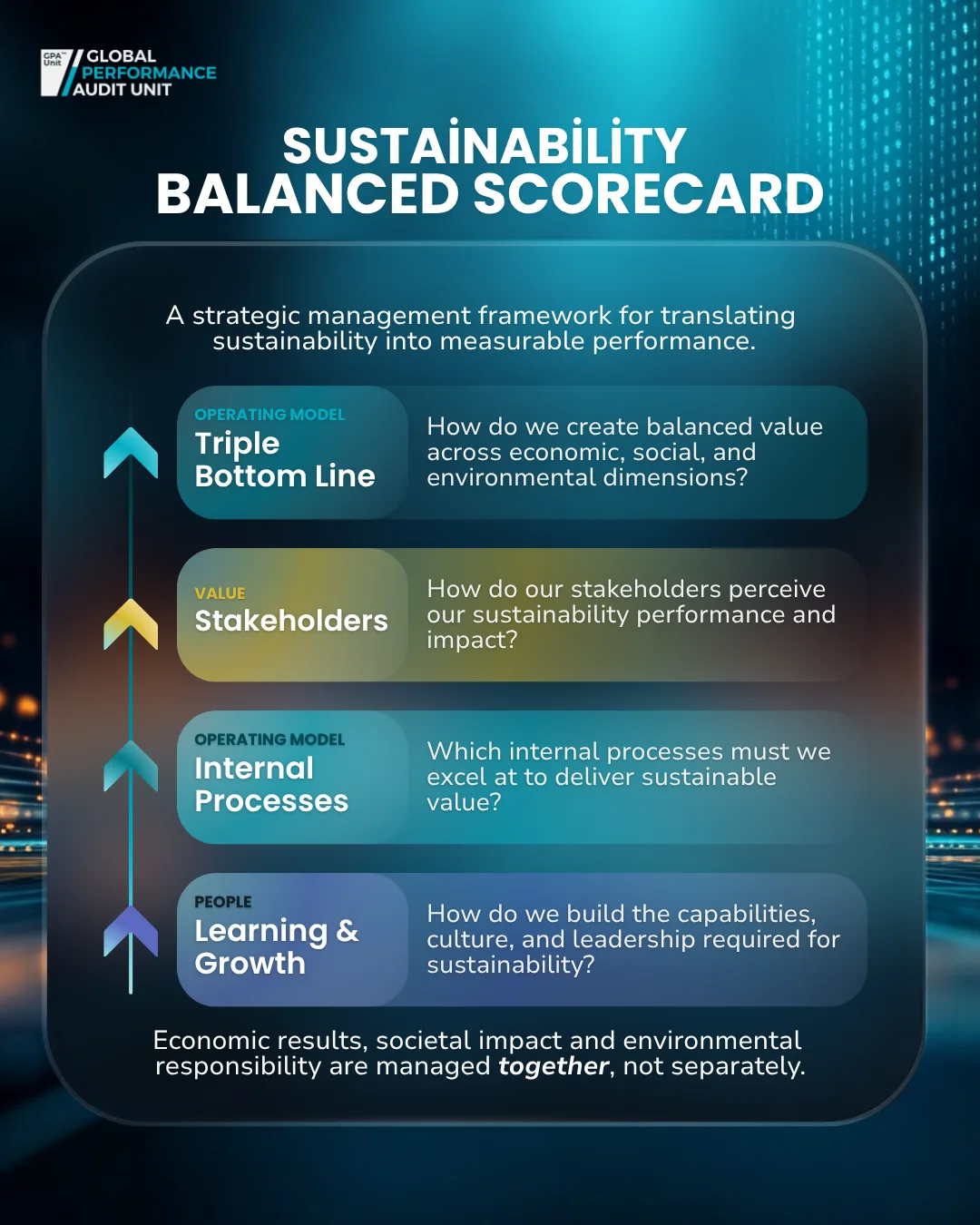
The Sustainability Balanced Scorecard integrates these dimensions into the process of strategy translation. Sustainability is not added at the end as a separate report, a symbolic commitment, or a polite fifth perspective that sits somewhere beside the “real” business. It becomes part of how the organization defines success, builds objectives, selects KPIs, assigns accountability, and reviews performance, thus transforming the ESG model from a communication tool to management architecture.
Triple Bottom Line becomes the broader operating model. Performance is understood through the balance between economic, social, and environmental outcomes. Profit still matters, of course. The point is not to replace business logic with good intentions, but to manage profit, social contribution, and environmental responsibility as connected parts of the same value creation model.
Stakeholders become the value perspective. The question expands from how customers perceive the organization to how employees, communities, regulators, investors, suppliers, partners, and customers experience its sustainability performance and impact. Their trust increasingly shapes long-term viability.
Internal Processes remain the execution engine. Procurement, production, logistics, innovation, governance, risk management, and performance review determine whether sustainability becomes real or stays nicely phrased. A sustainability strategy that does not change processes is usually just a statement with better formatting.
Learning and Growth remains the people and capability perspective. Sustainable value requires capabilities, culture, leadership, data, accountability, and decision-making maturity. Employees need to understand what sustainability means in their roles, and leaders need to manage the trade-offs behind long-term performance.
Managing sustainable value
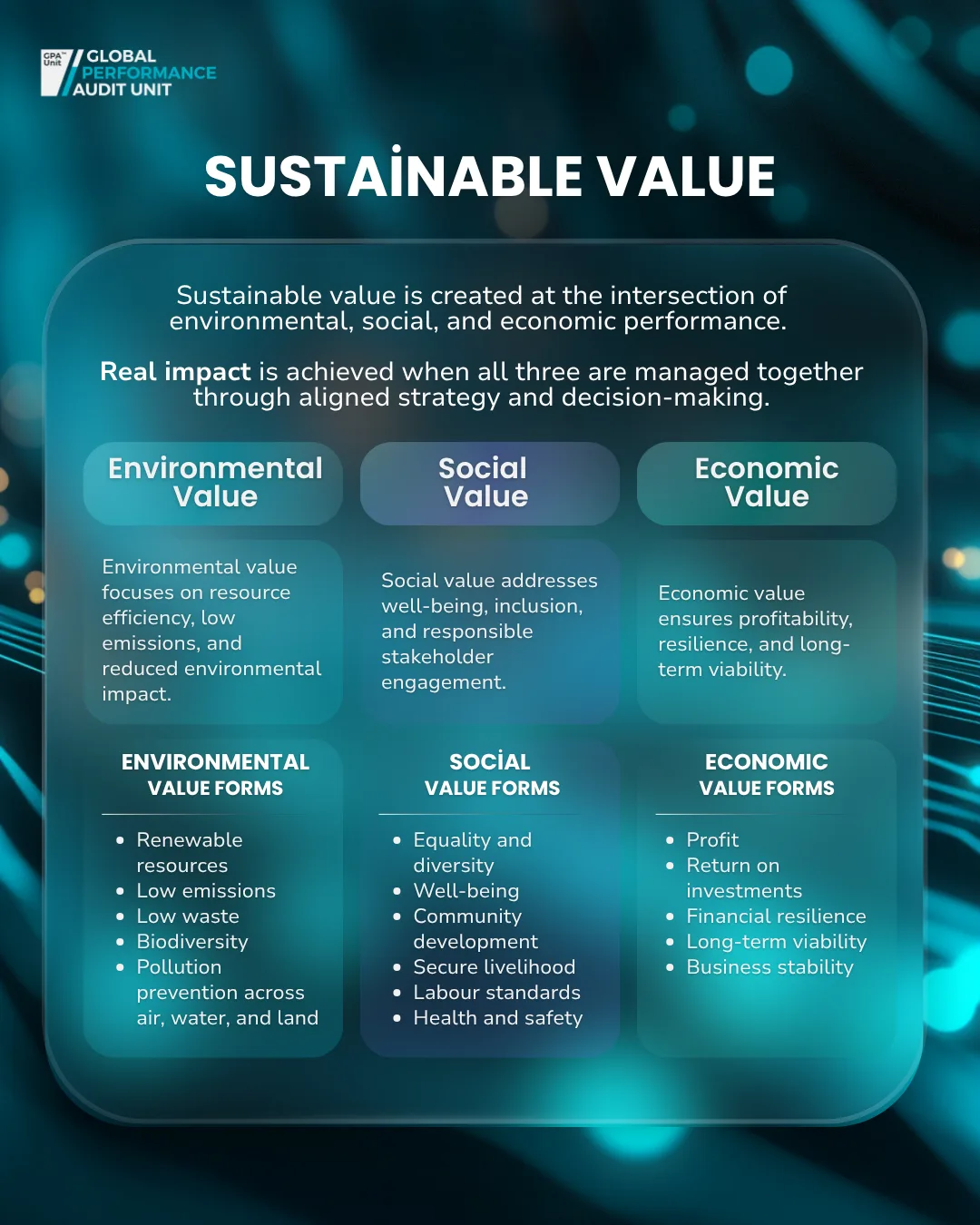
Managing the full value chain without losing sight of sustainability principles means creating the appropriate measurement instruments. In the context of the Balanced Scored, sustainable value means value created across three dimensions at the same time: economic, environmental, and social.
Economic value refers to profitability, resilience, and long-term viability. It includes profit, return on investment, financial stability, and business continuity. Without it, nothing else is sustained for very long.
Environmental value refers to the organization’s ability to reduce negative impact and use resources responsibly. It includes lower emissions, renewable energy use, waste reduction, biodiversity protection, and pollution prevention across air, water, and land.
Social value refers to the organization’s contribution to people and communities. It includes well-being, inclusion, equality and diversity, community development, secure livelihoods, labour standards, and health and safety.
The key point is that sustainable value only exists when all three dimensions are managed through the same strategy, scorecard, decisions and trade-offs.
Translating the triple bottom line into KPIs
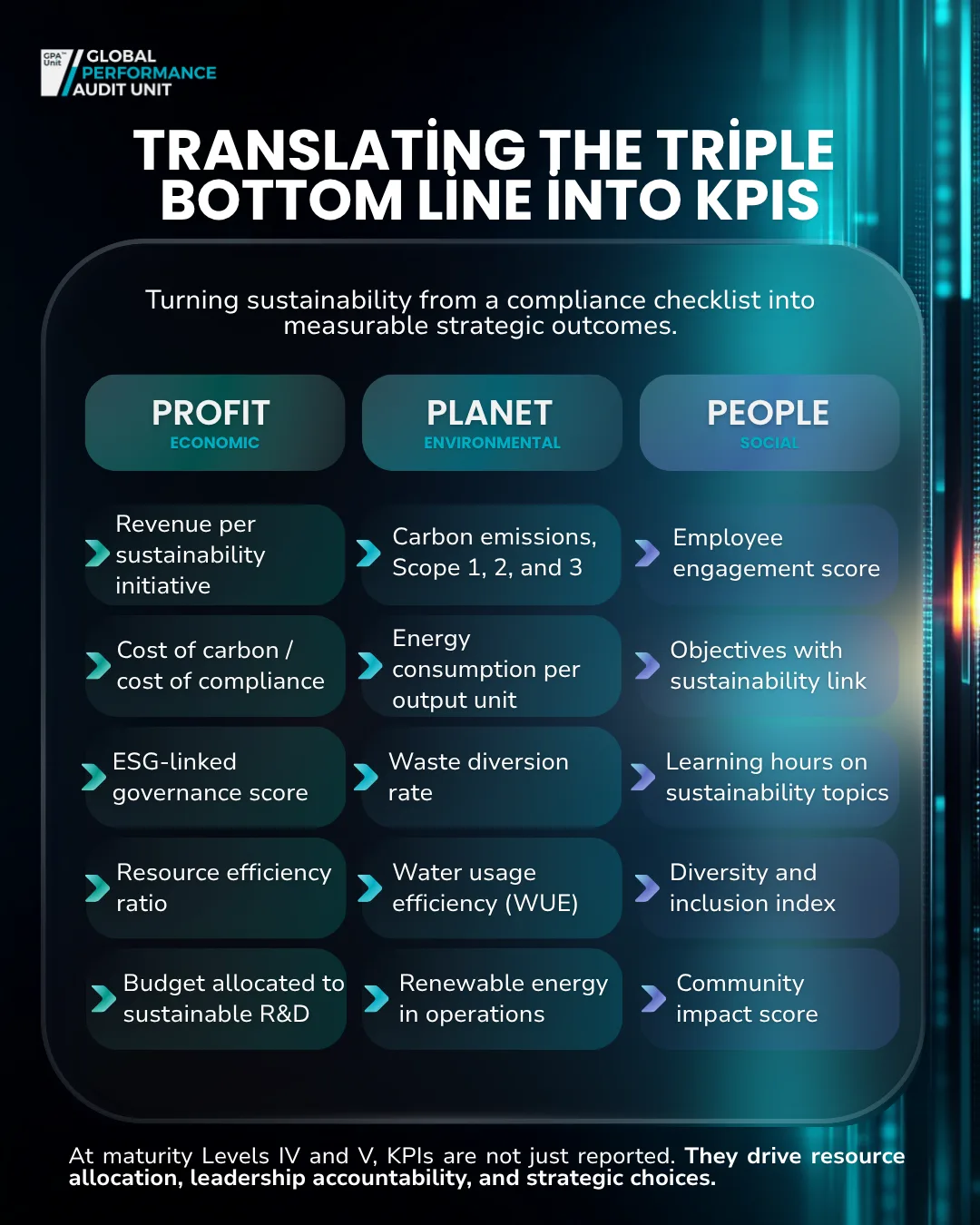
The Triple Bottom Line can be translated into KPIs across three connected dimensions.
Profit / Economic KPIs may include revenue per sustainability initiative, cost of carbon or compliance, ESG-linked governance score, resource efficiency ratio, or budget allocated to sustainable R&D. These indicators show whether sustainability is connected to financial viability, innovation, and long-term business value.
Planet / Environmental KPIs may include Scope 1, 2, and 3 carbon emissions, energy consumption per output unit, waste diversion rate, water usage efficiency, or renewable energy share. These indicators show whether the organization is reducing environmental impact in measurable, operational terms.
People / Social KPIs may include employee engagement score, percentage of objectives linked to sustainability, learning hours on sustainability topics, diversity and inclusion index, or community impact score. These indicators show whether sustainability is also reflected in the way the organization treats people, develops capabilities, and contributes to communities.
Of course, having these KPIs is not the same as managing through them, that is the maturity distinction. At lower maturity levels, sustainability KPIs are often collected, reported, and perhaps discussed once a year. They help the organization say what it has done. Useful, but limited.
At Levels IV and V, the role of KPIs changes. They are not only reported; they influence resource allocation, leadership accountability, operational priorities, and strategic choices. In other words, they stop being evidence for the report and start becoming instruments for management.
That is when sustainability measurement begins to look like performance management.
From compliance to conviction
Sustainability maturity, especially in the context of excellence, is built by the ability to use the concepts as part of how organizations think, decide, execute and adapt, thus moving from a compliance exercise to principle based accountability. What are the principles, then, that drive such accountability?
Sustainability foresight is the ability to anticipate ESG risks, stakeholder expectations, regulatory changes, and broader systemic shifts. Mature organizations do not wait for regulation to tell them what matters. They read the signals early and position themselves before external pressure becomes internal panic.
Disciplined sustainable execution is the ability to translate commitments into KPIs, targets, initiatives, budgets, and operational decisions. This is the less glamorous part, but usually the most important one. Sustainability becomes real when accountability, resources, and routines are aligned behind it.
Strategic resilience is the ability to absorb environmental, social, and regulatory shocks while maintaining performance and trust. It means having structures, processes, and stakeholder relationships strong enough to protect the organization when conditions change.
Adaptive sustainability maturity is the ability to continuously refine practices based on data, learning, and external change. Mature organizations do not treat sustainability frameworks as fixed templates. They adjust, improve, and evolve as the context evolves.
The important part is that these capabilities form a cycle. Foresight informs execution. Execution strengthens resilience. Resilience creates the conditions for adaptation. Adaptation then feeds back into better foresight.
Decisions or reports?
As mentioned above, principles and values are just as important when it comes to sustainability reporting, as scorecards and dashboards. The real shift in the vision of an organization happens when they decide to manage through sustainability, instead of measuring sustainability. That difference becomes visible in decisions. It appears when a supplier is reconsidered because the social risk is too high; or when an investment is redesigned because the environmental exposure changes the long-term business case. It can appear through leadership objectives including not only financial delivery but the quality and sustainability of the value created.
The real proof of maturity is not a better sustainability report, but a different management conversation.
Get our research first in Google Search and AI Mode.
Overall
Dr. Adrian Brudan Featured by GulfApex for Leadership in Performance Excellence
GulfApex has featured Dr. Adrian Brudan, CEO and Co-Founder of GPA Unit, in its Leadership Feature series.
GPA Unit Welcomes ALANSARI CONSULTING to Its Partner Network as an Associate Partner in the Kingdom of Bahrain
GPA Unit has welcomed ALANSARI CONSULTING as an Associate Partner in Bahrain, expanding access to internationally recognized, evidence-based strategy and performance assessments across Bahrain and the wider GCC.
How to Become a GPAU Employee Performance Management Accredited Assessor
The GPAU Employee Performance Management Assessor pathway develops professionals from certification to authorization and supervised client accreditation, building competence to assess how consistently organizations manage and improve employee performance.
GPA Unit Welcomes EFQM CONSULTING to Its Partner Network as an Associate Partner in the United Arab Emirates
GPA Unit has welcomed EFQM CONSULTING as an Associate Partner in the UAE, expanding access to internationally recognized, evidence-based strategy and performance maturity assessments across the market.
How to Become a GPAU Strategic Planning Accredited Assessor
How to Become a GPAU Strategic Planning Accredited Assessor The pathway to becoming an Accredited Assessor The GPAU assessor pathway provides a structured route from professional education to supervised assessment practice.