Home›Insights›How to Choose the Right Maturity Assessment
Login
Please wait...!
Insights
Overall
How to Choose the Right Maturity Assessment
A practical guide to selecting the right performance maturity assessment by matching its rigor, independence, and evidence requirements to the decision an organization needs to make.
by GPA Unit | 21 August 2026
| Share on
Contributing to national and global ambitions—such as Vision 2030, Vision 2040, and the EU’s 2050 Strategy—is a priority for governmental, semi-governmental, and private organizations worldwide. Achieving these ambitions requires robust systems for evaluating, structuring, and improving organizational performance.
However, the choice of maturity assessment should not depend solely on budget, organizational size, or the assumption that greater rigor is always better, but on the decision the assessment is expected to support.
Understanding the assessment spectrum
Organizations use performance management maturity assessments to understand the current state of their management systems, identify gaps against best practices, prioritize improvement initiatives, prepare for transformation, evaluate progress, compare capabilities across departments, and pursue external recognition.
The Global Performance Audit Unit (GPAU) provides a structured framework connecting strategy, measurement, improvement, culture, and employee performance across organizational, operational, and individual levels.
To address different organizational needs, the GPAU assessment portfolio provides a structured pathway from internal assessment to formal international recognition:
PerforAssess QuickScan: A comprehensive internal review conducted using GPAU’s assessment toolkit. It combines document-based evidence with internal validation and stakeholder input to establish a reliable baseline and prepare the organization for future third-party evaluation. The assessment typically takes one to two weeks per capability.
PerforAssess Diagnose: An expert-led maturity evaluation conducted by GPAU Accredited Assessors. Typically lasting one to two weeks per capability, it provides validated findings, assessor comments, an executive dashboard, priority recommendations, a high-level improvement roadmap, and a presentation of results.
PerforAssess Recognized: The most rigorous GPAU assessment option. For the Integrated Performance Maturity Framework, the process typically takes three to four months and combines document review, stakeholder surveys, and interviews, following principles aligned with ISO 19011:2018. It provides formal recognition, maturity certificates, and eligibility for the Performance Excellence Awards.
The Operations Performance Maturity Assessment can also be applied through these assessment options. Designed for business units, divisions, and departments, it provides a data-driven view of operational performance management practices, identifies capability gaps, and supports alignment between operational execution and corporate strategy.
Self-assessment versus expert-led diagnosis
QuickScan is valuable for developing orientation, establishing a common vocabulary, and preparing internal stakeholders. However, internal assessors operate within the system they are evaluating. This position provides important contextual knowledge but can also introduce several limitations:
Familiarity bias: Established practices may appear stronger because they are familiar.
Optimistic scoring: Teams may assess intended or partially implemented practices as if they were fully institutionalized.
Ownership bias: Process owners may find it difficult to evaluate systems they designed or currently manage.
Inconsistent interpretation: Different departments may interpret the same maturity criterion differently.
Evidence gaps: The existence of a policy may be treated as proof that the practice is consistently applied.
Political sensitivity: Internal assessors may hesitate to challenge senior stakeholders or expose cross-functional weaknesses.
Fragmented visibility: Individual functions may understand their part of the system without seeing how the different components work together.
Score fixation: Attention may shift toward achieving a preferred maturity score rather than understanding the causes of identified gaps.
These limitations do not make self-assessment inherently unreliable. They define the conditions under which the results should be treated as indicative rather than independently validated.
An expert-led Diagnose assessment becomes particularly valuable when an organization faces unexplained execution gaps, conflicting stakeholder perspectives, or a performance plateau despite having established policies and procedures. Independent assessors test formal processes against operational reality, introduce greater discipline into evidence review, provide a neutral interpretation of conflicting perspectives, and help leadership prioritize the improvements with the greatest potential impact.
The distinction is important. QuickScan helps the organization examine itself. Diagnose helps it identify issues that may be difficult to recognize—or address—from within.
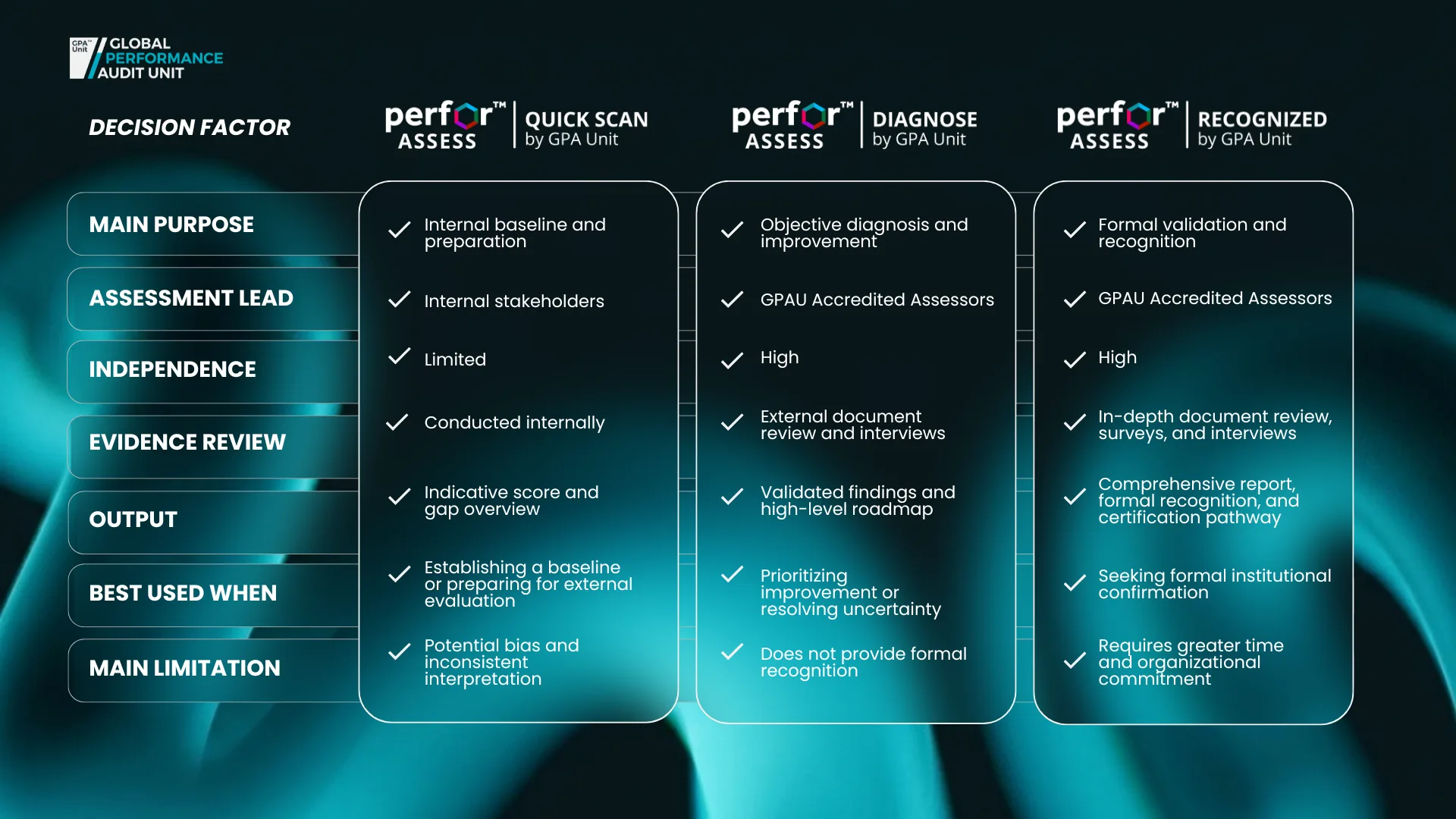
Comparing the assessment options
The following framework can help leadership select the most appropriate route:
The journey beyond recognition
Achieving recognition is an important milestone in an organization’s performance excellence journey. However, sustained transformation depends on the improvements implemented during subsequent cycles.
The GPAU framework distinguishes among three forms of institutional acknowledgment:
Recognized: An independent endorsement confirming the organization’s maturity level—from Level I to Level V—within the Integrated Performance Maturity Model. The evaluation is based on objective evidence, standardized criteria, and consistent scoring.
Certified: Issued by the GPAU Institute for Standards & Accreditation, certification confirms that organizations achieving Level IV or V comply with the relevant GPAU International Standards, including GPAU-IS 91.000:2025.
Awarded: The Performance Excellence Awards recognize organizations demonstrating excellence and innovation in strategy and performance management. Recipients are honored at the Performance Excellence Forum & Awards Gala, while Level V organizations may become eligible for induction into the Performance Excellence Hall of Fame. Award categories cover Strategic Planning, Performance Measurement, Performance Improvement, Performance Culture, Employee Performance Management, Integrated Performance, and Operations Performance.
Recognition is not the end of the process. GPAU also provides two reassessment pathways:
Quick Reassessment: Designed for organizations seeking rapid validation of improvements within six months of the initial Recognized Assessment. It focuses on implemented changes and measurable progress across selected or all assessed capabilities.
Standard Reassessment: Designed for organizations that have completed medium- or long-term improvement programmes. Conducted from six months after the initial recognition until six months before the next framework update, it provides a comprehensive evaluation of whether improvements have been sustained and institutionalized.
Both pathways allow organizations to validate progress, recalibrate their maturity profile, and maintain alignment with GPAU International Standards. However, reassessment does not automatically result in a higher score or maturity level. Advancement depends on evidence that improvements have been implemented and embedded across the organization.
Choosing the appropriate level of rigor
Choosing a maturity assessment is ultimately a strategic decision. Organizations should avoid using an internal assessment for high-stakes decisions that require independent evidence. Equally, they should avoid commissioning an extensive recognition assessment when a structured internal review or focused external diagnosis can answer the immediate question.
Before proceeding, leadership should consider five questions:
What decision will the assessment inform?
How independent do the results need to be?
Do we have qualified internal assessors?
Are we likely to recognize our own systemic weaknesses?
What do we need at the end: a baseline, an explanation, a roadmap, or formal recognition?
The answers point toward different assessment routes:
If the organization needs a structured internal baseline, QuickScan provides the appropriate starting point.
If it needs to understand hidden gaps and determine what to improve first, Diagnose provides an independent expert perspective.
If it needs formal confirmation of its maturity, certification, or award eligibility, Recognized provides the required rigor.
The most appropriate maturity assessment is not necessarily the most extensive one. It is the assessment whose level of rigor, independence, and evidence matches the importance of the decision that follows.
Get our research first in Google Search and AI Mode.
Overall
Dr. Adrian Brudan Featured by GulfApex for Leadership in Performance Excellence
GulfApex has featured Dr. Adrian Brudan, CEO and Co-Founder of GPA Unit, in its Leadership Feature series.
GPA Unit Welcomes ALANSARI CONSULTING to Its Partner Network as an Associate Partner in the Kingdom of Bahrain
GPA Unit has welcomed ALANSARI CONSULTING as an Associate Partner in Bahrain, expanding access to internationally recognized, evidence-based strategy and performance assessments across Bahrain and the wider GCC.
How to Become a GPAU Employee Performance Management Accredited Assessor
The GPAU Employee Performance Management Assessor pathway develops professionals from certification to authorization and supervised client accreditation, building competence to assess how consistently organizations manage and improve employee performance.
GPA Unit Welcomes EFQM CONSULTING to Its Partner Network as an Associate Partner in the United Arab Emirates
GPA Unit has welcomed EFQM CONSULTING as an Associate Partner in the UAE, expanding access to internationally recognized, evidence-based strategy and performance maturity assessments across the market.
How to Become a GPAU Strategic Planning Accredited Assessor
How to Become a GPAU Strategic Planning Accredited Assessor The pathway to becoming an Accredited Assessor The GPAU assessor pathway provides a structured route from professional education to supervised assessment practice.