Home›Insights›Is Your Performance Management System Ready for AI?
Login
Please wait...!
Insights
Integrated Performance
Is Your Performance Management System Ready for AI?
An exploration of new research connecting the field of performance management to AI readiness
by GPA Unit | 06 August 2026
| Share on
AI is entering performance management through familiar use cases, including appraisal summaries, feedback drafting, performance dashboards, rating support, and predictive analytics. These applications may save time, but they also carry a risk: when the existing performance management system is fragmented or limited to HR, AI can scale those limits rather than solve them.
For decades, most organizations (and most academic articles) have placed performance management in the HR function, where it has become closely associated with appraisal cycles, rating scales, employee development plans, and annual reviews. As AI is added to these processes, many organizations may simply automate the part of performance management that is already most visible.
But, as always, practice isn’t that simple. Leaders should not begin AI adoption by asking, “Where can we use AI?” but should ask, “Which part of our performance management system needs to improve, and what outcome should change?”
That question is relevant to government entities and companies across the GCC, where performance management must connect strategy, operations, people, data, and accountability, and an overall national Vision. AI can support that connection, but only when performance management is treated as an organizational discipline rather than an HR process.
Performance management is broader than employee appraisal
Public and private organizations operate under different conditions. Companies answer to customers, owners, and markets, while government entities answer to citizens, mandates, budgets, regulatory requirements, and public accountability. The management requirements beneath those differences are similar, though. Both types of organization need to:
set a clear direction and turn it into objectives;
measure progress through reliable data;
use measurement to improve operations;
plan, assess, and support individual performance;
build a culture in which people take ownership of results.
The operating environment changes, but these management tasks remain. Both public and private organizations need to connect strategic priorities with operational work and individual contributions.
The public sector has worked with this principle for several decades through New Public Management. The model encouraged public organizations to focus on efficiency, effectiveness, service quality, performance standards, and outcome-based evaluation, drawing some management practices from the private sector.
New Public Management did not settle where performance management should sit inside an organization, though, and this remains part of the problem. In many organizations, strategy is managed by one function, performance measurement by another, operational improvement somewhere else, and employee performance by HR, yet performance management as a discipline is still broadly associated with HR.
The system that should connect these areas is often divided among them.
AI can reinforce the existing structure
When AI enters performance management only through HR workflows, it is likely to focus on activities such as writing employee objectives, summarizing feedback, preparing appraisals, recommending ratings, or identifying development needs. These uses may improve the speed of the process, and some may improve its quality. They do not automatically improve the wider performance management system.
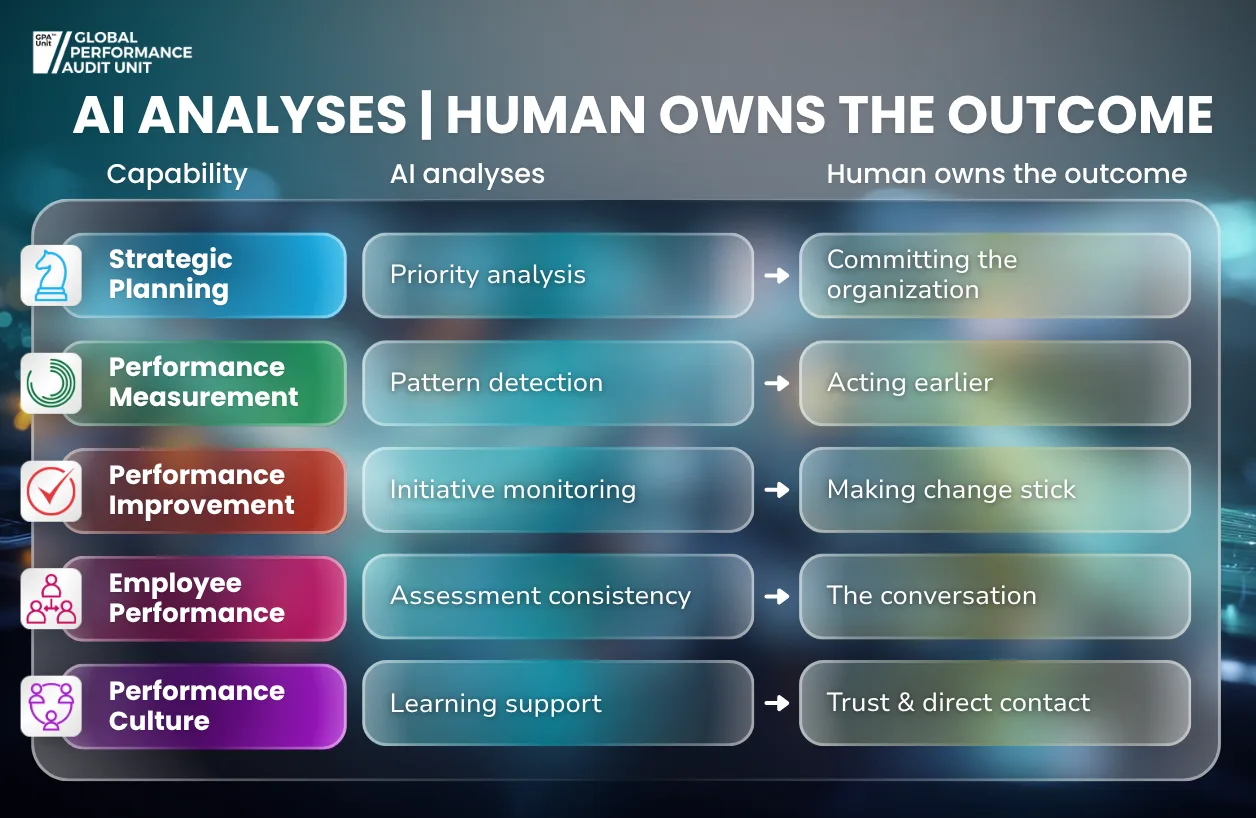
This is why GPA Unit never treats employee performance management as another name for performance management, but as one capability within a wider organizational system.
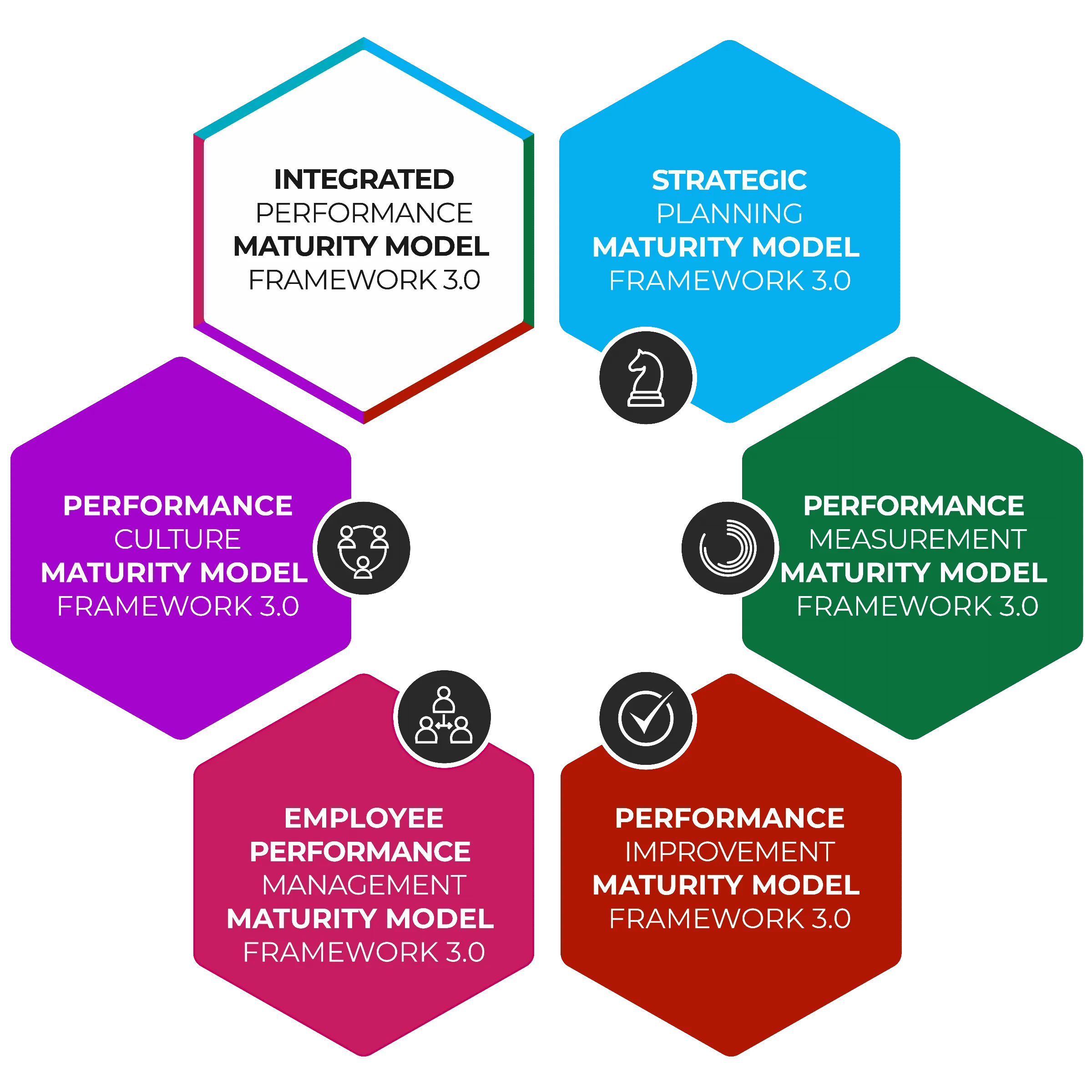
The Integrated Performance Management Maturity Assessment Framework includes five connected capabilities:
Strategic planning: setting direction, defining priorities, and connecting long-term goals with operational reality.
Performance measurement: collecting, validating, analysing, and communicating data that supports decisions.
Performance improvement: identifying performance gaps, analysing their causes, managing improvement initiatives, and learning from results.
Performance culture: shaping the leadership practices, behaviours, communication, trust, and ownership that influence how people respond to performance information.
Each capability uses different data, works through different management cycles, and carries different risks. AI should therefore be assessed separately within each capability, rather than introduced as one general performance management solution.
Six conditions for AI-ready Performance Management
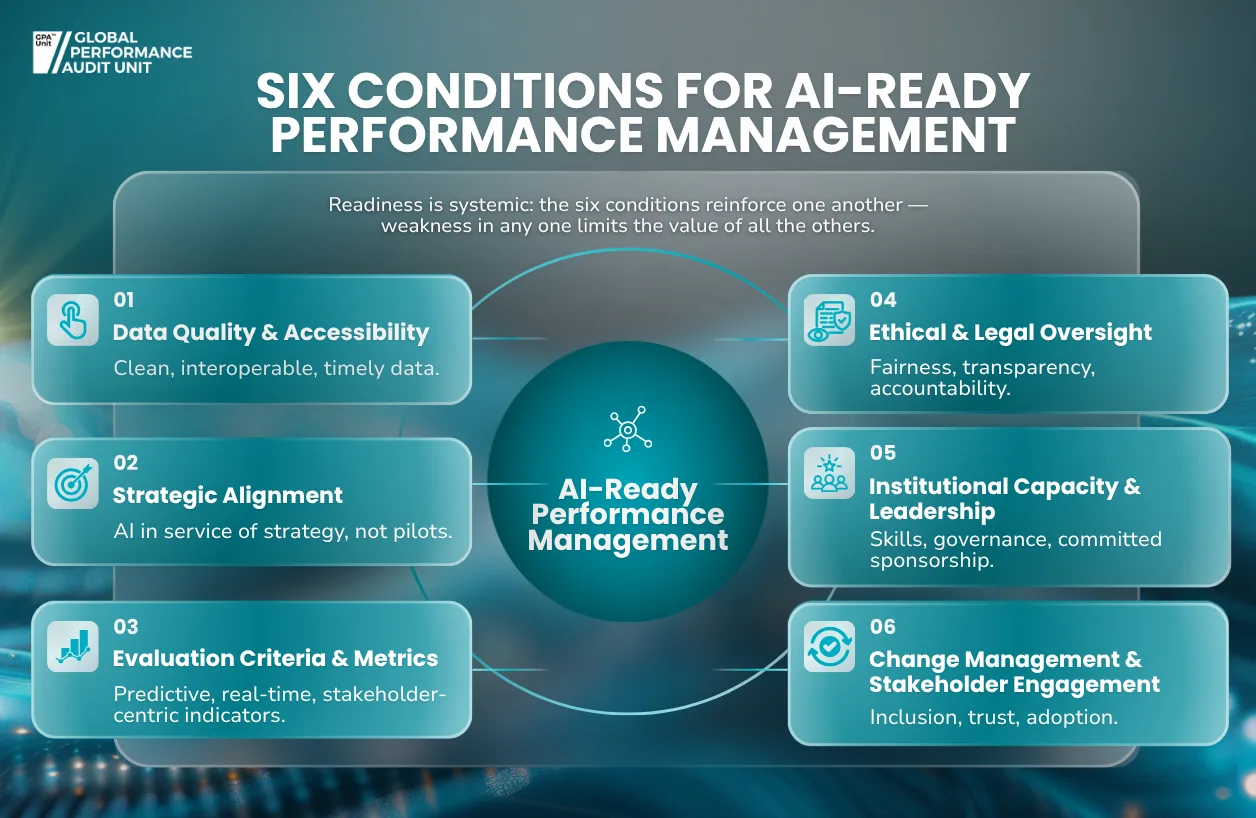
A 2025 scoping review by Godfrey Maake and Cecile Schultz examined 22 peer-reviewed empirical studies published between 2015 and 2025. The research focused on the use of AI in local-government performance management and identified six interdependent factors associated with successful implementation.
1. Data quality and accessibility
AI depends on accurate, timely, accessible, and interoperable data. When data is incomplete, inconsistent, held in separate systems, or collected through unclear processes, AI may produce misleading analysis.
AI readiness therefore starts with data management, not with model selection. Leaders need to know where performance data comes from, who owns it, how it is validated, and whether different systems can exchange it.
2. Strategic alignment with performance goals
AI use cases should support an agreed strategic priority or performance objective. They should not operate as isolated pilots with no direct link to the organization’s planning and monitoring processes.
This means that leaders need to connect each AI use case with a strategic objective, KPI, service target, improvement priority, or management decision. The review found that this connection helps prevent fragmented initiatives and keeps AI outputs linked to long-term performance goals.
3. Evaluation criteria and metrics
AI changes what organizations can measure and how often they can measure it. It may support real-time indicators, predictive measures, anomaly detection, and analysis of patterns that would be difficult to identify manually.
More data does not automatically lead to better performance measurement, though. Leaders still need to decide which indicators matter, how they relate to outcomes, and how they will be used in decisions.
The research points to the need for predictive, real-time, and stakeholder-focused measures that show the value created by AI rather than simply recording system activity.
4. Ethical and legal oversight
AI-supported decisions require clear rules for fairness, accountability, transparency, privacy, and human review. These questions become more sensitive when AI affects employee evaluation, access to public services, resource allocation, or decisions with legal and social consequences.
An organization should be able to explain what information the system uses, how recommendations are produced, who reviews them, and who remains accountable for the final decision.
Efficiency alone is not an adequate test. AI-supported performance management also needs to be seen as fair and legitimate by the people affected by it.
5. Institutional capacity and leadership
Technology cannot compensate for limited management capability. Organizations need people who can read AI outputs, question their assumptions, connect them with operational knowledge, manage related risks, and act on the findings.
The research also points to the role of governance structures, digital infrastructure, leadership support, and internal knowledge. Without these conditions, AI adoption can remain symbolic, with tools and pilots in place but little measurable change in performance.
6. Change management and stakeholder engagement
AI changes workflows, responsibilities, decision rights, and sometimes the relationship between managers, employees, service users, and data. People need to know why the system is being introduced, how it will affect their work, and where human judgment will remain.
Stakeholder involvement should continue through design, implementation, monitoring, and evaluation. The review found that participation can support trust and adoption, while exclusion from algorithmic decision-making may weaken legitimacy.
My reading of these six factors is that AI-enabled performance management is an enterprise issue. Data governance, strategy, metric design, ethics, leadership, and organizational change cannot be owned by HR alone.
The research did not set out to make that argument, but the factors it identified extend across functions and management levels.
Research limitations
The study provides a useful structure, but it's important to note that it is a scoping review of local-government research, not a statistical assessment of AI’s effect on organizational performance.
The authors also note several limitations. The study relied on secondary evidence, included English-language peer-reviewed publications, did not cover every academic database, and found uneven geographic representation. It therefore identifies common factors across the reviewed studies, but it does not prove that every factor will operate in the same way in every sector or country. That is where future research can contribute to offering a bigger picture.
The benefits of applying a maturity lens in AI readiness
AI tends to magnify what is already present. It can support a well-managed process, but it can also accelerate fragmented reporting, weak measurement, unclear accountability, and poor decisions.
This is where a performance maturity assessment becomes useful.
The GPAU Maturity Model Framework assesses five capabilities: Strategic Planning, Performance Measurement, Performance Improvement, Employee Performance Management, and Performance Culture. Each capability is assessed on a common five-stage scale from Initial to Leading, while also examining alignment across organizational, operational, and individual levels.
The purpose is to identify where AI can support an existing strength and where basic management conditions need attention first.
Probing questions for AI use cases
Organizations and performance managers should ask some probing questions before introducing AI into any performance management process. Some of these can be:
1. What performance problem are we solving?
Name the current constraint and the result that needs to change. Starting with a defined problem reduces the risk of selecting use cases simply to demonstrate AI activity.
2. Is AI the right solution?
A process change, clearer policy, better data, a simpler digital tool, or stronger management practice may solve the problem more effectively.
3. Which performance capability does the use case support?
Identify whether the use case belongs to strategic planning, performance measurement, performance improvement, employee performance management, or performance culture, then assign clear ownership.
4. What is the baseline, and how will success be measured?
Measure the current process before implementation. Define success through outcomes such as time, cost, quality, service experience, decision accuracy, risk, employee experience, or operational performance.
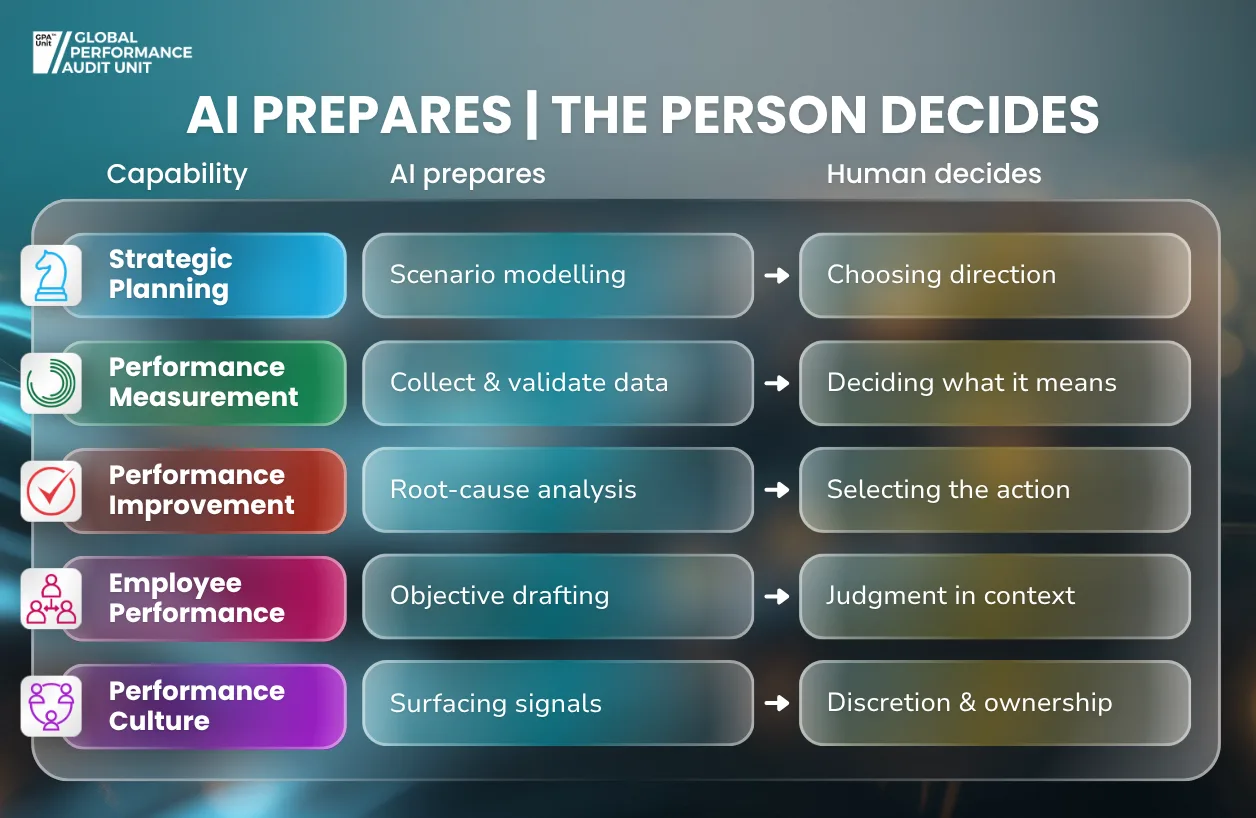
5. Where must human judgment remain?
Define which decisions AI may support and which decisions must remain with accountable leaders and managers, particularly where values, employee evaluation, public accountability, or stakeholder rights are involved.
6. Have the people affected by the system been involved?
Managers, employees, technical teams, data owners, policy owners, and external stakeholders may read the same use case differently. Their participation can identify practical risks before those risks become part of the system.
Judge AI by the performance it improves
The central question is not whether an organization uses AI in performance management but whether AI improves the performance management system.
Organizations that apply AI only to appraisals may gain a more efficient HR process, but the wider system can remain fragmented. Organizations that connect AI with strategy, measurement, improvement, employee performance, and culture have a better chance of producing measurable value.
This requires shared ownership across the organization, supported by reliable data, clear metrics, ethical oversight, capable leadership, and active stakeholder involvement.
AI may help organizations see their performance system more clearly, but leaders still need to decide what should improve, how success will be measured, and which human responsibilities should remain. That is where AI readiness starts, and it is also what performance management maturity is meant to assess.
Get our research first in Google Search and AI Mode.
Employee Performance Management
From Level 1 to Level 2 in Employee Performance Management: A Roadmap
Moving from Level 1 to Level 2 in Employee Performance Management marks the transition from fragmented, reactive practices to a more structured and consistent system.
GPA Unit Welcomes ALANSARI CONSULTING to Its Partner Network as an Associate Partner in the Kingdom of Bahrain
GPA Unit has welcomed ALANSARI CONSULTING as an Associate Partner in Bahrain, expanding access to internationally recognized, evidence-based strategy and performance assessments across Bahrain and the wider GCC.
How to Become a GPAU Employee Performance Management Accredited Assessor
The GPAU Employee Performance Management Assessor pathway develops professionals from certification to authorization and supervised client accreditation, building competence to assess how consistently organizations manage and improve employee performance.
GPA Unit Welcomes EFQM CONSULTING to Its Partner Network as an Associate Partner in the United Arab Emirates
GPA Unit has welcomed EFQM CONSULTING as an Associate Partner in the UAE, expanding access to internationally recognized, evidence-based strategy and performance maturity assessments across the market.