Home›Insights›Maturity Outlook 2026: Early Findings from GCC Organizations
Login
Please wait...!
Insights
Employee Performance Management
Maturity Outlook 2026: Early Findings from GCC Organizations
The 2026 Maturity Outlook research covers five areas that form part of the wider strategy and performance management system.
by GPA Unit | 16 November 2026
| Share on
GPA Unit continuously collects data on organizational maturity across five interconnected areas: Strategic Planning, Performance Measurement, Performance Improvement, Employee Performance Management and Performance Culture.
Each year, the main findings are consolidated into the Strategy & Performance Maturity Outlook Research Series. The 2026 edition focuses on organizations across the GCC region.
The 2026 research covers five areas that form part of the wider strategy and performance management system.
Strategic Planning looks at how organizations define direction, priorities and objectives.
Performance Measurement examines how performance is translated into indicators, targets and monitoring practices.
Performance Improvement looks at how organizations respond to results and translate information into action.
Employee Performance Management examines how individual performance is managed, reviewed and developed.
Performance Culture looks at the wider environment in which expectations, accountability, recognition and improvement take place.
The research looks at more than overall maturity in the region, as it also examines differences between sectors, associations between management practices, and the characteristics that appear more frequently among higher-maturity organizations.
The full findings will be presented during the Performance Excellence Digital Forum on 9 December 2026, where Cristina Mihăiloaie, Director of the GPAU Center for Research & Innovation, will deliver the session “Maturity Outlook 2026: Where Organizations Stand”, from 12:40 to 13:00 Riyadh time.
Ahead of the launch, several findings from the research already show clear differences in how organizations plan, manage performance and support employee development.
Four findings from the 2026 research
1. Strategic planning is concentrated within a one-to-three-year horizon
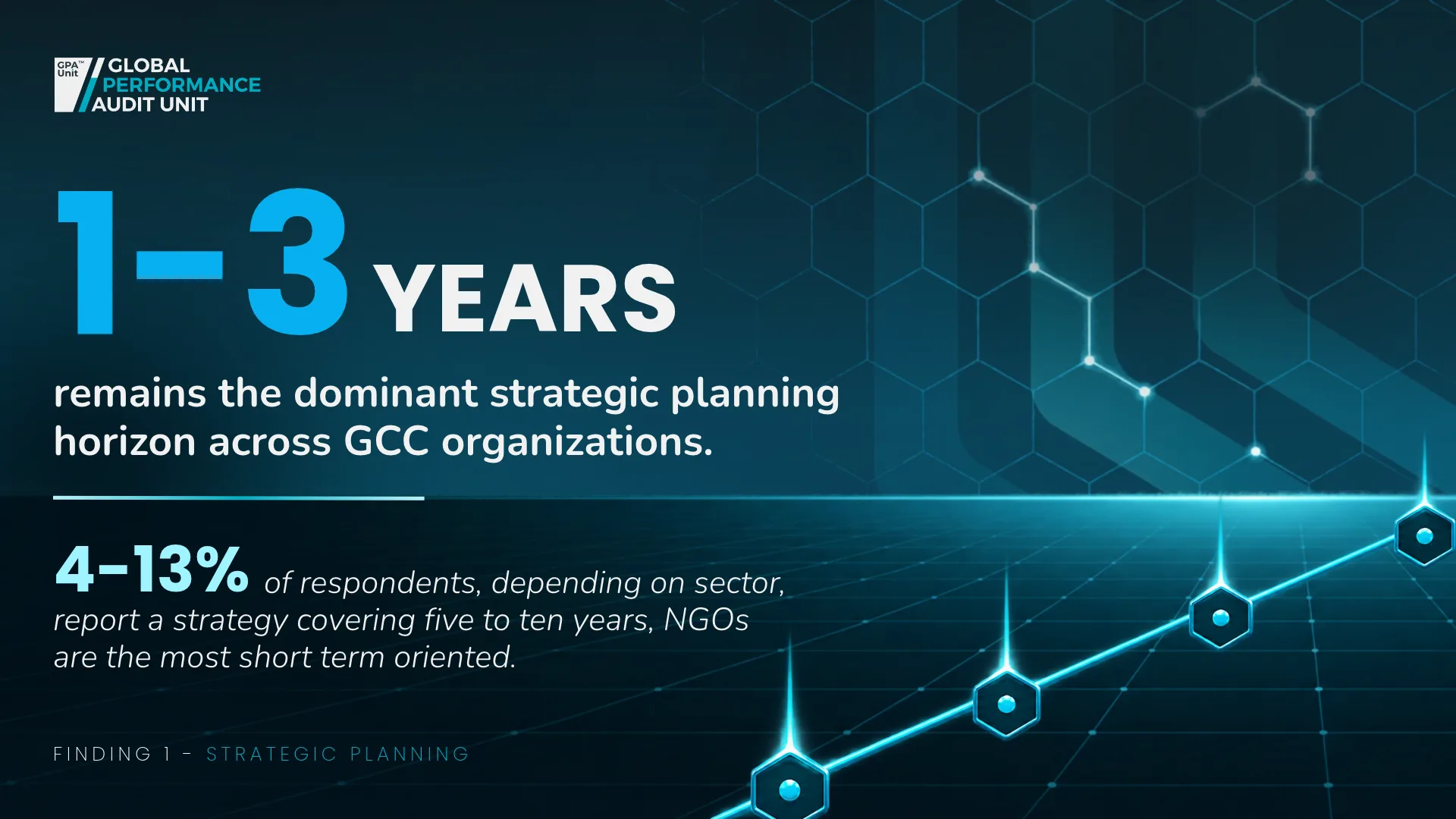
Across respondents, one to three years is the most common strategic planning timeframe. The pattern changes when the data is reviewed by sector, with NGOs showing the strongest short-term orientation. Longer planning horizons remain relatively uncommon in the public and private sectors as well, where only 4% to 13% of respondents report having a strategy covering five to ten years.
The data therefore shows a clear concentration around shorter strategic cycles, while planning beyond five years represents a relatively small share of responses. It also illustrates why sector-level analysis matters: organizations operating in different contexts may show different planning patterns even when they are part of the same regional sample.
2. Top-tier organizations report a more balanced strategic focus
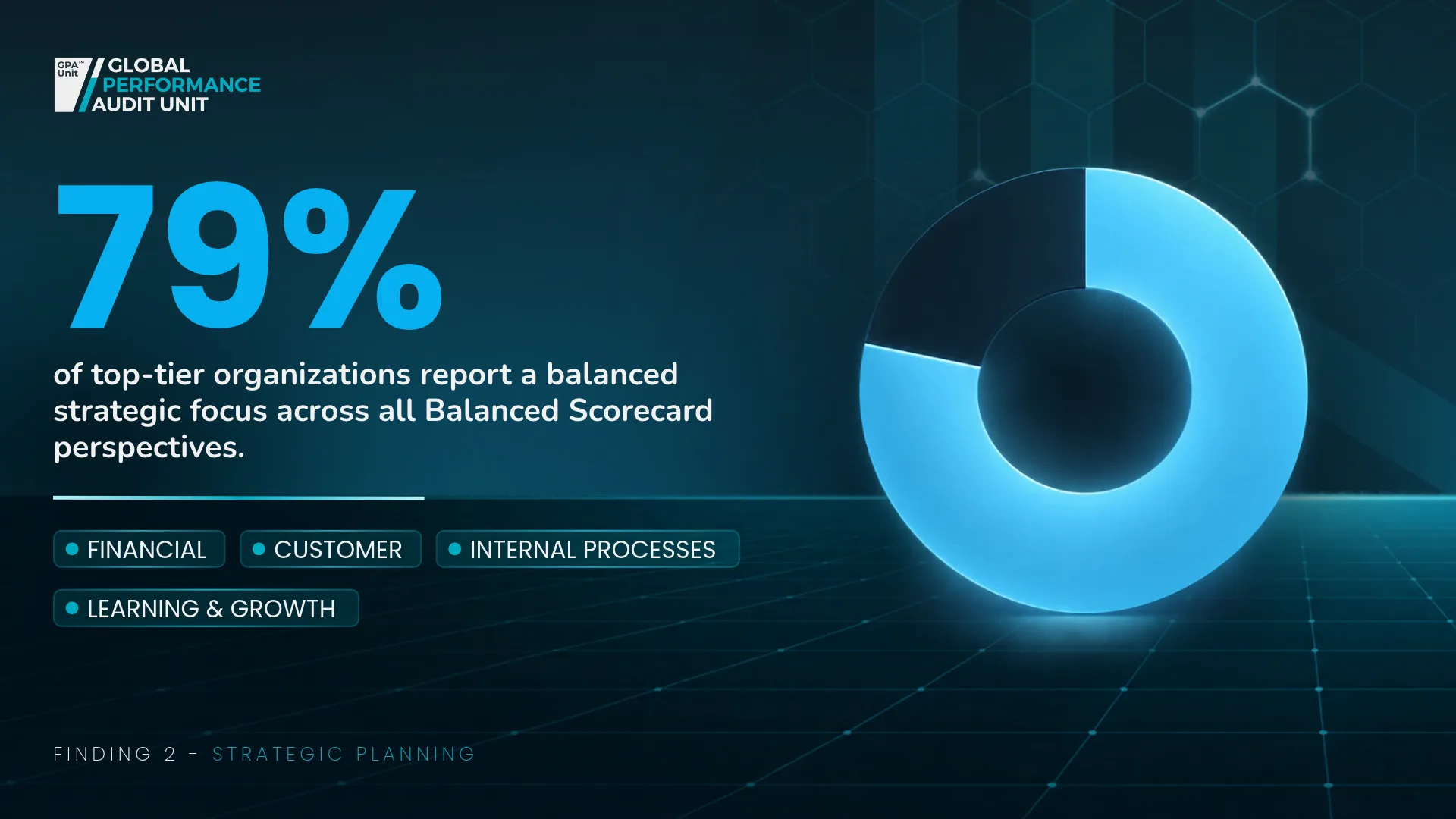
The research also examines what organizations prioritize within their strategic plans. Financial outcomes and internal operations remain central, but organizations increasingly need to account for customers, stakeholders, people and organizational capabilities at the same time. Among top-tier organizations in the study, 79% report a balanced focus across all Balanced Scorecard areas.
This distinguishes balanced planning from strategies that concentrate mainly on one area, such as financial performance or internal operations. In the study, top-tier organizations are more likely to distribute strategic attention across the different areas required for implementation, rather than managing these priorities separately.
3. Development-focused performance systems are associated with frequent manager dialogue
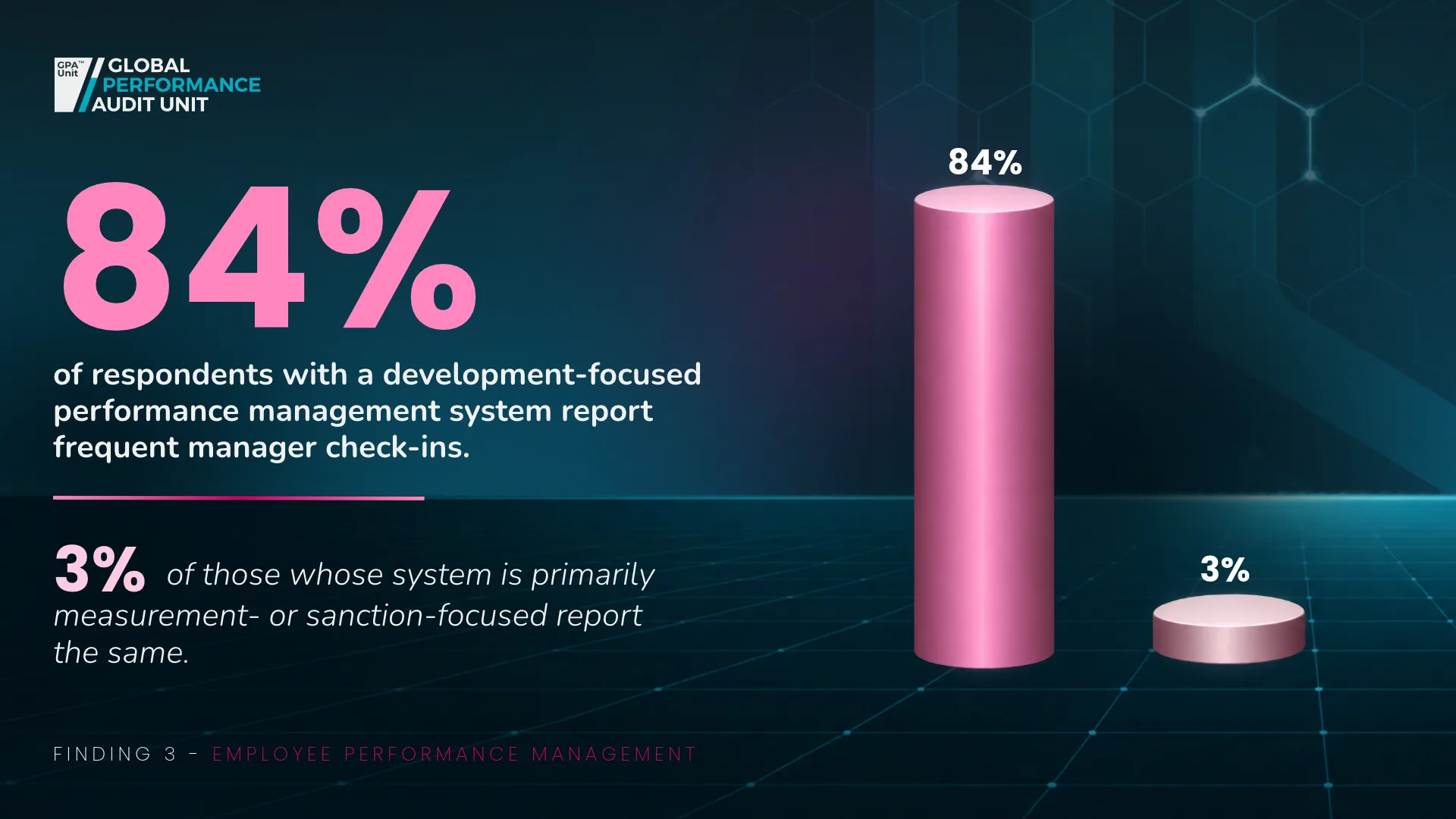
One of the clearest differences appears in Employee Performance Management. Among respondents who describe their performance management system as focused on continuous feedback and development, 84% also report frequent manager check-ins. Among respondents who describe the system as primarily measurement- or sanction-focused, only 3% report frequent manager check-ins.
The employee experience of performance management is therefore closely associated with the frequency of manager conversations throughout the year. Formal reviews, objectives and ratings remain part of the system, but respondents who experience performance management as developmental are much more likely to report regular dialogue with their managers.
The contrast is particularly clear:
84% — continuous feedback and development + frequent manager check-ins;
3% — measurement- or sanction-focused system + frequent manager check-ins.
4. Mentoring is strongly associated with perceived support for skill development
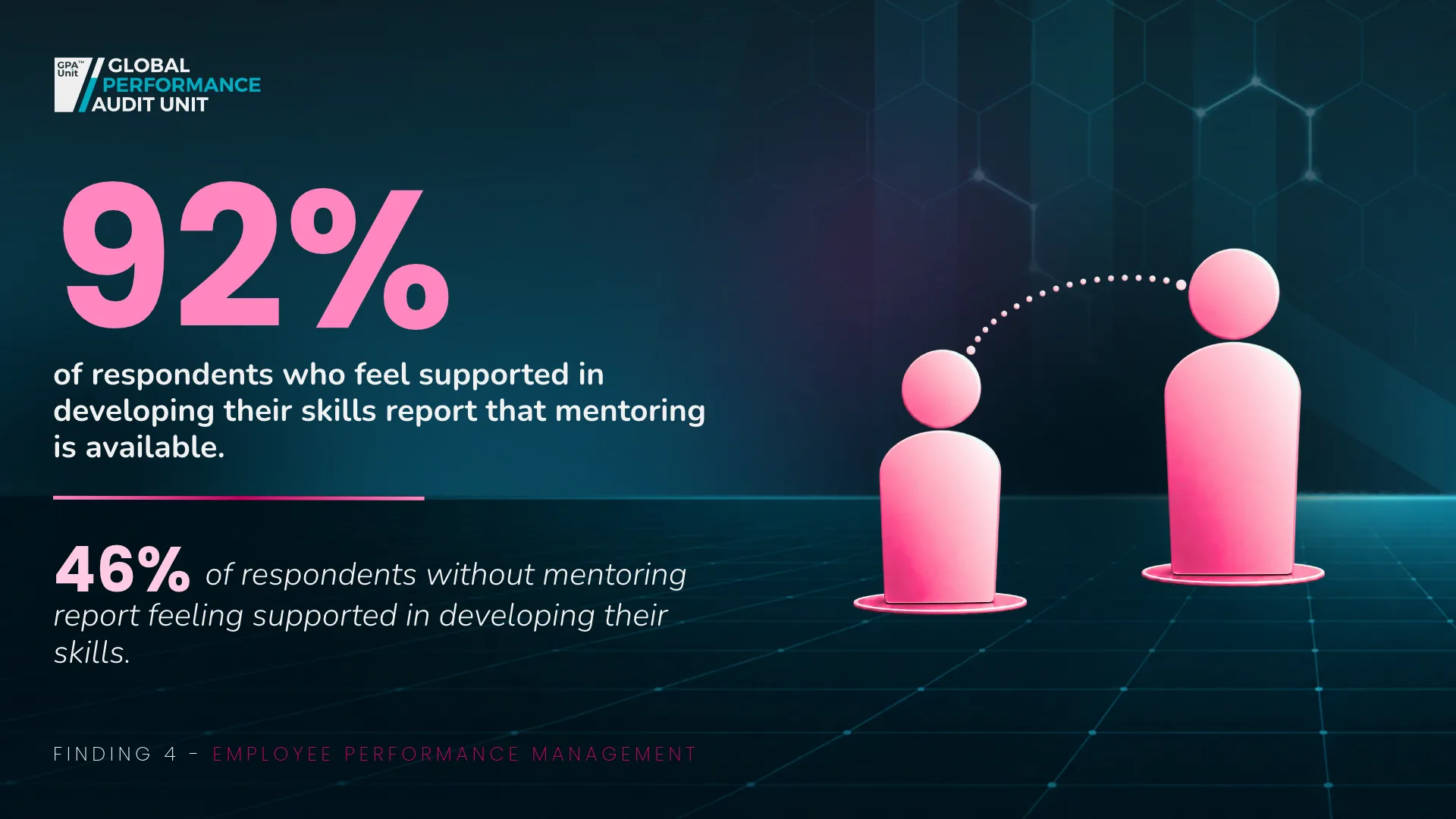
The research also looks at associations between practices that are often managed separately. Among respondents who feel supported in developing their skills, 92% also report having mentoring in place. Among respondents without mentoring, 46% report feeling supported in building their skills.
The data does not establish causation, but it shows a clear association between mentoring and employees’ perception that the organization supports their development. This is particularly relevant because mentoring is not always introduced specifically as a skill-building mechanism; it may also support career development, knowledge transfer, engagement, onboarding or leadership development.
The difference can be summarized simply:
92% of respondents who feel supported in skill development also report mentoring;
46% of respondents without mentoring report feeling supported in skill development.
Data collection for the next edition is already open
While the 2026 findings are being prepared for publication, GPA Unit has already opened data collection for the 2026/2027 edition of the research. Organizations and professionals can participate through the GPAU Center for Research & Innovation surveys:
Get our research first in Google Search and AI Mode.
Overall
From Workflow to System: The Operational Maturity Threshold
Operational challenges rarely emerge as sudden failures. Instead, they develop gradually through small inefficiencies, recurring issues, fragmented information, and competing priorities that quietly accumulate over time.
From Level 1 to Level 2 in Employee Performance Management: A Roadmap
Moving from Level 1 to Level 2 in Employee Performance Management marks the transition from fragmented, reactive practices to a more structured and consistent system.
GPA Unit Welcomes ALANSARI CONSULTING to Its Partner Network as an Associate Partner in the Kingdom of Bahrain
GPA Unit has welcomed ALANSARI CONSULTING as an Associate Partner in Bahrain, expanding access to internationally recognized, evidence-based strategy and performance assessments across Bahrain and the wider GCC.
How to Become a GPAU Employee Performance Management Accredited Assessor
The GPAU Employee Performance Management Assessor pathway develops professionals from certification to authorization and supervised client accreditation, building competence to assess how consistently organizations manage and improve employee performance.