Home›Insights›National, Global and Specialized Excellence Frameworks: What Is the Difference?
Login
Please wait...!
Insights
Overall
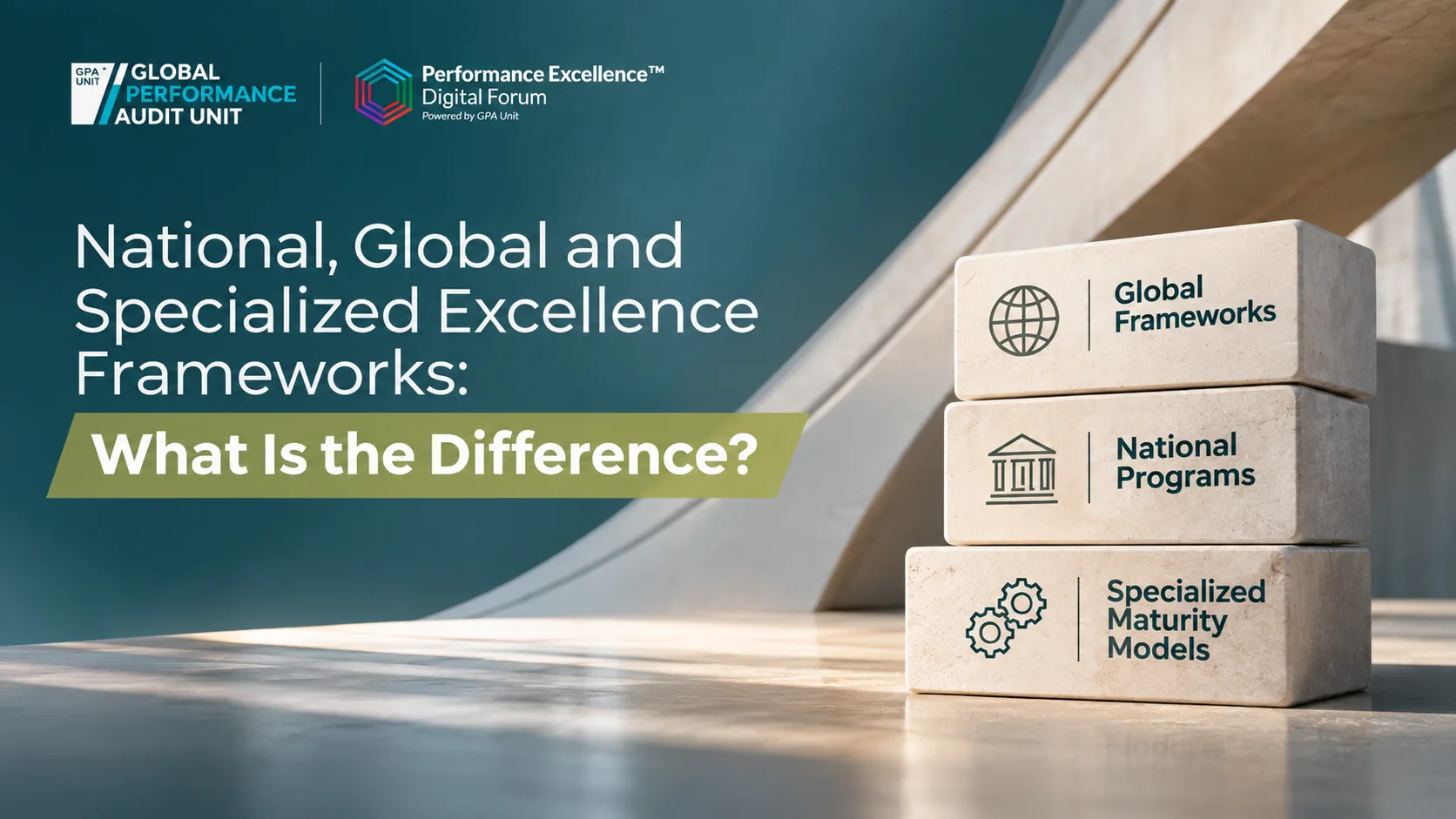
National, Global and Specialized Excellence Frameworks: What Is the Difference?
The research comparison looks across international excellence models, national excellence programs and specialized maturity frameworks to clarify these differences.
by GPA Unit | 16 November 2026
| Share on
Organizations looking to assess and improve performance can choose from a wide range of excellence frameworks, maturity models and recognition programs. They are often discussed together, but they do not necessarily assess the same capabilities or produce the same type of outcome. A comparison of several established approaches such as EFQM, the Malcolm Baldrige framework, PMI and Axelos maturity models, Balanced Scorecard-based strategy maturity models, and national excellence programs in the UAE, Saudi Arabia, Qatar and Jordan, shows three broad differences: the scope of the assessment, the context in which the framework is applied, and whether the primary outcome is diagnosis, improvement, recognition, or a combination of these.
These distinctions will also provide the starting point for a panel at the Performance Excellence Digital Forum on 9 December 2026, moderated by Dr. Teodora Gorski, Head of Strategic Partnerships & Growth at GPA Unit. Her work spans strategy and performance management, sustainability, artificial intelligence and organizational culture, with more than 25 publications covering strategy, leadership, sustainability, education and performance practices.
Assessment, recognition, excellence and maturity frameworks are often discussed together, although they do not always serve the same purpose or assess the same capabilities. The following FAQs clarify the main differences in scope, application and expected outcomes, as well as the areas where national, global and specialized frameworks may overlap.
FAQ 1. What types of assessment and excellence frameworks are available?
The frameworks included in the comparison can be grouped into three broad categories. Each addresses organizational performance from a different starting point.
Organizational excellence frameworks assess the organization across several dimensions. EFQM, for example, covers areas such as purpose and strategy, organizational culture and leadership, stakeholder engagement, performance and transformation. National excellence programs also tend to take a broad institutional view, covering combinations of leadership, strategy, services, innovation, operations and results.
Management capability maturity models examine a specific management capability in greater depth. PMI's OPM3 and Axelos' P3M3, for example, focus on the maturity of project, programme and portfolio management.
Strategy and performance maturity models focus more specifically on how organizations formulate, execute and manage strategy and performance. Balanced Scorecard-based maturity models examine areas such as strategic thinking, strategy maps, KPIs and initiatives, while integrated performance maturity models extend the assessment across connected performance management capabilities.
The question answered by each type of framework is therefore different. An organizational excellence model may ask how the organization performs as a whole, while a project maturity model asks how consistently project management capabilities are defined and applied. A strategy maturity assessment focuses instead on the systems used to formulate and execute strategy.
FAQ 2. What is the difference between national and global frameworks?
One distinction is the context for which the framework has been designed.
Internationally applied frameworks provide a common assessment structure that can be used across multiple organizations and, in some cases, across sectors and geographies. EFQM, for example, is designed for organizations across the public, private and nonprofit sectors and combines organizational assessment with formal recognition pathways.
National programs operate within a defined country or institutional environment. The comparison includes the Dubai Government Excellence Program, King Abdulaziz Quality Award in Saudi Arabia, Qatar Government Excellence Award and King Abdullah II Award for Excellence in Government Performance and Transparency in Jordan.
Their scope also reflects their context. Government-focused programs can place explicit attention on areas such as:
public service delivery and service recipients;
transparency and governance;
government innovation and future readiness;
institutional performance and measurable results.
Eligibility also differs. Some programs are specifically designed for government organizations, while others, such as Saudi Arabia's King Abdulaziz Quality Award, include both public- and private-sector organizations.
National and broader international frameworks therefore do not need to perform exactly the same role. One can provide alignment with a local institutional context, while another can provide a wider reference model or assessment methodology.
FAQ 3. Do all excellence and maturity frameworks assess the same areas?
No. There is overlap in terminology, but the scope and depth vary considerably.
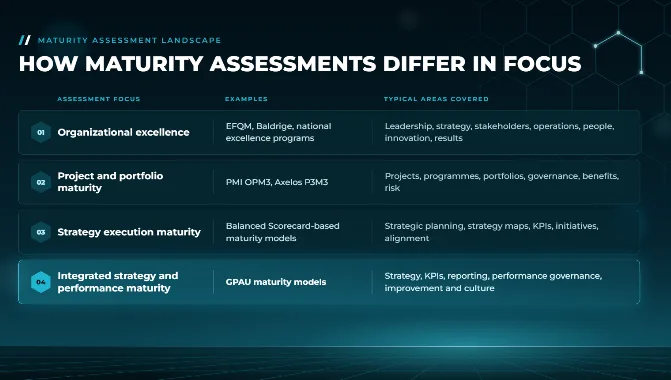
Several frameworks assess leadership, strategy, stakeholders, operations and results, but specialized maturity models go deeper into a narrower set of capabilities. The comparison can be summarized as follows:
Strategy, KPIs, reporting, performance governance, improvement and culture
This difference in scope affects what an assessment can tell an organization. A broad excellence framework can provide a view across the institution, while a specialized maturity assessment can examine one management system in more detail.
The assessment methodology also varies. Some frameworks use structured scoring against excellence criteria; others use maturity levels to determine how consistently practices are defined, deployed, measured and improved. The resulting score or level therefore has to be interpreted within the framework that produced it.
FAQ 4. Is assessment the same as recognition?
Assessment and recognition are related, but they are not the same process.
An assessment establishes the current state of an organization or management capability against defined criteria. Depending on the framework, the output may include a maturity profile, scores across assessment areas, identified gaps or improvement priorities.
Recognition adds a formal acknowledgement of performance or maturity. EFQM, for example, combines assessment with recognition pathways and an international award. National excellence programs commonly include medals, awards or formal recognition categories. By contrast, PMI's OPM3 and Axelos' P3M3 primarily produce maturity assessments rather than public organizational awards.
The distinction can be reduced to three functions:
Assessment identifies where the organization currently stands.
Improvement uses the results to determine what should be strengthened.
Recognition acknowledges an achieved level of maturity or excellence.
A framework can include one, two or all three. This is also why the purpose of an assessment matters. An organization participating mainly to obtain recognition may use the same framework differently from an organization using the assessment as the starting point for a multi-year improvement program.
FAQ 5. Can national, global and specialized frameworks complement each other?
Yes, because their scope can be different.
An organization may participate in a national excellence program while also using a specialized framework to examine a specific capability. A government entity, for example, may be assessed against a national excellence model covering leadership, service delivery, innovation and institutional results, while separately assessing the maturity of its strategy execution or project management system.
Similarly, a broad organizational excellence framework can identify areas that require further development, while a capability-specific maturity model can provide more detailed assessment within one of those areas.
Using several frameworks also creates a practical issue: overlap. Leadership, strategy, governance, performance measurement and improvement appear in many assessment models. Organizations therefore need to understand where frameworks reinforce one another and where multiple assessments may simply evaluate similar evidence through different criteria.
This makes the relationship between frameworks as relevant as the frameworks themselves.
From framework comparison to the Digital Forum discussion
These questions will form the context for “Advancing Strategy and Performance Excellence Across Public and Private Sectors: The Complementary Roles of National and Global Assessment, Recognition and Excellence Frameworks”, a 25-minute panel at the Performance Excellence Digital Forum on 9 December 2026.
The panel will bring together representatives of national and global excellence programs to discuss three questions:
What roles should national and global excellence frameworks play in advancing organizational performance?
How can assessment move beyond compliance and recognition to generate meaningful institutional improvement?
How can national programs reflect local priorities while remaining aligned with international good practices?
The discussion is part of a wider Forum program examining how maturity assessment, strategy, people, culture and technology contribute to organizational performance. The event combines research presentations, practitioner perspectives and organizational case studies from different regions and sectors.
The Performance Excellence Digital Forum takes place online on 9 December 2026 and is free to attend.
Get our research first in Google Search and AI Mode.
Overall
From Workflow to System: The Operational Maturity Threshold
Operational challenges rarely emerge as sudden failures. Instead, they develop gradually through small inefficiencies, recurring issues, fragmented information, and competing priorities that quietly accumulate over time.
From Level 1 to Level 2 in Employee Performance Management: A Roadmap
Moving from Level 1 to Level 2 in Employee Performance Management marks the transition from fragmented, reactive practices to a more structured and consistent system.
GPA Unit Welcomes ALANSARI CONSULTING to Its Partner Network as an Associate Partner in the Kingdom of Bahrain
GPA Unit has welcomed ALANSARI CONSULTING as an Associate Partner in Bahrain, expanding access to internationally recognized, evidence-based strategy and performance assessments across Bahrain and the wider GCC.
How to Become a GPAU Employee Performance Management Accredited Assessor
The GPAU Employee Performance Management Assessor pathway develops professionals from certification to authorization and supervised client accreditation, building competence to assess how consistently organizations manage and improve employee performance.