Artificial intelligence can help organizations work faster, but speed is not necessarily evidence of better decisions. A study published in Organization Science in 2026 offers a particularly clear example. Conducted with Boston Consulting Group (BCG), it tested how GPT-4 affected the work of 758 management consultants.
On tasks suited to the technology, AI users completed 12.2% more tasks, worked 25.1% faster, and received approximately 32% higher quality ratings. On a different, deliberately difficult managerial task, however, participants using AI were on average 19 percentage points less likely to reach the correct answer. Some of their incorrect recommendations were nevertheless judged more coherent and persuasive.
The contrast raises a practical question for performance management: are organizations measuring the effects of AI on results, or mainly how quickly and convincingly work is produced?
One technology, two very different outcomes
The researchers conducted a preregistered randomized experiment with three conditions: no AI, access to GPT-4, and access to GPT-4 plus guidance on effective prompting. The study examined two types of consulting assignments.
In the first, 385 consultants completed 18 product-innovation tasks, including market segmentation, concept development, and communicating a product strategy. AI assistance improved both completion rates and the quality of responses as assessed by evaluators.
In the second, 373 consultants analyzed a hypothetical company and recommended which brand had the best growth prospects. The assignment required combining spreadsheet data with interview evidence. The numerical data alone appeared to support one answer, but qualitative information altered the correct conclusion. GPT-4 tended to favor the incorrect recommendation.
The share of participants identifying the correct answer was:
- 84.5% without AI.
- 70.6% with GPT-4.
- 60.0% with GPT-4 and prompting guidance.
Across the two AI-assisted groups, accuracy was approximately 19 percentage points lower than among consultants working without AI. The finding concerns one specifically designed task, not evidence that AI generally reduces decision quality. The experiment used GPT-4 in 2023; its results should not be treated as a test of every AI system available today.
The study deliberately placed different tasks on different sides of the system’s capabilities. Its positive and negative results therefore need to be read together: strong performance on one task did not guarantee reliability on another. This is a more useful lesson for management than either a blanket promise of AI-driven productivity or a blanket warning against adoption.
When a wrong recommendation sounds more convincing
The researchers assessed the correctness of recommendations separately from their presentation. Independent evaluators rated coherence and persuasiveness on a ten-point scale without knowing the correct answer.
Average coherence scores were 5.86/10 without AI, 6.90/10 with GPT-4, and 7.33/10 with GPT-4 and prompting guidance. The advantage in presentation remained visible even among consultants who reached incorrect conclusions.
A recommendation may therefore look more professional without being more accurate. This distinction matters wherever AI is used to prepare performance reports, support strategic choices, or justify operational decisions. If an organization evaluates recommendations mainly through clarity, speed, or apparent sophistication, it may overlook flaws in the underlying analysis.
The difference is subtle because a clear and well-organized recommendation is usually desirable. Persuasiveness is not itself a problem; treating it as a substitute for validation is. The experiment separated these dimensions through independent assessments, revealing an apparent improvement that would have been missed if all aspects of performance had been combined into a single quality score.
What should performance management measure?
The authors describe AI capabilities as a jagged technological frontier: tasks that appear similar in difficulty to professionals can fall on opposite sides of what a model can perform reliably. That frontier changes as technology develops, making fixed assumptions about suitable AI tasks unreliable.
Organizations often track AI adoption through usage rates, time saved, output volume, or cost reduction. These measures can demonstrate efficiency, but they do not establish whether decisions are correct or organizational objectives are better achieved. The BCG experiment shows why productivity, presentation quality, and decision accuracy need to be distinguished.
A more complete evaluation would ask where AI is being used, how outputs are checked, which outcome indicators are monitored, and who is accountable when an AI-assisted recommendation conflicts with other evidence. These are organizational design and management questions, not only technology questions.
For example, a strategy function could monitor both the time needed to prepare a forecast and the forecast’s accuracy after outcomes become known. A quality function could evaluate whether AI-assisted reviews detect defects rather than merely produce more reports. Operations teams could assess the consequences of decisions, not only how quickly recommendations reach managers. These are illustrative measures, not additional findings from the BCG study; their relevance would depend on the actual task and its risks.
From compliance to performance culture
Imagine an employee who uses an approved AI system, follows every procedure, finishes early, and submits a convincing recommendation. If the recommendation is wrong, procedural compliance has not produced the intended performance outcome.
The experiment did not measure organizational maturity or culture, so it cannot tell us which management practices would prevent such errors. It does, however, identify a risk that makes those practices worth examining. Are employees encouraged to challenge AI-generated conclusions? Do managers reward careful verification as well as speed? Can quality assurance distinguish a well-presented answer from a correct one?
Moving from compliance to performance culture involves examining not just whether prescribed processes were followed, but whether they generated reliable results. In an AI-enabled organization, that distinction becomes especially consequential.
This does not mean every AI-assisted task requires exhaustive review. Verification has a cost too, and its intensity should depend on the likely consequences of an error. The management challenge is to choose sensible controls, test whether they work, and revise them as tools and tasks change. More procedures are not necessarily evidence of greater maturity.
Rethinking maturity at the GPAU Digital Forum
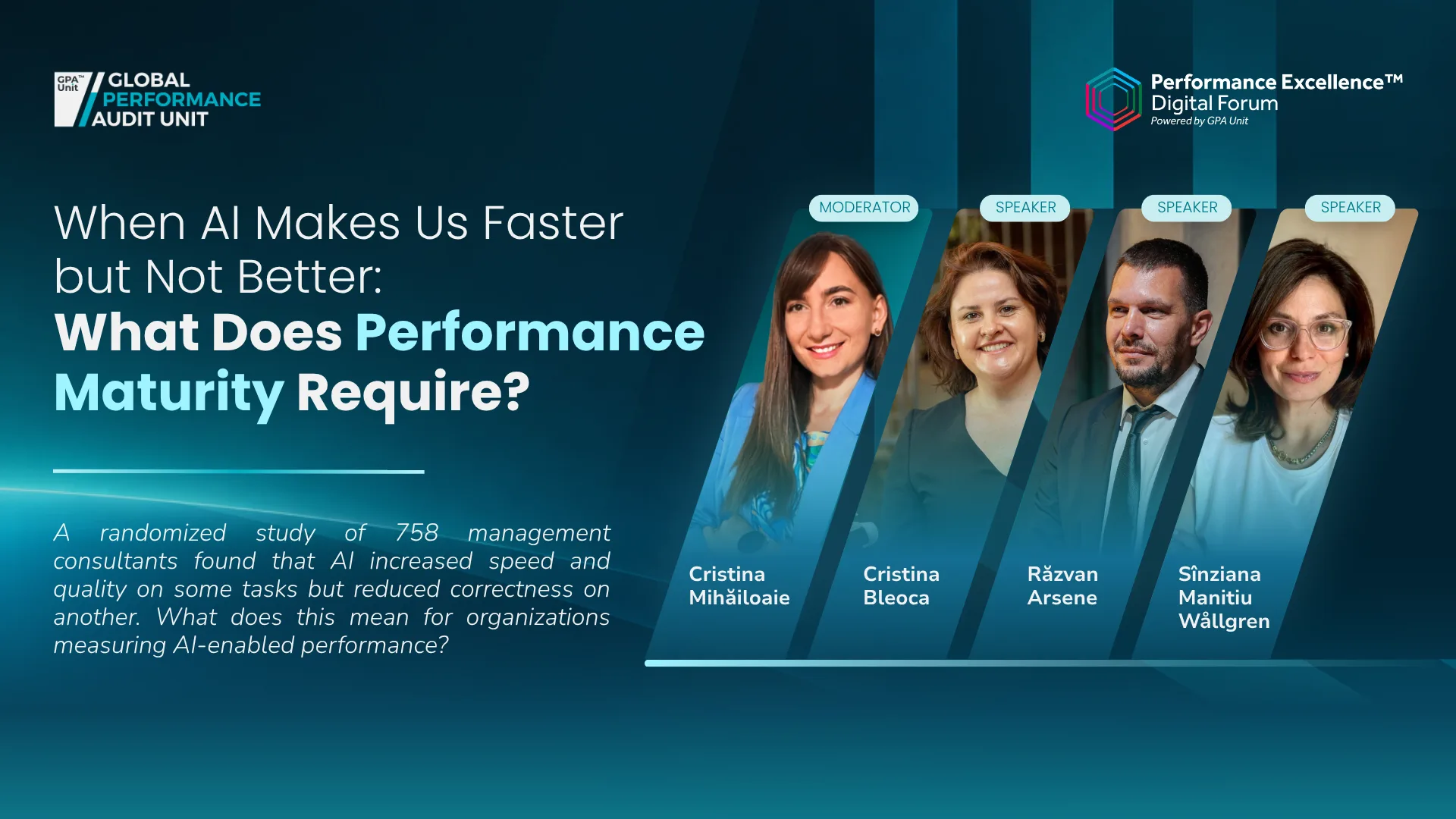
These questions connect to the roundtable From Compliance to Culture – Rethinking Performance Maturity in the Context of the AI Paradigm at the Performance Excellence Digital Forum 2026, taking place online on 9 December 2026.
Scheduled for 13:00–13:25 Riyadh time (GMT+3), the discussion will be moderated by Cristina Mihăiloaie, Director of the GPAU Center for Research & Innovation. Speakers include Răzvan Arsene, VP Quality at Autoliv EMEA; Sînziana Manitiu Wållgren, Director of Operational Excellence and Strategy at Husqvarna Construction; and Cristina Bleoca, Operations Manager at Tchibo Coffee Services.
Drawing on quality, strategy, and operations perspectives, the panel will consider AI as a catalyst for performance excellence, the move beyond compliance toward an authentic performance culture, and strategy and performance management maturity in Europe.
The question raised by the BCG findings is a useful one to take into that discussion: how can organizations recognize when AI genuinely improves performance—and when it merely makes work faster or more persuasive?
Explore the Digital Forum agenda and registration details.
Research reference
Dell'Acqua, F., McFowland III, E., Mollick, E., Lifshitz, H., Kellogg, K. C., Rajendran, S., Krayer, L., Candelon, F., & Lakhani, K. R. (2026). Navigating the Jagged Technological Frontier: Field Experimental Evidence of the Effects of Artificial Intelligence on Knowledge Worker Productivity and Quality. Organization Science, 37(2), 403–423. Published paper · Open-access research paper.
Get our research first in Google Search and AI Mode.